Main Street
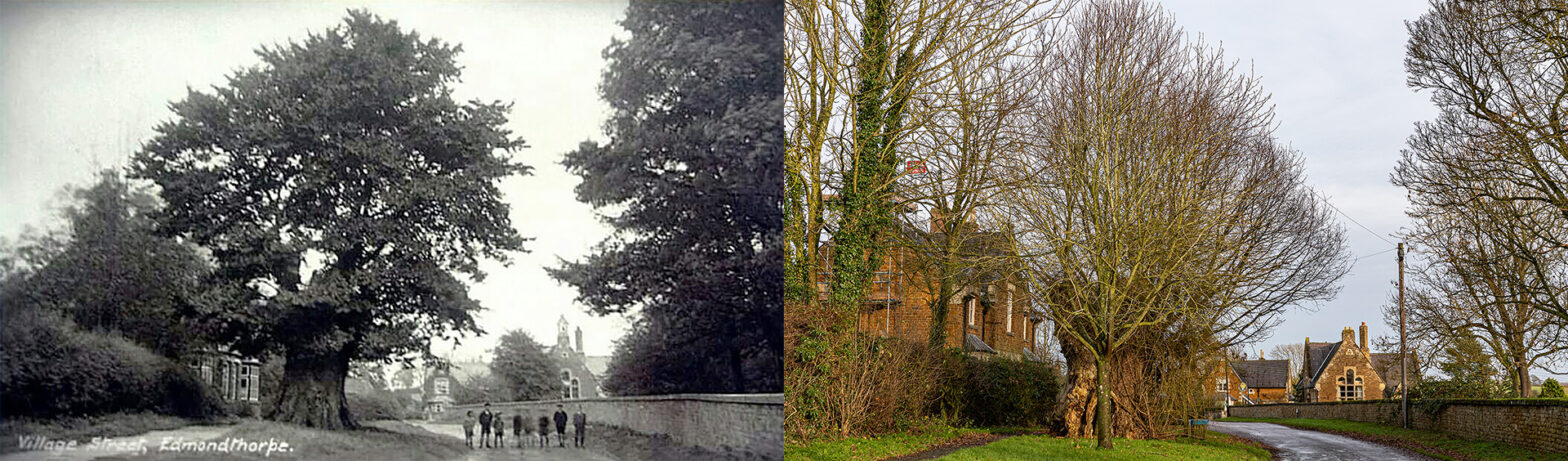
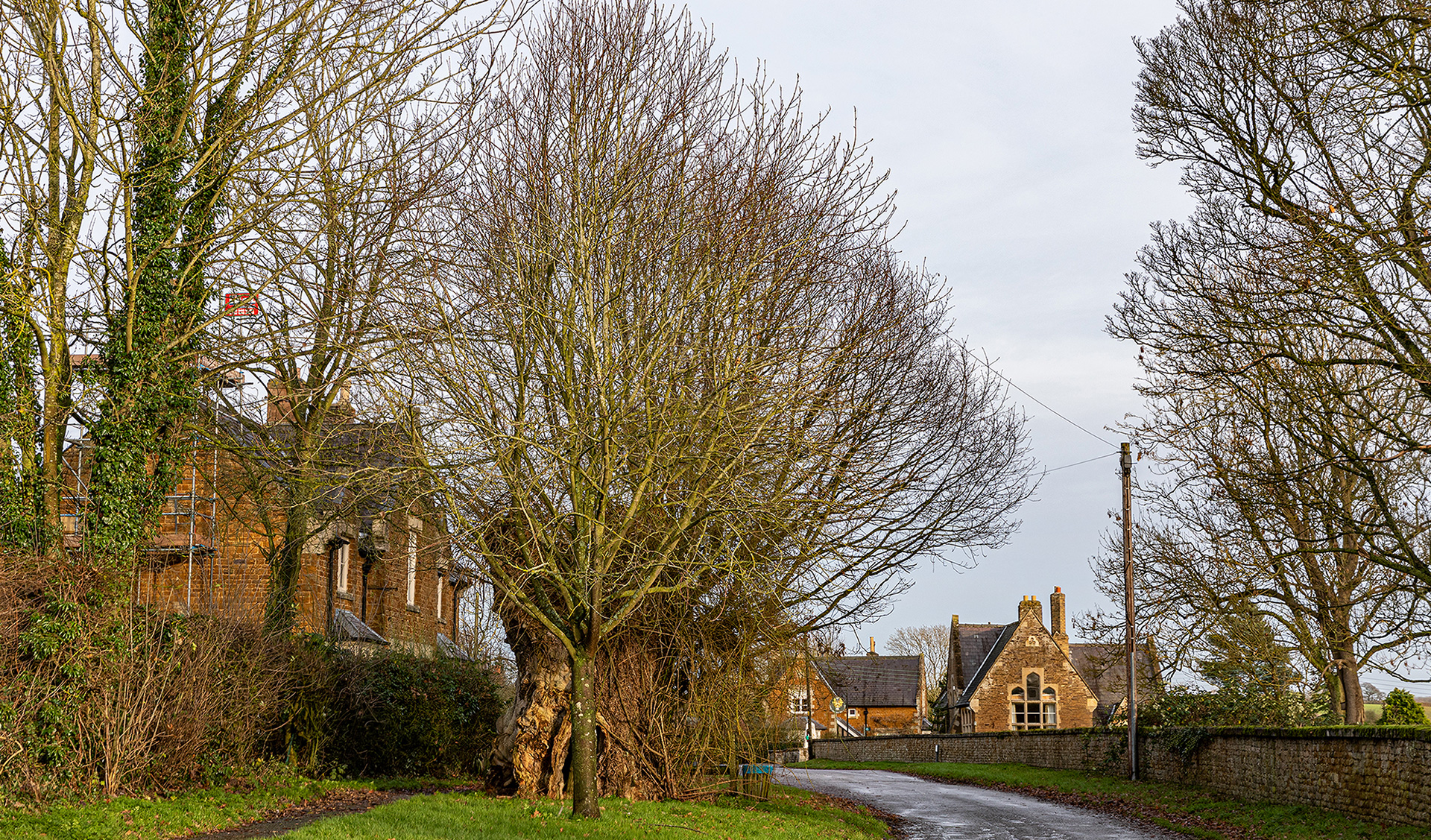
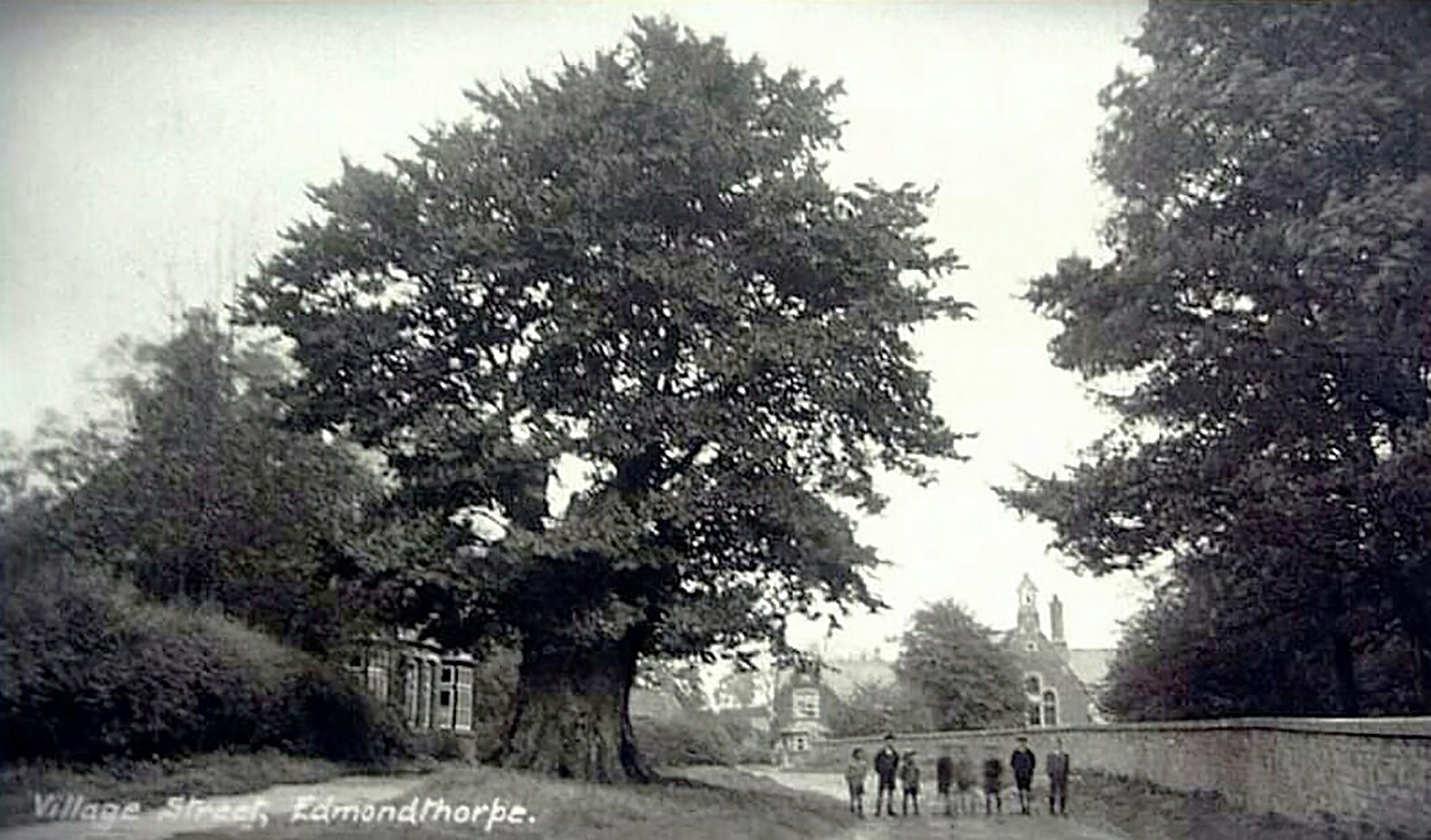
The elm on Main Street, dead for about 40 years, ravaged by Dutch elm disease, is still an outstanding feature in this tranquil village on the border of Leicestershire and Rutland. “The Cross Tree, as we call it, in front of the Old Post Office has holes in the bottom of the hollow trunk,” recollected Amy Roberton. “Many a child has played in there.” Alli Jane Wal added: “I remember hiding at the top inside the tree with my sister.” Rita Staniforth, now 75, grew up in Edmondthorpe and remembered the tree always being hollow. The branches you see now are a mixture of an elder growing in the hollow elm, brambles growing around the trunk, and other trees planted on the grass verge about 20 years ago. In days gone by, the massive tree provided cover for men of the village to drink beer from the nearby off-licence.
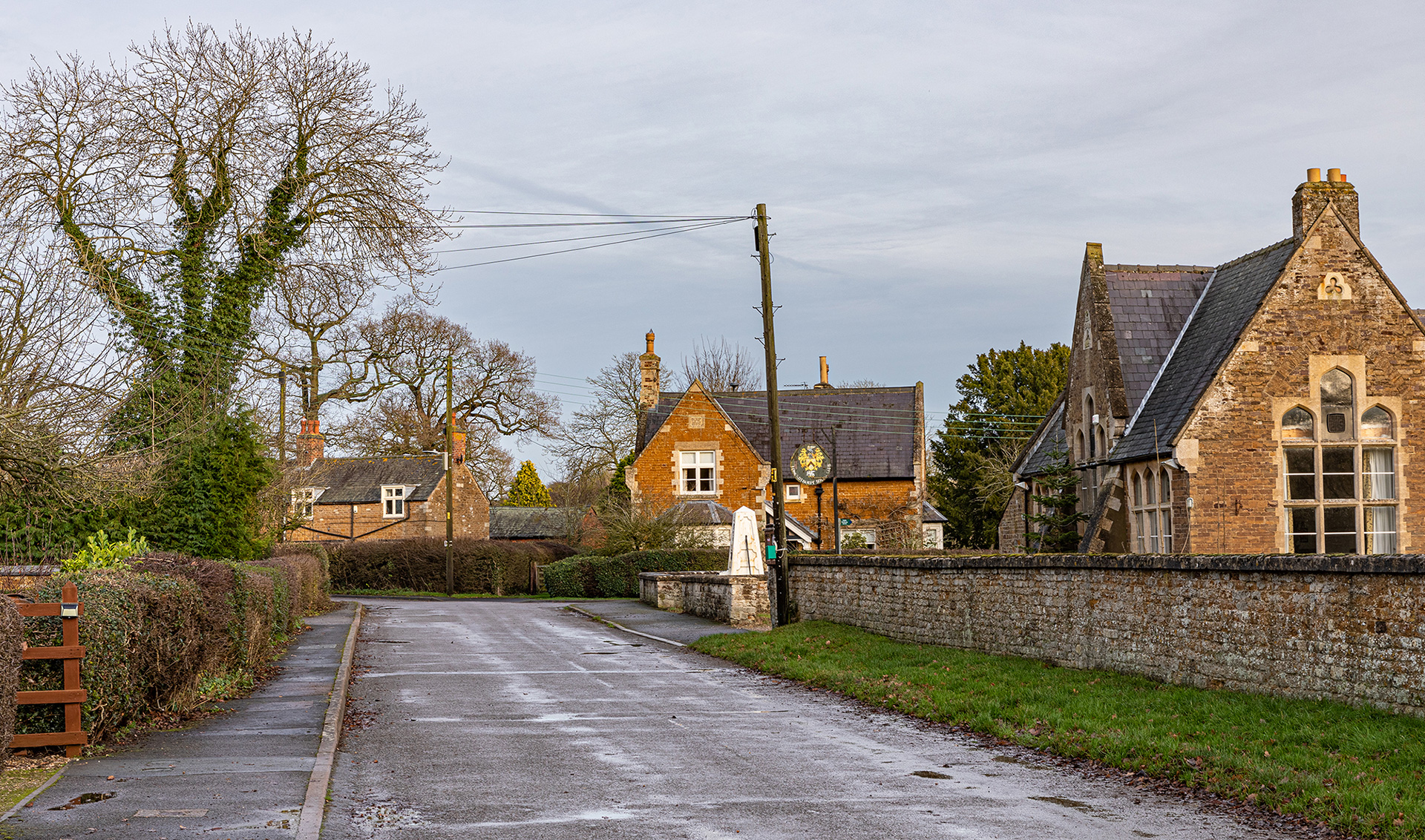
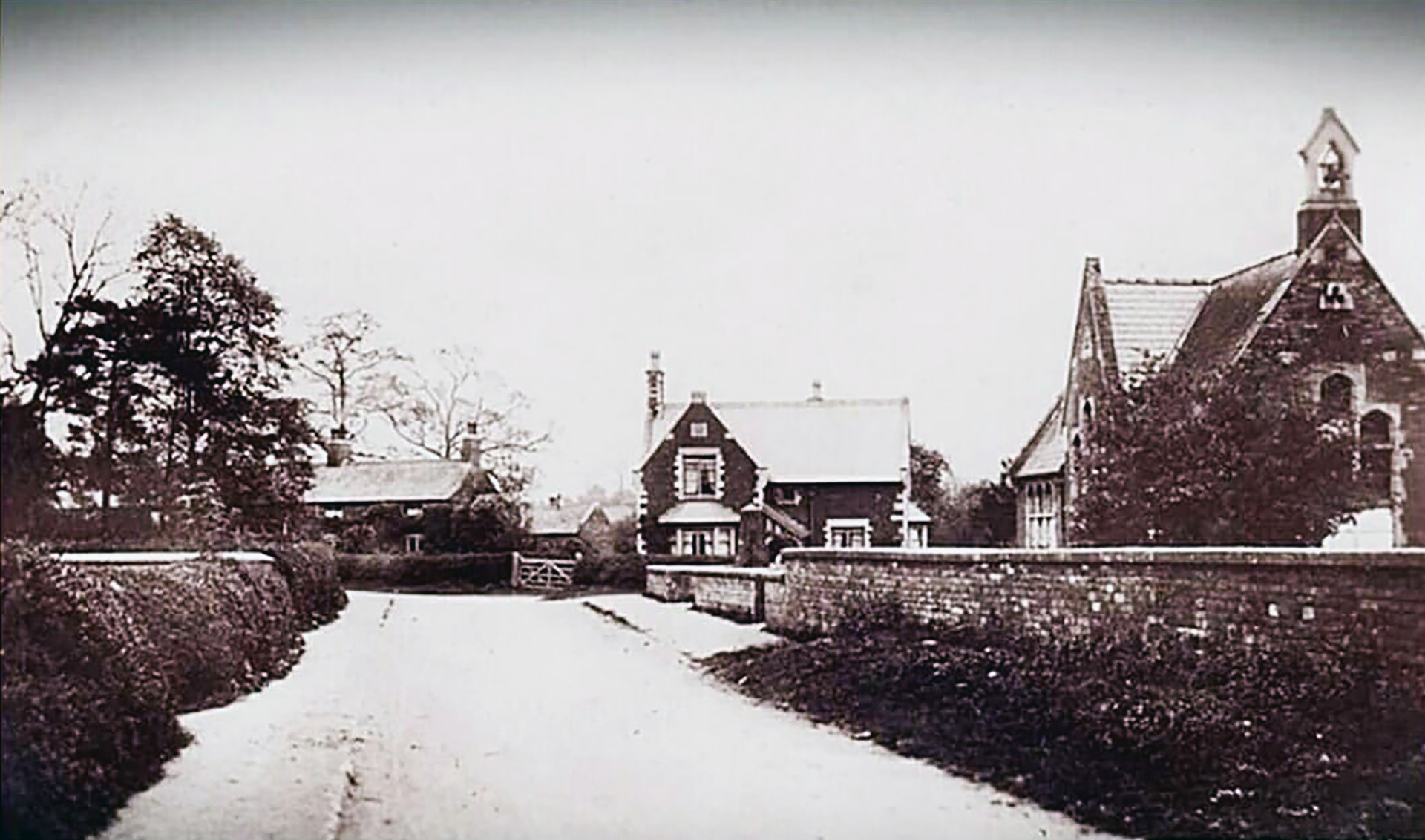
The site of the old off-licence is now where the scaffolded Old Post Office stands on the left, built in 1885. Like most of the village’s buildings, it is chiselled with the initials WAP, after William Ann Pochin, the Lord of the Manor, during the second half of the 19th century. When the old postcard was taken, about 1905, Miss Emma Worsdale was sub-postmistress. The Leicester Chronicle of 19 December 1959 mentioned: “Ann Gresham, Post Office, Edmondthorpe.”
In 1984 there was still a post office and a village shop run by Don and Jean Theobold when Jean told Richard Edmondson of the Melton Times: “We are more of a service to the village. I am quite happy here, or I would not have stayed for 19 years. The village is pretty and quiet. I think you see more tractors than cars.” A series of ornate drawings, all done by Theobold’s son Trevor decorated the shop’s interior. Trevor was educated at the John Ferneley and Upper Schools in Melton and went to art college in Carmarthen. He moved to South Wales, where he was a warden in a country park, and lectured once a week at the college he studied.
In the background on the right stands the elementary school erected in 1838 and extensively rebuilt in 1863 at the expense of William Ann Pochin. Kelly’s Leicestershire and Rutland Directory 1904 indicated the school could hold about 100 children and that the average attendance was 29.
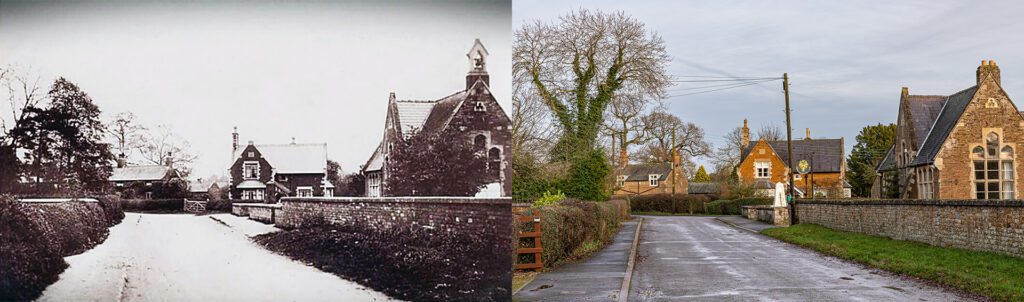
A second old postcard of Main Street gives a better look at the village’s school, on the right. The Grantham Journal of 4 September 1886 wrote about Miss Waterworth as the schoolmistress. She started in January 1883, coming from Ripon College, and stayed for 3,5 years. On August 27th, the annual School Day took place. “As the weather was rather unsettled, the children were amused with games in the School-room.” In the evening, the villagers bade farewell to the schoolmistress with a present. “The gift was a sewing machine in a handsome walnut case and as a token of good will and esteem from the Rector, the parents of the School children, and others in the village. Mr. Morley, in presenting the testimonials, spoke in the highest terms of Miss Waterworth’s qualities, both personally and as a teacher. He said that during the past three-and-a-half years she had been amongst them she had worked conscientiously and faithfully, and had gained the love and respect of the children. She would leave without a single stain on her character, and all would regret her departure.”
In 1904 Miss Edith Ellen Booth was the school’s mistress. “A Christmas tree was laden with useful presents and toys, which gave much delight to all. Thanks are due to Miss Booth, the headmistress, and also her assistant teacher, Miss Bird,” wrote the Stamford Mercury on 6 January 1905. Miss Booth stayed until 1926.
On 9 August 1930, the Grantham Journal reported about the wedding of the retired Schoolmistress with Mr George Wormall. It was Miss Haywood who took over in 1926.
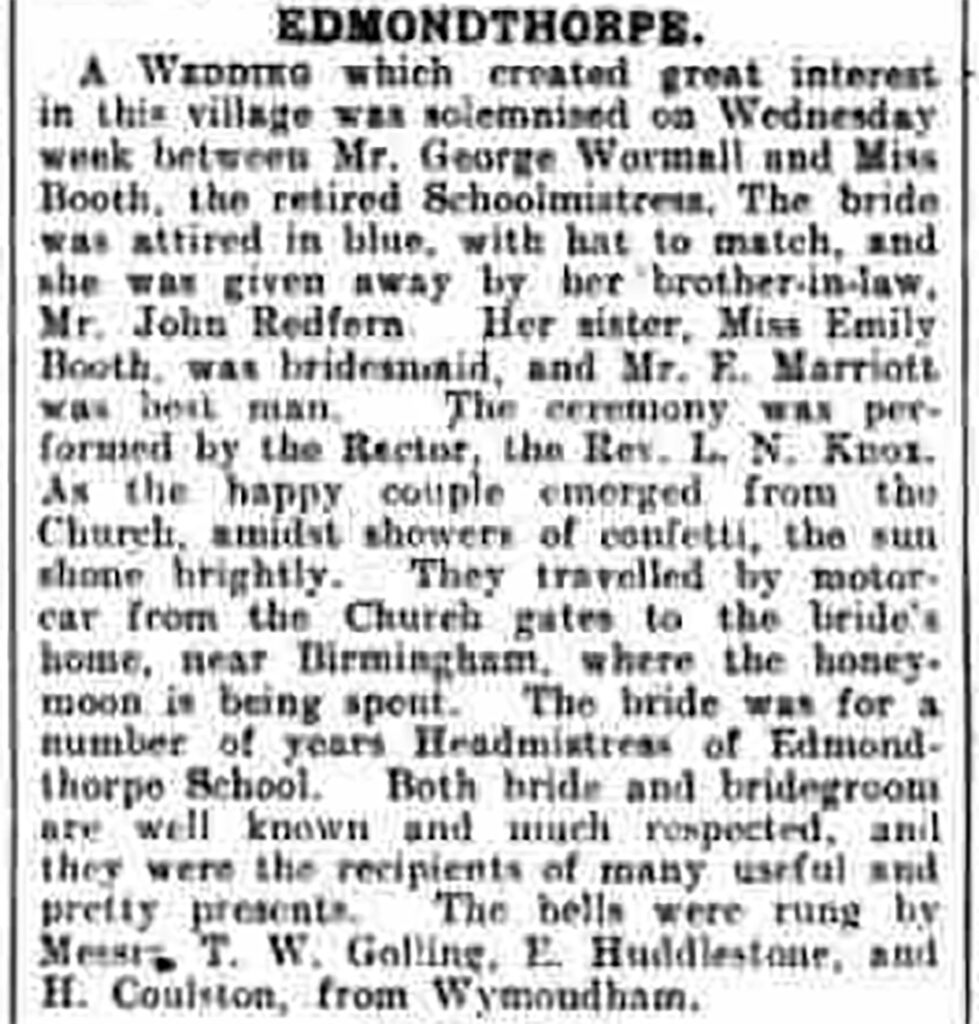
The Grantham Journal of 26 June 1926 reported: “Miss H.F. Haywood, formerly a pupil teacher at Waltham, has been appointed Head-Mistress of Edmonthorpe School. The last six years, Miss Hatwood has been an assistant mistress at Enderby.”
Read more newspaper clipping on the School’s history by clicking on the thumbnails below.
“I went to school there in the early 1950s when Mrs Ethel Rossiter was the only teacher,” recollected Jenny Laidler. “We had a coke fire in the room next to the teacher’s desk, and there were outside toilets, which consisted of a concrete gully where we sat in a row. And there was a wooden toilet in a shed. Mrs Allwood cooked the dinners, and pink junket was our favourite pudding. I left the school when I was around eight and went to Wymondham, where my mum was a teacher.”
The Leicester Mercury quoted Gwendoline Smith on 14 March 1977: “With just 14 pupils and a single teacher, Leicestershire surely has little like it today. Teaching took place in a single room, infants at one end and juniors at the other, under the capable Mrs Adcock. The crisis that would have ensued should Mrs Adcock have taken ill never came.” Mrs Smith could not remember taking even one day off in the many years she lived in the village. “The one time they did have a day off was when the hunt had a meeting.”
Amy Roberton said: “My mum Julie Hickman and uncle John Veasey went to Edmondthorpe elementary school. Both still live in the village.” Karen Gresham added: “Howard, my husband, was one of the pupils in the last year taught by Mrs Clark. His job was to mix the powdered ink with water in a big jug and fill the inkwells in the desks. He can remember wearing his coat and gloves in lesson time as it was so cold inside apart from right next to the stove where the teacher sat. They weren’t allowed to run around the walls during school time, but they did afterwards!”
Karen continued: “The bell that you can see on the schoolhouse had been dismantled before the school closed in 1966 and was replaced with two chimney pots.” “It was taken down because it was unsafe,” recollected Sandra Harrison. Karen Gresham: “The following year, the school reopened as the Social Club. John and Meg Gresham, my husband Howard’s parents, were some of the founder members. There was live music every month until New Year’s Eve 2019, and the bar was open on Friday nights. Since then, we’ve been open on and off depending on the restrictions. Depending on how things go with the pandemic, we plan to open in February for Friday Pub nights.”
In front of the Social Club sits another exciting feature of the village’s history: an obelisk-shaped human-sized cast and wrought iron water pump, marked WAP 1856. It is believed to be unique in the country. It has a spout in the form of a dragon and a curved handle with a loop end.
Gwendoline Smith told in 1977: “As for the pump outside, the kids used to put their heads under it when it was hot. It is reputed by the villagers never to go dry.” Rita Staniforth recollected: “I can’t remember the village pump working, but my boyfriend and I used to write each other letters and hide them up the mouth of the dragon when our parents forbade us to meet! We lived opposite the primary school, as my grandparents lived there before that! My grandfather was the gardener down at the Hall.”
To conclude, Amy Roberton recollected: “An ex villager once said that returning to Edmondthorpe is as getting into a warm bath. Lots of memories made and more still to make. Always more sheep, chickens and dogs than people.”
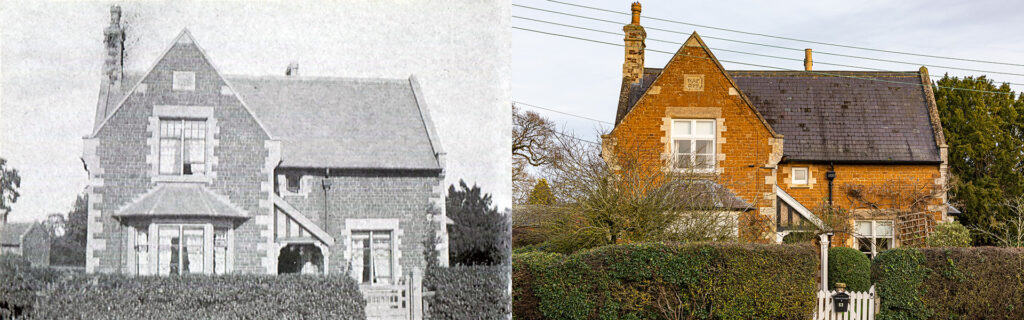
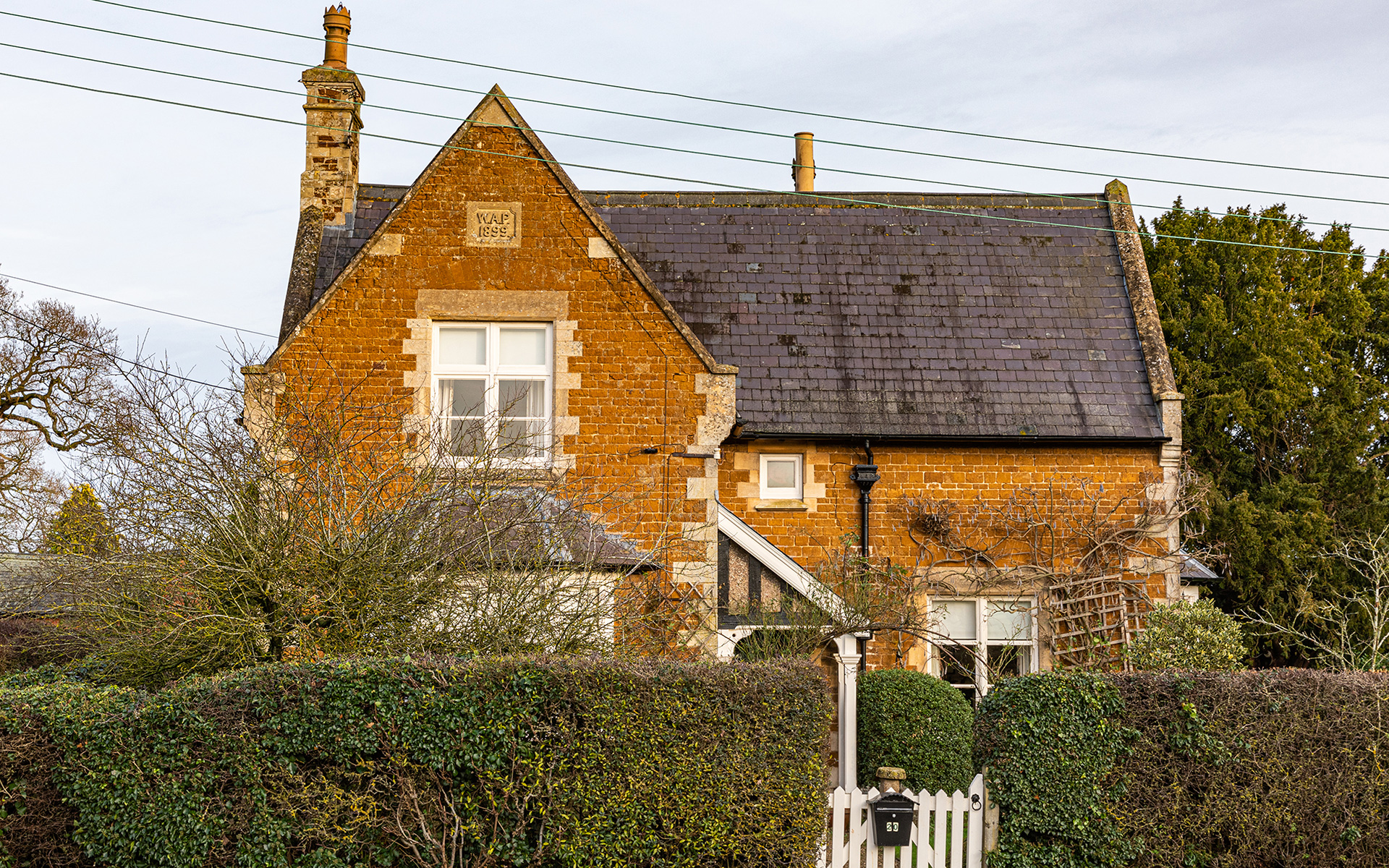
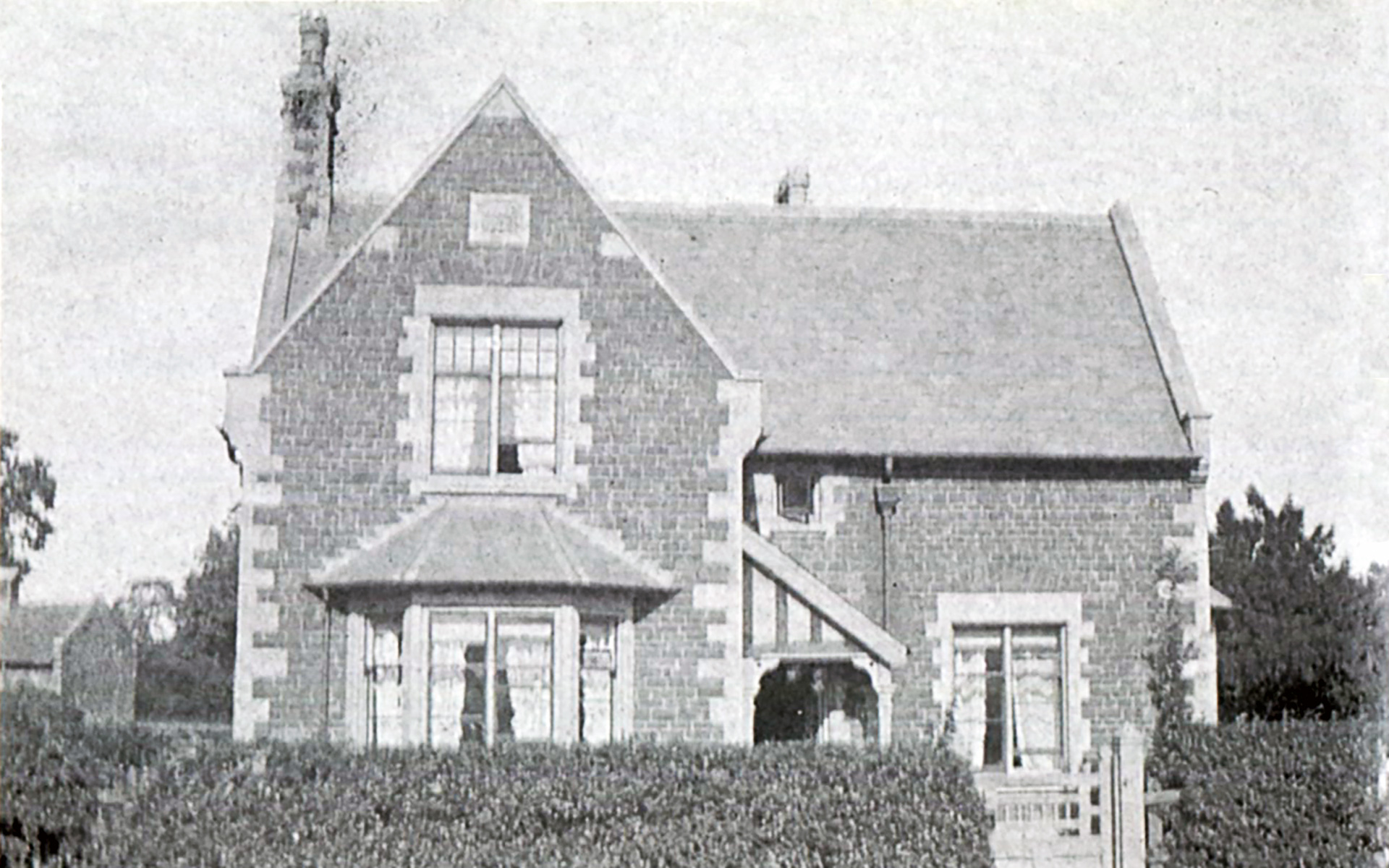
The detached house on the left of the old village school was The School House in 1905, occupied by Edith Ellen Booth, the school’s headmistress.
On the village
William Ann Pochin (1844-1901) was Lord of the Manor of Bourne Abbots and High Sheriff of Leics. He owned several properties, and in 1849 Barkby Hall was recorded as his principal seat and residence. By 1881, he lived at Edmondthorpe Hall, built in 1621, on 73 acres of land. In 1868 the building was enlarged for £5,000, and at that time, Edmondthorpe was a thriving town. William Ann Pochin is credited with establishing and improving many properties locally, often carrying a date and his initials (WAP). By 1912, Edmondthorpe Hall was the residence of Victoria Alexandrina, Countess of Yarborough, but during the Second World War, it was used as a camp for Prisoners of War, and it burnt down in 1943. The influence of Edmondthorpe waned, and there has been no tangible development in the village for over 100 years.
At the beginning of the 1980s, the Rev Philip Hunt wrote in his series Our villages history in the Melton Times: “The village of Edmondthorpe is barely a mile away from its larger neighbour Wymondham. Along its winding village street, it is better to go past the church and leave that treasure until the end of the walkabout. The village is fortunate in that it possesses a Post Office and shop which doubtless supplies a larger area than the immediate village. On the right of the main street is a gatehouse and drive leading down to what was once a very important Leicestershire mansion, some of its building dating from Tudor times. At one time, it was the home of the Smiths and then the Pochin families. Along the village street is the former schoolhouse, built in 1863 by Squire Pochin and now used as a village club. In front of it is the parish pump with a date just seven years older. This village has some good farm buildings and cottages and is not strictly speaking a cul-de-sac, but at this point, most people would prefer to turn back and view the church of Saint Michael. This is amazingly kept considering its spaciousness and small population. The tower would appear to be the oldest part, probably mid-13th century. The rest of the building a hundred years later. And it still retains its mediaeval chancel screen. There is here a fine mid-17th century tomb which perpetuates the only known ghost story of any of the villages dealt with in these articles – the legend of the Cat Woman.”
That tale of the white (in other versions black) cat of Edmondthorpe is probably one of Leicestershire’s most enduring ghost stories referring to Lady Ann, one of the two wives of Sir Roger Smith remembered in a remarkable three-decker monument in St Michael and All Angels church. The lower recumbent effigy is Lady Ann and has a deep red stain on one of the alabaster wrists. Experts say it is merely a mark, but there is a tradition that the mark bleeds periodically, and the legend is why.
During Lady Ann’s lifetime, a cat lived at the family home, Edmonthorpe Hall. The feline had a reputation for being a considerable thief about the kitchens and was not much loved by the Manor’s staff. One morning the butler caught the cat trying again to steal food. He went for the cat with a cleaver, succeeding in wounding it on one paw before it escaped through the window. It was never seen again. That same day Lady Ann was seen with a bandage on one wrist, and when the bandage was removed a vivid red scar remained on her wrist.
The stain made by the cat’s blood stayed on the flagstones of the kitchen floor. Attempts to clean them failed, and they remained for centuries along with the legend. Eventually, Lady Yarborough, the then owner of the hall, had the flags lifted and replaced in 1920. For years, the flagstones stayed on show in Gollings Workshop in Wymondham for anyone who cared to look.
After Lady Ann died and her effigy was erected, it seemed too much of a coincidence that the alabaster should have a red flaw in precisely the same place as the real-life Lady Ann’s scar. But over the year, the tale remained, and the scar was reported to have regularly bled.
Time passed, and Edmondthorpe Hall became a Prison of War camp during World War Two. A fire destroyed the Hall and the story goes that the camp cook threw a rolling pin, which upset a candle into a pot of fat, starting a destructive blaze that could be seen for miles around. Why did the cook throw the rolling pin? Because of a cat that kept coming into the kitchens, looking for food. Many people had seen it around, and after the fire, it disappeared!
The story is told with an illustration in the book Legends and Folklore of Britain published by the Readers Digest Association in 1973.
R.B. Davis
In 1956 R.B. Davis (Leicestershire) produced a written booklet titled Wymondhan and Round-about. It was a bundle of notes he made for a presentation to the Wymondham Women’s Institue in April 1956.
You can read the four pages on Edmondthopre by clicking on the thumbnails below.
Collection Kevin Exton
More pictures
Would you like to add pictures? Send a message.
Domesday Book
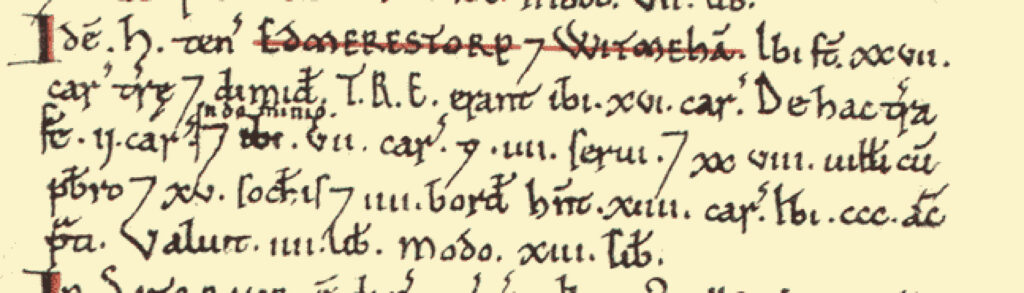
Edmondthorpe was a settlement in Domesday Book, in the hundred of Framland and the county of Leicestershire.
It had a recorded population of 26 households in 1086, putting it in the largest 40% of settlements recorded in Domesday (NB: 26 households is an estimate, since multiple places are mentioned in the same entry).
Land of Henry of Ferrers
- Households: 28 villagers. 15 freemen. 4 smallholders. 4 slaves. 1 priest.
- Ploughland: 16 ploughlands. 7 lord’s plough teams. 14 men’s plough teams.
- Other resources: 2.0 lord’s lands. Meadow 300 acres.
Valuation
- Annual value to lord: 13 pounds in 1086; 4 pounds when acquired by the 1086 owner.
Owners
- Tenant-in-chief in 1086: Henry of Ferrers.
- Lord in 1086: Henry of Ferrers.
One response to “Edmondthorpe”
Amazing, I have the same memories!
I lived at the post office from aged 5 to 12 leaving in 2000.
My little oak tree was my hiding place.
Lovely village.