
Rosebery Avenue – 1904-1906/8
About a century ago, standing in the middle of a street with a heavyweight camera mounted on a robust tripod to take a picture wasn’t an issue. Traffic was sparse and slow. But a photographer’s visit was an attraction, and residents were often pictured in their Sunday best. For a 2022 remake, the middle of the road could be rather dangerous. Luckily not so on Rosebery Avenue, a dead-end street in Asfordby Valley. But a photographer with a tripod, taking her time to find the correct position and angle for a good shot, draws some attention, even nowadays. One of the ladies chatting with her friends further on the street came and asked what I was doing.
On the back of the old postcard (Mick Charles Collection), a post stamp unveils the date the postcard was sent: August 1906 or 1908, so the picture was taken between 1904 and 1908. The villas on the right-hand side of the street still exist after nearly 120 years. The six semidetached villas at the back were dedicated to the famous British 19th-century adventurers Stanley (1841-1904), Gordon (1833-1885) and Livingstone (1813-1873), and built in 1904, the year Sir Henry Morton Stanley died. One of the ladies living in the villas said: “I came to Asfordby Valley as a child when my father started working at Asfordby Gun Range, uphill behind the railway line.”
On the left on Rosebery Avenue are a series of bungalows. “They were built in 1937,” one of the other ladies said. “When I came to live here a few years ago, I did find the deeds, always being interested in the history of the place I stay.” Another lady in the group recollected: “The trees in the old picture were cut down one day.” None of the ladies remembered when. “A man who used to live here complained about the trees. And the next day, they were gone.”


On the village
Strolling around Asfordby Valley and looking at the old Ordnance Survey maps helped reconstruct the birth and growth of the village. The 1884-map only indicated the Nottingham to Melton Mowbray Midland Railway and the main road from Melton to Asfordby. The first cottages in Asfordby Valley were built in 1900 at Brook Crescent because of the expansion of the nearby Holwell Iron Company. On the road running parallel with the busy A6006 fashionable early 20th-century dwellings are named The Willows (1901), The Limes (1902), The Cedars (1908) and Alma Villas (no date). In 1904 Stanley Villas, Gordon Villas and Livingstone Villas were built on a new road called Rosebery Avenue. More cottage came at Brook Crescent (uphill), and North Street was created.
Gun Range
Asfordby Gun Range was established during the First World War as the Holwell Gun Proof Range. It was government war policy that all guns being manufactured or repaired needed to be thoroughly tested to ensure that they were fit for purpose. The inspection process for guns and carriages began at the design phase, through the supply of raw materials and manufacture, ending with a firing test at the proof range. In 1917 guns and carriages were being manufactured and repaired in such numbers that the existing proof ranges could not keep up with the inspection requirements. It was decided that three new gun proof ranges needed to be established, serving Leeds (Meanwood), Nottingham (Holwell) and Birmingham (Bilberry Hill).
During WW2, the range became known as Asfordby Gun Range servicing and testing barrels of 9-inch navy guns. The website of the Carpetbagger Aviation Museum, located in Harrington, Northamptonshire, tells what happened with the range after WW2: “After the war, the noise became a major source of annoyance to Asfordby Valley residents. Possibly the site fell into disuse for a while because, in 1965, local residents protested at plans by the Ministry of Defence to reopen it, and a noise muffling tunnel was installed in 1968. When it closed in March 1971, some 70 employees were made redundant. The MOD blamed the closure of the 50-year-old range and redundancies on the local residents. The last gun was fired at Asfordby Gun Range in October 1971 in a short ceremony to mark its closure.”
During the 1980s and 1990s, the badly decaying site was occasionally used as a police dog training centre. The location was also featured in an episode of the 1990s Central TV programme Boon starring Michael Elphick. Airsoft is now played in the derelict area, a military simulation activity of mock combat with authentic military-style weapons.
Bomb hitting Asfordby Valley
Holwell Iron Company was a potential target for the Germans during World War Two because of the production of war assets. Residents of nearby Asfordby Hill and Asfordby Valley were afraid one or more bombs that should miss the ironworks factory would strike in their neighbourhood, in their street, or on their house. In the early hours of 23rd November 1940, a single German raider dropped bombs on Asfordby. Photographs were taken after the bomb hit Asfordby Valley were published in the Melton Times. One of the photos is picturing Plant’s Garage on the corner of Asfordby Road and Brook Crescent. Graham Plant, the son of Wilf Plant, still lives there. They were both successful speedway riders. At the time of the original publication, the Air Censor would not permit the publication of material which might help the enemy and ordered the name of the garage to be obliterated.

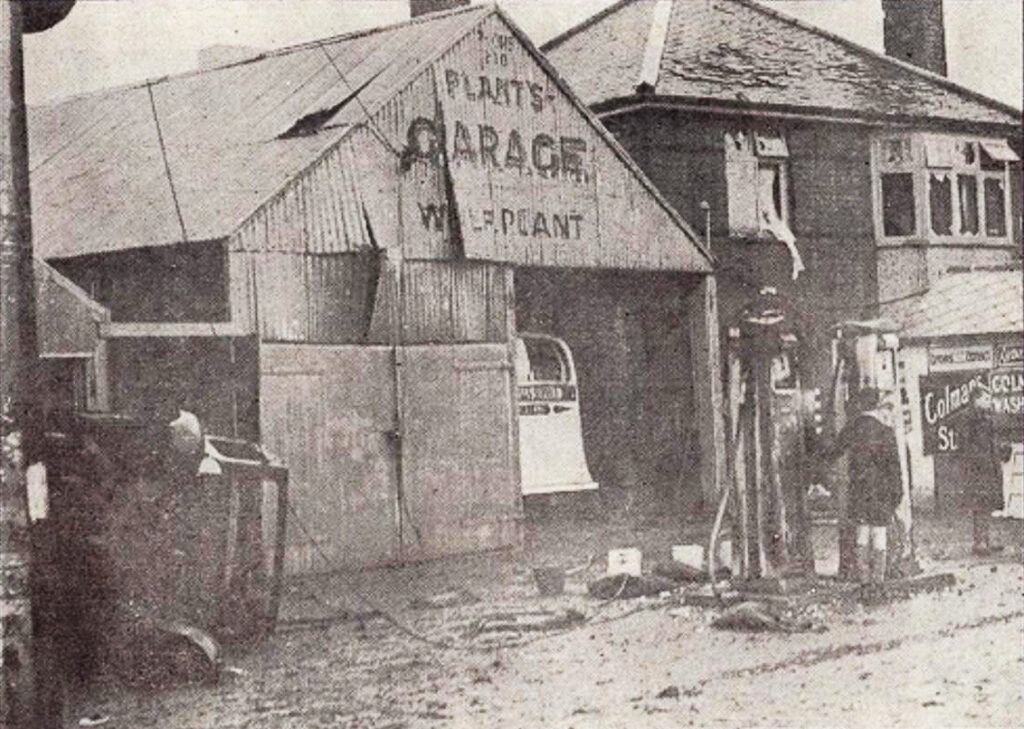
The Leicester Evening Mail, published on the evening of the early morning attack, reported: “Air raid warnings were sounded in an East Midlands town last night. No bombs were dropped on the town itself, though in the adjoining county area high explosives fell in one district, causing five fatal casualties, injuring a number of persons, and damaging some property. Fatally wounded were Tom Jones, who was on his way to work, George Seymour, Fred Bishop, a warden [J.E. Laxton?], and little Iona Perfect, who was aged two.
Soon after an early morning ‘Alert’ had sounded a lone raider was heard hovering around, Almost immediately exploding bombs were heard and windows of shops and houses vibrated. Doors and windows of two rows of houses were blown in and there were some miraculous escapes. Mr John Randall was standing near a petrol pump when an incendiary dropped, causing the pump to blaze up. With great presence of mind he threw buckets of sand and water and put the fire out. He did not escape injury, however, his ankle and face were hit.
Mrs Plant who was in bed in the house attached to the garage, ducked under the blankets and escaped without injury, although glass and splinters came flying through the bedroom and pieces of shrapnel made holes in the wall.
One bomb exploded near the house of Mrs Stapleford who was downstairs making her husband’s breakfast in the kitchen. She dashed upstairs through clouds of dust and flying debris to see whether her two little girls, who were in bed, were all right. She was reassured when they answered her call and she brought them downstairs for safety.
Mr Bannister had gone to work, but his Home Guard greatcoat which was hanging behint (sic) the door was torn to shreds when the door was torn off the hinges.
Tragedy came to one house. Little two-year-old Iona Perfect was sleeping in a bed downstairs when the front door was blown on top of her and she died soon afterwards. Beryl Perfect, her sister, was in bed upstairs sleeping with another sister. She heard a bomb explode and courageously shielded her bedmate with her body. Both escaped injury.
At Mr A. North’s house a piece of iron railing from across the road blew right through the walls, grazed his front room ceiling, smashed pictures, yet all the occupants escaped.
Mrs Burnaby was early on the spot with a mobile canteen serving free cups of tea and sandwiches to the people, and to the members of ARP [Air Raid Precautions] services who were working like trojans repairing damage to the houses. Mrs F.T. Durrance, Mrs B. Greggs and Mrs C. Owley, when interviewed by the Evening Mail, each said they were in bed when the bombs dropped.”
The four adult victims of the air raid, probably all employees of the Holwell Iron Company, are mentioned at the Holwell Works WW2 Memorial, a bronze plaque at the entrance of the administration block of St Gobain PAM Foundries.

Ian Kent said: “My granddad, Thomas Jones, was one of the five killed that day. He was going to the Holwell Iron Works. It was on the seat halfway up the hill.” Linda Broadhead recollected: “My Nan, Kitty Preston, who lived on the corner of Asfordby Road and Rosebury Avenue, used to talk about the Asfordby bombings. We used to go with her over the fields just opposite her house, walking the dog and collecting sticks for the fire, and she showed us a crater where a bomb landed.” “My dad, George Hollingworth, told us he was watching a raid from his parent’s home on Melton Road, which looked over to the Works. The house shook so much with the bombing he hit his head on the back door frame, causing it to bleed,” said Anne Edward.
Another air raid attack?
Maurice Antill was born in Asfordby on 12th August 1936, and he told a story published on the BBC’s WW2 People’s War pages. Puzzled by the date of 3rd October 1940, wondering if this is a date for another air raid attack?
“On Tuesday October 3rd 1940 I was playing with my brother outside our house when our neighbour Mrs Radcliffe came and told us not to play on the road as we might get killed – “You would be better off in the field across the road!”
So we crossed the road and squeezed through the railings into the field. Just inside the field was a brook – kids’ paradise. We all played there but on this occasion we ran up the field with some other kids. We knew that it would soon be tea time.
We lived in the shadow of Holwell Iron Works and at the back of the house was the Gun Range where they tested guns, but at the age of four, who cared about things like that. The next thing I knew was that some leaves fell on my head. It was dark and dirt was raining down on us. The bomb dropped by a lone bomber had hit a brook. It was said that if it had hit the concrete road Asfordby Valley I would have been no more.
I am told that my brother took me home and all the windows in the houses along the street were blown out. At the top of our stairs the dividing wall between us and Mrs Radcliffe was not there anymore. My mother had been doing some toast in front of the fire but that was spoilt by all the soot coming down from the chimney.
It was a lucky escape and I think only two people were hurt. One, my aunty, was hit by shrapnel in the arm and a girl who was in the field rolled under a gate and hurt her arm.”
Would you like to add your story and recollection? Leave a comment at the bottom of this page or send a message.
More pictures
Would you like to add pictures? Send a message.
Domesday Book
See the story on Asfordby.
Links
Would you like to add a link? Send a message.