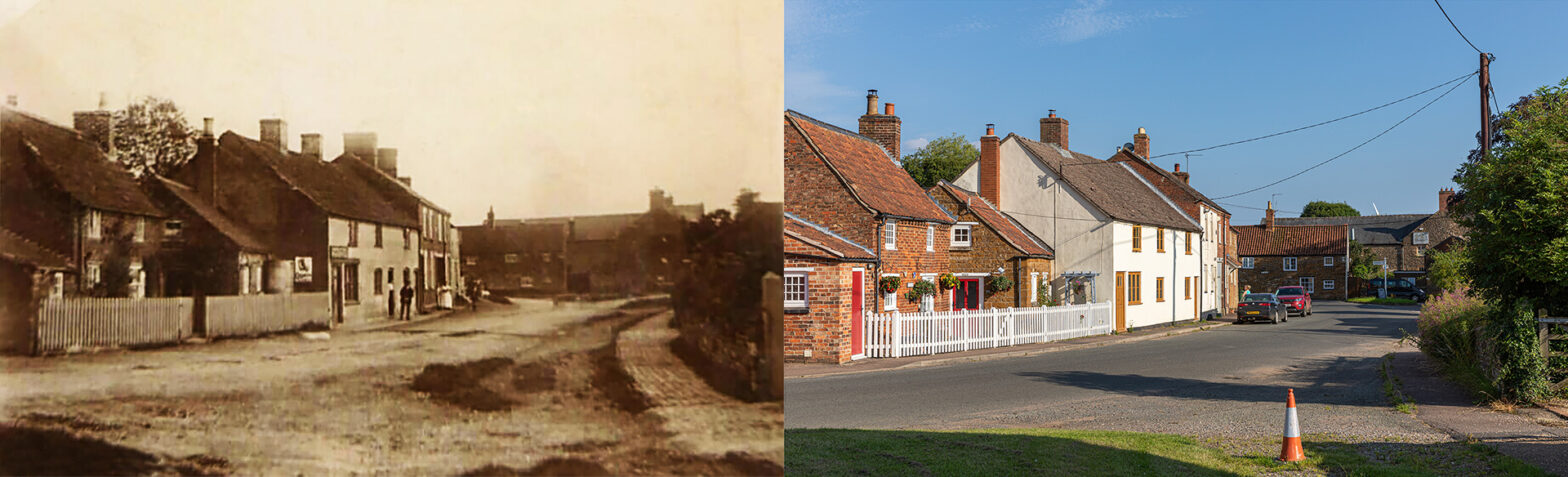
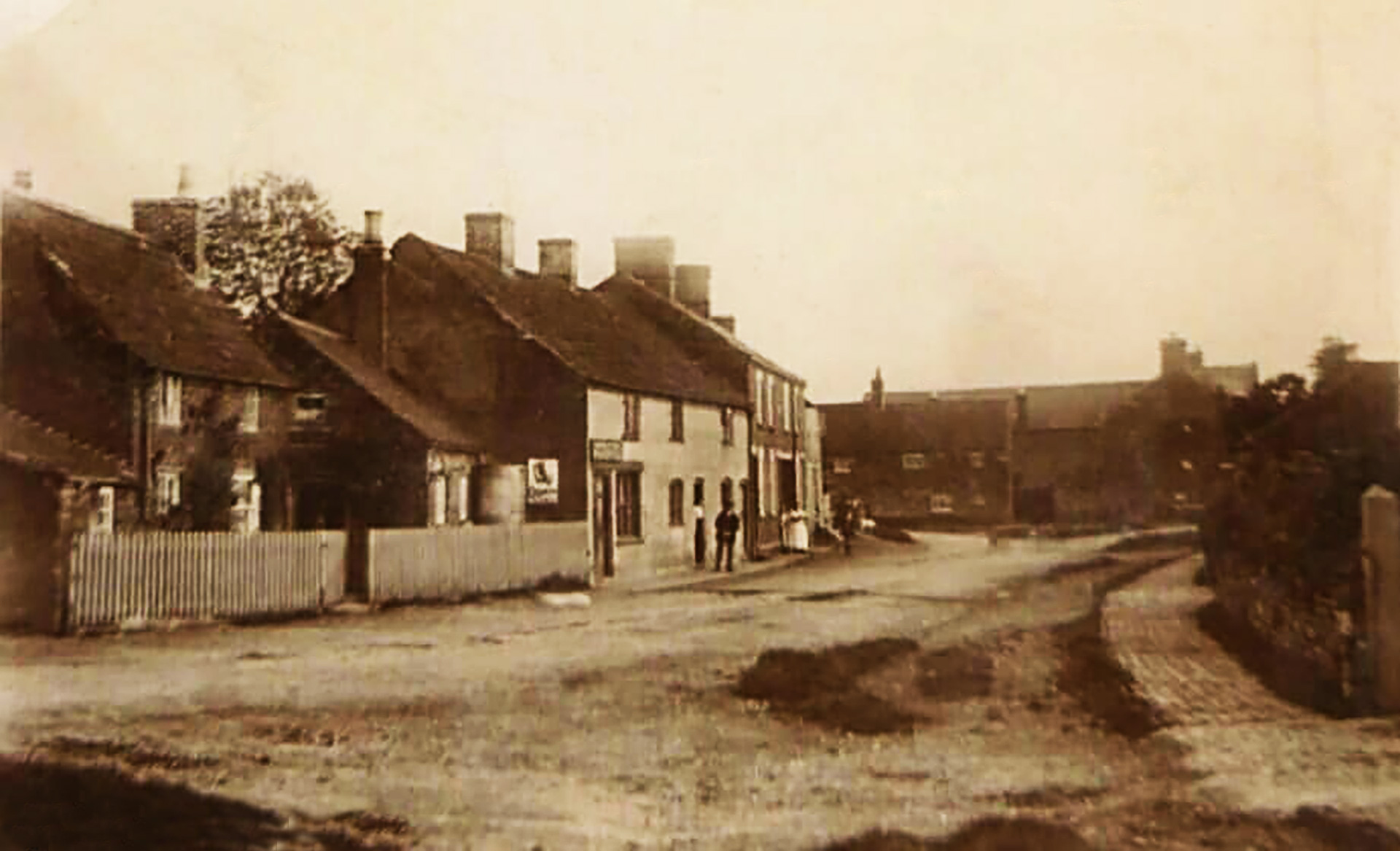
Main Street – 1916
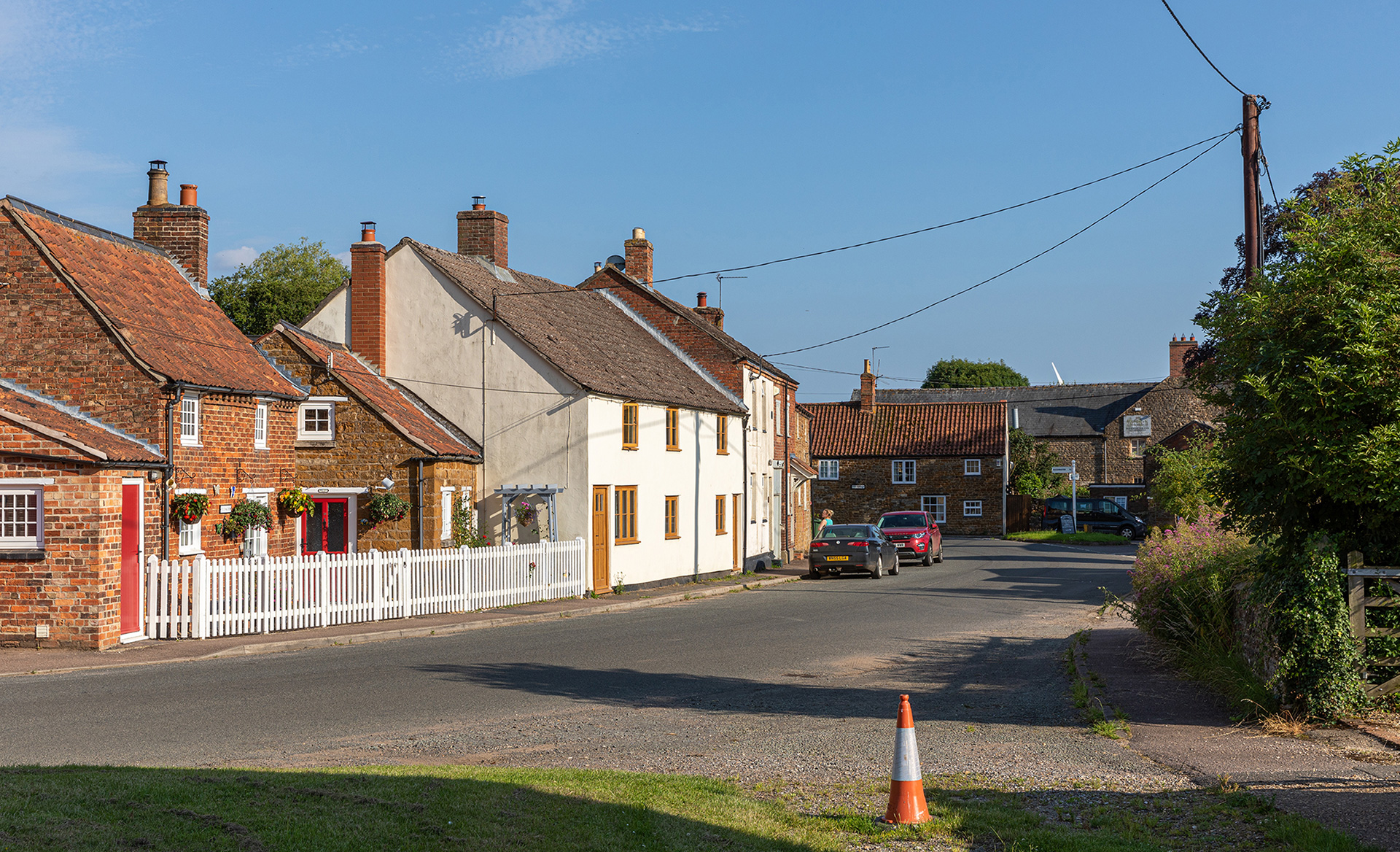
Nonagenarian Ray Bennett welcomes me to his house in Sproxton and immediately starts talking about the village’s history. Born and raised in Sproxton, Ray has spent his whole life in the village. With a vivid memory, he talks about the Main Street picture. Ray explains: “Starting left was the Post Office. Ms Fardell was the postmistress. Her husband kept chickens across the street and further on Buckminster Road.” In the 1950s the Post Office became a bakery. “The ovens were still in there in the 1970s”, remembers Rosie Thompson, who adds to the story. A renewed white wooden fencing is in the same place as a century ago. One point of difference is on the far left, a red-painted door, replacing a window, which opens directly onto the street.
Rosie Thompson recalls: “The long white house was a shop”. Ray adds the details: “Ernest Harry Trayford kept the shop. He used to sell provisions, everything you needed for everyday life. I recall he measured the sugar out of a big bag into a small blue bag, and I also went there to buy paraffin for our oil lamps.” Trayford was not only a grocer but also the village sub-postmaster,
“Ernest Trayford was a relative of mine as my grandmother was a Trayford,” wrote Anne Lee from Australia, when reading this article. “The Trayfords lived in Sproxton from the early 1900s and many of them, including my great grandparents, are buried in the churchyard at St Bartholemew’s. Three Trayfords are also mentioned on the War Memorial inside the church. The family now has descendants living in Australia and America.”
“The next building was living accommodation, two in front and one in the rear accessible by an entrance, wide enough to get a car through. In the 1950s it was turned into a shop and the Post Office.”
The centre background of the picture shows some cottages. Ray continues his story: “The three cottages on the left, dated circa 1780, were condemned years ago, but it was all done up into one property, now called Vine Cottage. To the right, on the corner of Coston Road is Forge Cottage, with, at the back a blacksmith’s shop. John Wyer owned all that property.” In the new picture, just hitting the tree is the chimney of The Crown Inn, where Ray was publican until 1985, just as his father was before him. During WW1 Henry Joel Tarratt did run the pub. “Further down Coston Road on the right, was a public house, The Three Horseshoes, and on the left, in The Nook there was an alehouse. Just a bit of history”, Ray laughs.
Alehouses have existed in the British Isles since before the Norman Conquest. As the name suggests, alehouses were simply houses in which ale or beer was sold and quite dissimilar to our pubs of today.
An inn was typically a house to accommodate travellers. There were generally two types of Inn – those that faced the road and those that were built around an inner courtyard. By the end of the seventeenth century, thanks to the growing coaching network and new turnpike roads, inns were increasing in number.
The term public house can be applied as the collective noun for inns and alehouses, with the first recording of the term appearing in 1669. Despite the fact that many public houses had a bar and a cellar. By 1880 there was more regulation around licensing and standards.
Back to the picture. Ray remarks: “On the right-hand side, hidden by the tree, lies Bank Farmhouse, dated 1810, its farmyard, and another old blacksmith’s shop. There were three blacksmiths in the village.” More to the right, out of the picture’s scope is Middle Farm, one of 13 farms in the village during his childhood. Ray points at little stumps of iron in the low stone wall. “You see where the railings were? Those are the remnants of a cut-down iron railing, because of the much-needed iron for the First World War.”
The School – 1916
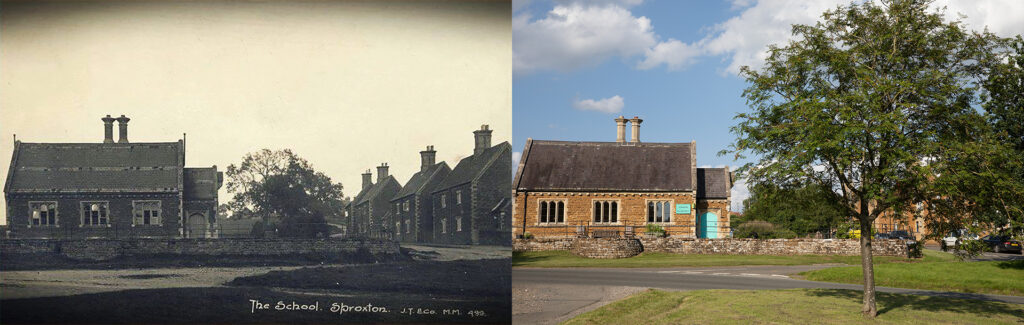
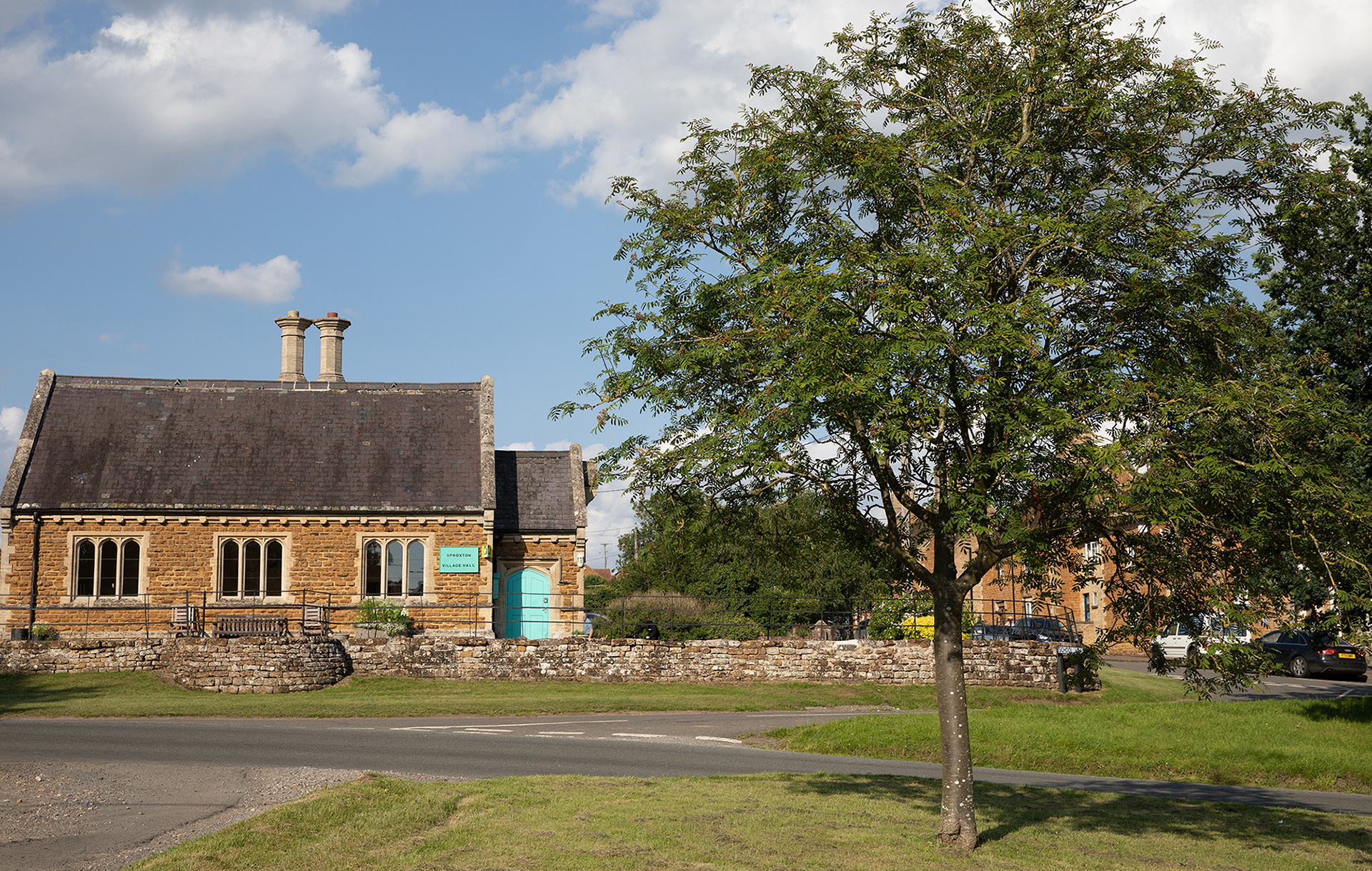
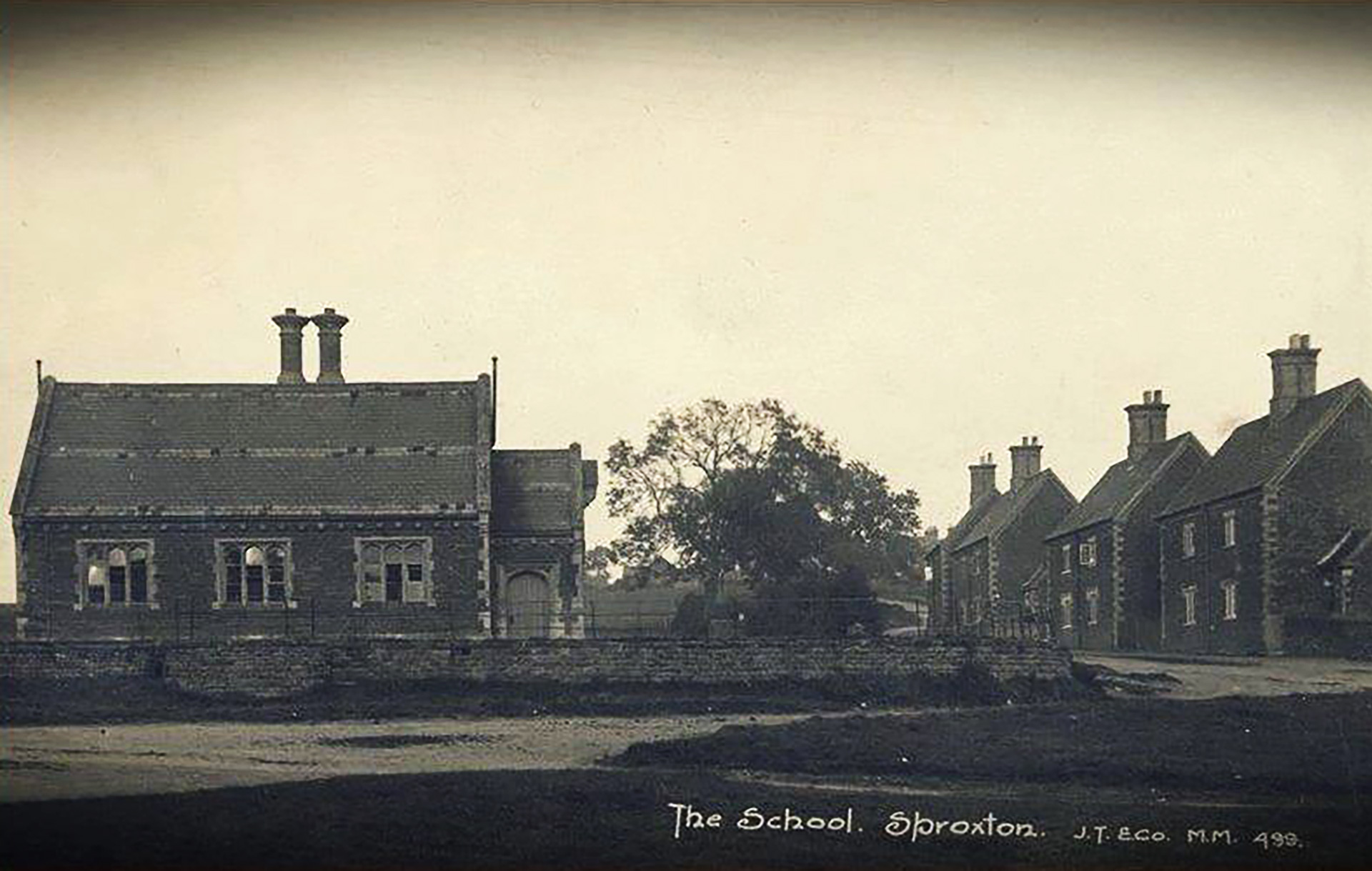
In 1916 Francis Joseph Warham was the headmaster of the Sproxton elementary school. The school was built in 1871 for 100 children and closed in 1976. Since then the building has been converted into the Village Hall. Ray Bennett: “I went to school there and learned more up there than I did at Melton. I went to school until I was 14. The Sproxton school had two rooms. The back room was for the infants, the big room was for the older children. You went into the big room when you were about 7.”
Post Mill
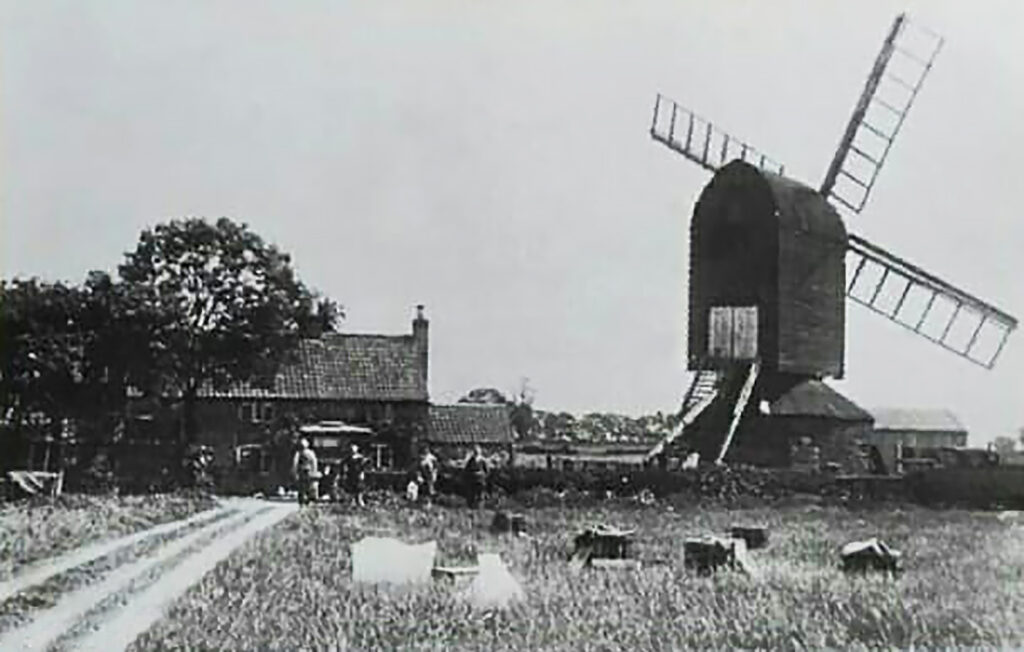
Asking Ray where the post mill was standing, we take the car up to Saltby Road and he drives up to the village boundary with Saltby. “The mill was dead on the boundary of Sproxton and Saltby.” Ray points into the field where now wheat is ready to be harvested. “The farm and the mill, are both gone.” The mill was rebuilt in 1889 after it blew down and killed the miller. Wakes & Lamb of Newark rebuilt the mill using materials from the old mill and from one at Castle Bytham. It was wrecked by the gales of March 1916, but repaired. That year the miller was Mr J. Pridmore. Four years later the post mill was out of use and was demolished in 1949 when owned by Mr T.A. Mount. It had to make way for the Sproxton opencast iron ore workings.
Ironstone
On our way back to the village Ray starts talking about the ironstone mined on Saltby Heath adjoining the village. “Many men from the village worked at the mines. So did I after World War II. The work was hard, but the hours were shorter and the pay was better than in farming.” The line went up to Skillington Road and High Dyke to Great Ponton. “It was run by the Park Gate Iron and Steel Company, established in Parkgate (South Yorkshire), who also operated ironstone quarries in Northamptonshire and Leicestershire.” A bungalow on Hillcrest, which is still there, was built for the foreman of the ironstone. Ray adds: “Some weeks 38,000 tons was sent over the line. This was good quality, but they closed it down because Swedish ore was 90 per cent iron.”
Church
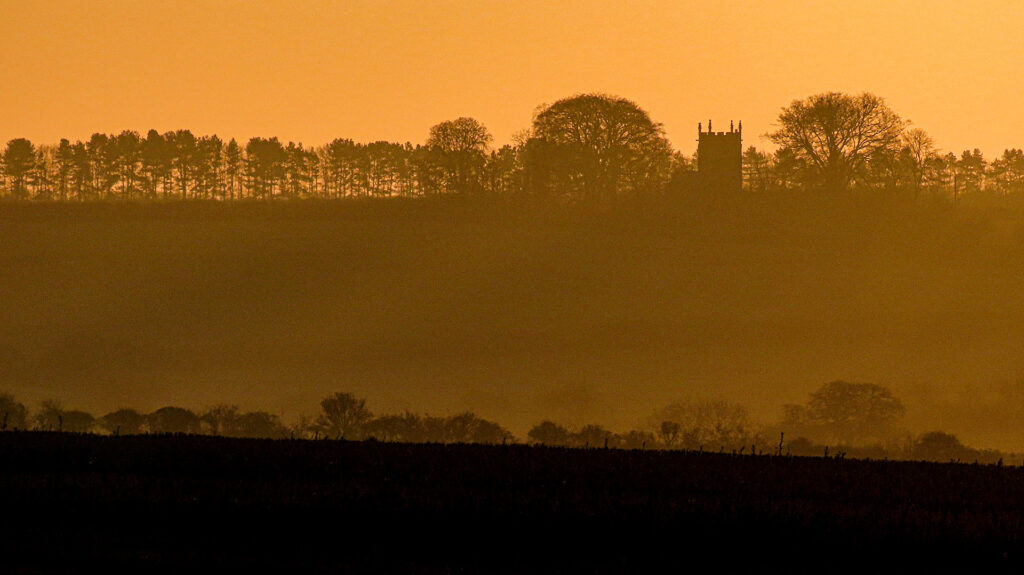
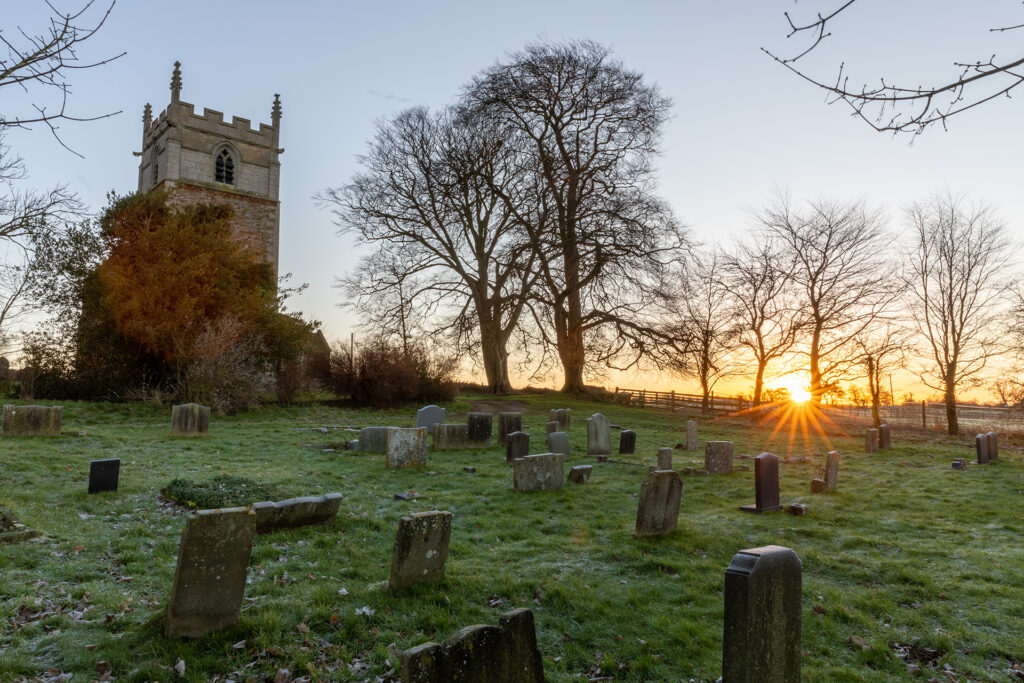
Ray parks his car on the church driveway. St Bartholomew Church lies at the far south end of the village. “It is always windy up here”, says Ray, as he stands in the churchyard in front of an Anglo-Scandinavian cross, the only complete example of a pre-Conquest cross in Leicestershire, likely of the 10th century. Like other crosses, it is thought that it was taken down at the time of the reformation. Ray tells about its remarkable survival. “The single long piece of stone found use as footbridge of a ditch between the church and the village. It was recognised for what it was in the late 18th century after finding it being used as a feature of a garden grotto in William Mountsey’s vicarage. When the church was restored in 1882 by architect Henry Woodyer, the cross was replaced in the churchyard on its socket, which was still there.” Its use as a footbridge, explains the completely worn face on the east side of the cross.
Inside the 14th century church, Ray tells the story of soldier E. Wright, who is named on the World War I roll of honour, on the church wall. “He was killed in Basra, in Iraq. There was a memorial for him and his lads in the capital Baghdad. It was moved to the desert before Saddam Hossein got into power, to save it from being ruined. Next to the wooden plaque is another WWI sandstone tablet and an additional plaque in remembrance of Jack Fahy. Ray adds: “He was on a mission in Italy, disarming mines. One of the monies was booby-trapped. He took the top one and the bottom one blew off.”
A family story
“My great grandfather John Henry Draper and his wife Emma lived in Sproxton,” wrote Phillip Draper. “Their five children attended the village school, I think from 1880 until the 1890s. John was a farmer and blacksmith at Skillington Road, before moving to Muston Gorse Farm in the Vale of Belvoir. In the 1901 census, his son Harold was living with (Aunt?) Elizabeth Parker on Main Street in Sproxton.”
“Bertie Draper, born in 1895, and serving at the 7th Lincs during WW1 was killed on 9 August 1916. He is remembered in Sproxton St Bartholomew’s Church. There is a wall-mounted tablet with a wreath carved in relief at the centre-top, dedicated to eight Sproxton casualties of WW1. During this time, the family were living in Sedgebrook, Lincolnshire (1911 Census). All the boys fought in WW1 and are recorded with honour in Sedgebrook St Lawrence’s Church.”
More pictures
Domesday Book
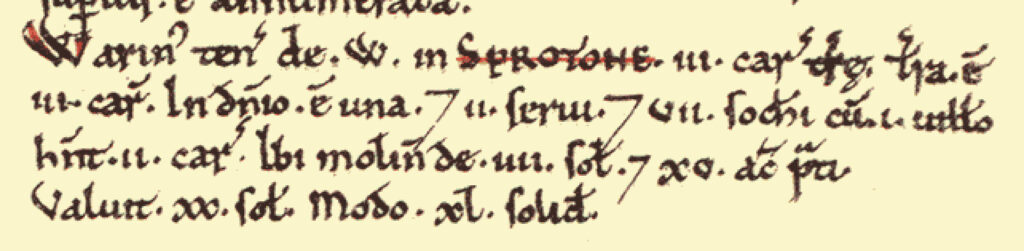
Sproxton was a settlement in Domesday Book, in the hundred of Framland and the county of Leicestershire.
It had a recorded population of 41 households in 1086, putting it in the largest 20% of settlements recorded in Domesday, and is listed under 3 owners in Domesday Book.
- Land of Guy of Craon
- Households: 1 villager. 7 freemen. 2 slaves.
- Ploughland: 3 ploughlands. 1 lord’s plough teams. 2 men’s plough teams.
- Other resources: Meadow 15 acres. 1 mill, value 4 shillings.
Valuation
- Annual value to lord: 2 pounds in 1086; 1 pound when acquired by the 1086 owner.
Owners
- Tenant-in-chief in 1086: Guy of Craon.
- Lord in 1086: Warin.
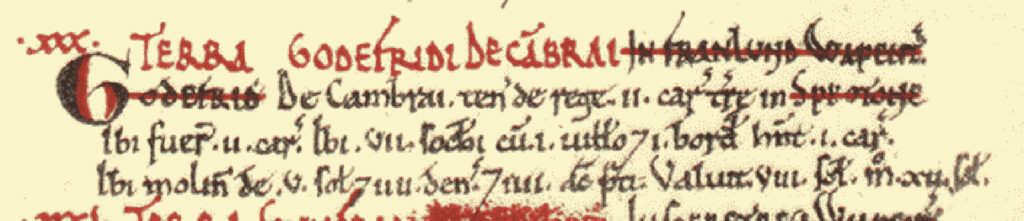
2. Land of Godfrey of Cambrai
- Households: 1 villager. 7 freemen. 1 smallholder.
- Ploughland: 2 ploughlands. 1 men’s plough teams.
- Other resources: Meadow 4 acres. 1 mill, value 5 shillings and 2 pence.
Valuation
- Annual value to lord: 12 shillings in 1086; 8 shillings when acquired by the 1086 owner.
Owners
- Tenant-in-chief in 1086: Godfrey of Cambrai.
- Lord in 1086: Godfrey of Cambrai.
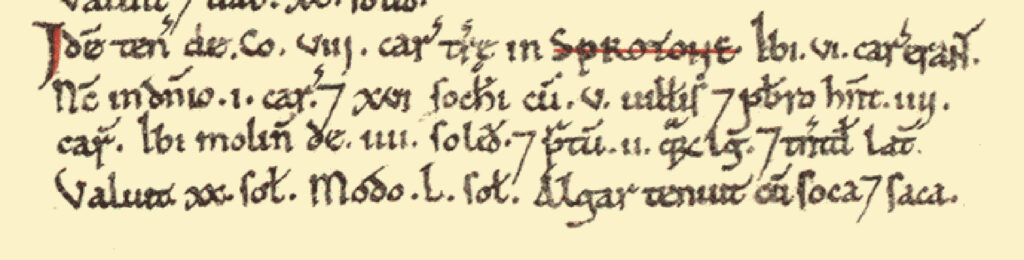
3. Land of Countess Judith
- Households: 5 villagers. 16 freemen. 1 priest.
- Ploughland: 6 ploughlands. 1 lord’s plough teams. 4 men’s plough teams.
- Other resources: Meadow 2 * 2 furlongs. 1 mill, value 4 shillings.
Valuation
- Annual value to lord: 2 pounds 10 shillings in 1086; 1 pound when acquired by the 1086 owner.
Owners
- Tenant-in-chief in 1086: Countess Judith.
- Lord in 1086: Hugh Musard.
- Lord in 1066: Algar.
Links
- Historic England – Architectural Red Box Collection: Pictures of St Bartholomew Church from the National Buildings Record
- J.D. Bennett, Windmills in Leicestershire: An Introduction in Leicestershire Historian, Spring 1971
4 responses to “Sproxton”
My great grandfather lived and worked in Sproxton. John Henry Drape and Emma. Their five children attend the village school, 1880 until the 1890s. I am not sure of the dates living on Skillington Road. John was a farmer and blacksmith before moving to Muston Gorse Farm in the Vale of Belvoir. In the 1901 census, his son Harold was living with (Aunt?) Elizabeth Parker on Main Street in Sproxton.
Bertie, born in 1895, was killed in August 1916 WW1, remembered in Sproxton church. During this time, the family were living in Sedgebrook, Lincolnshire (1911). All the boys fought in WW1 and are recorded with honour in Sedgebrook Church.
Thank you for your recollections. I will add these to the Sproxton story. The feature on Muston (village) will be added in a few weeks. Estelle
Ernest Trayford mentioned as a grocer and postmaster was a relative of mine as my grandmother was a Trayford. The Trayfords lived in Sproxton from the early 1900’s and many of them, including my great grandparents , are buried in the church yard at St Bartholemews. 3 Trayfords are also mentioned on the War Memorial inside the church. The family now has descendants living in Australia and America.
Thank you for your recollection. I will add this info to the story.