In 2014 historian André Bauwens, history researcher Estelle Slegers Helsen and photographer Peter Verdurmen highlighted the past and present of the main streets in Sluis, a small Dutch city near the Belgian border. This is article #6.
In 2014 realiseerden historicus André Bauwens, onderzoekster Estelle Slegers Helsen en fotograaf Peter Verdurmen een reeks over vroeger en nu in Sluis, een stadje in Nederland op de grens met België. Dit is artikel #6.
(EN) Sluis already had a tram connection with Draaibrug at the end of the nineteenth century. “The tram drove in the Kapellestraat right next to the sidewalk, on the side where our store was,” says Annie Ohms. “When he passed by, you had a soot in your face before you knew it. He stopped a little further at Vervake. You could also drop off and pick up parcels there.” “The tram came from Draaibrug through the Nieuwstraat and the Kapellestraat over the Markt, through the Vrijstraat to the current Walplein. There was a railway yard and a water tower to supply the steam tram with water,” says André D’hoore.
The Belgian tram also halted there; initially, it was a steam tram, but it was electrified in 1934. “It was a yellow tram from Knokke via Westkapelle,” says Elodie Dusarduijn-Quataert. André D’hoore: “The tram brought Belgians who worked at the Du Fossé furniture factory and the Superia bicycle factory. In the summer months, many tourists also came with that tram.”
(NL) Sluis kende al een tramverbinding met Draaibrug aan het eind van de negentiende eeuw. “De tram reed in de Kapellestraat vlak naast de stoep, aan de kant waar onze winkel was”, vertelt Annie Ohms. “Als hij voorbij kwam, had je roet in je gezicht voor je het wist. Hij stopte even verderop bij Vervake. Daar kon je ook pakjes afgeven en ophalen.” “De tram kwam van Draaibrug door de Nieuwstraat en de Kapellestraat over de Markt, door de Vrijstraat tot op het huidige Walplein. Daar was een emplacement en stond een watertoren om de stoomtram van water te voorzien”, zegt André D’hoore.
Daar stopte ook de Belgische tram, aanvankelijk een stoomtram, maar vanaf 1934 geëlektrificeerd. “Het was een geel trammetje dat via Westkapelle uit Knokke kwam”, zegt Elodie Dusarduijn-Quataert. André D’hoore: “Met het trammetje kwamen Belgen die werkten bij de meubelfabriek van Du Fossé en de fietsenfabriek Superia. In de zomermaanden kwamen met die tram ook veel toeristen mee.”


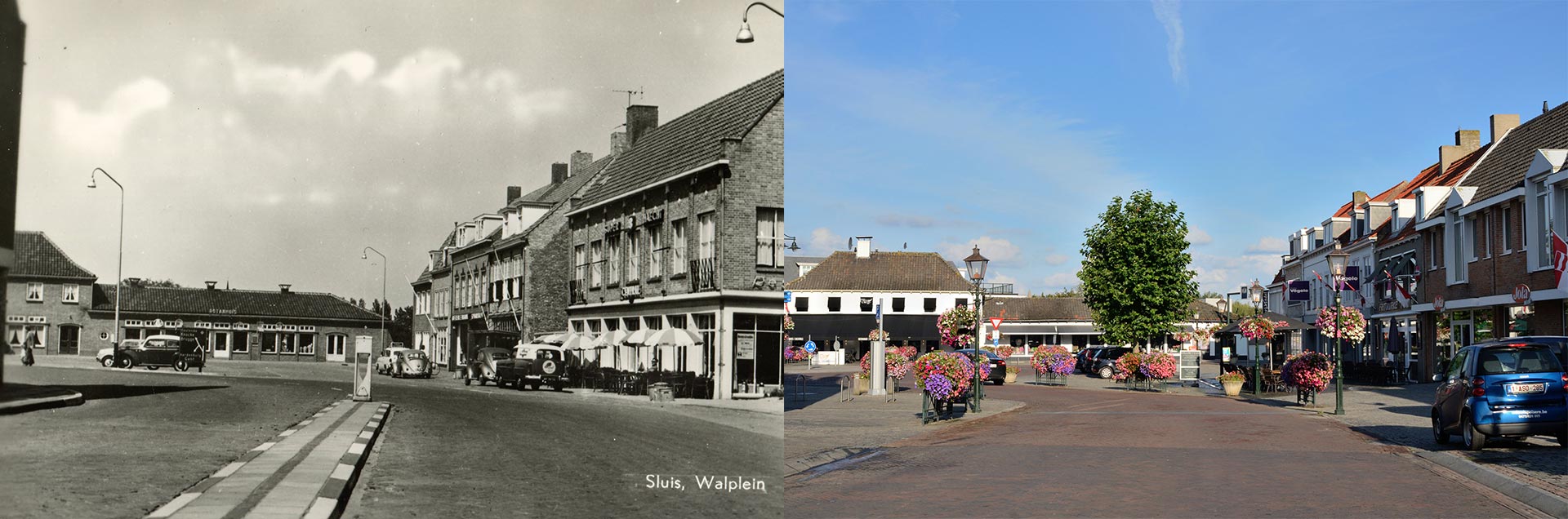
Then – A view at the newly built Walplein from the Nieuwe Weg in the early 1950s. Almost all of the buildings are deemed to be coffee houses, hotels and retail businesses. | Now – Walplein in 2014.
Toen – Het nieuw gebouwde Walplein gezien vanuit de Nieuwe Weg begin jaren vijftig van de vorige eeuw. De panden hebben bijna allemaal een bestemming als horeca- of detailhandelszaak. | Nu – Het Walplein in 2014.
(EN) “From the 1920s, the Dutch steam tram also ran from the railway yard via the ramparts to Retranchement and Zuidzande,” says André D’hoore. You had to have a lot of patience to ride the tram. Els Hermans went to boarding school in Brabant and came by train to Vlissingen and by boat to Breskens. “When we went from there to Sluis, he drove around everywhere, and that was quite a journey before you got home again.”
The yard was also the place where beets were loaded. Rinus Leenhouts: “They were transported to various sugar factories. Bricks from the brick factory were also transported this way. The tram also brought coal to Sluis.” Charles Verstraete adds: “When the tram with freight wagons was on the road, it had to play right next to the town hall. Because that’s where it came to an end.”
(NL) “Vanaf de jaren 1920 reed de Nederlandse stoomtram vanaf het emplacement via de wallen ook naar Retranchement en Zuidzande”, weet André D’hoore. Voor een rit met de tram moest je wel veel geduld hebben. Els Hermans zat op kostschool in Brabant en kwam met de trein tot in Vlissingen en ging met de boot tot in Breskens. “Als we vandaar naar Sluis gingen dan reed hij overal rond en dat was een hele reis voor je weer thuis was.”
Het emplacement was ook de plaats waar bieten werden geladen. Rinus Leenhouts: “Ze werden naar verschillende suikerfabrieken getransporteerd. Ook bakstenen van de steenfabriek werden zo vervoerd. De tram bracht voorts steenkolen tot in Sluis.” Charles Verstraete voegt daaraan toe: “Als de tram met goederenwagons op pad was, dan moest hij pootaan spelen ter hoogte van het stadhuis. Want daar liep het op.”
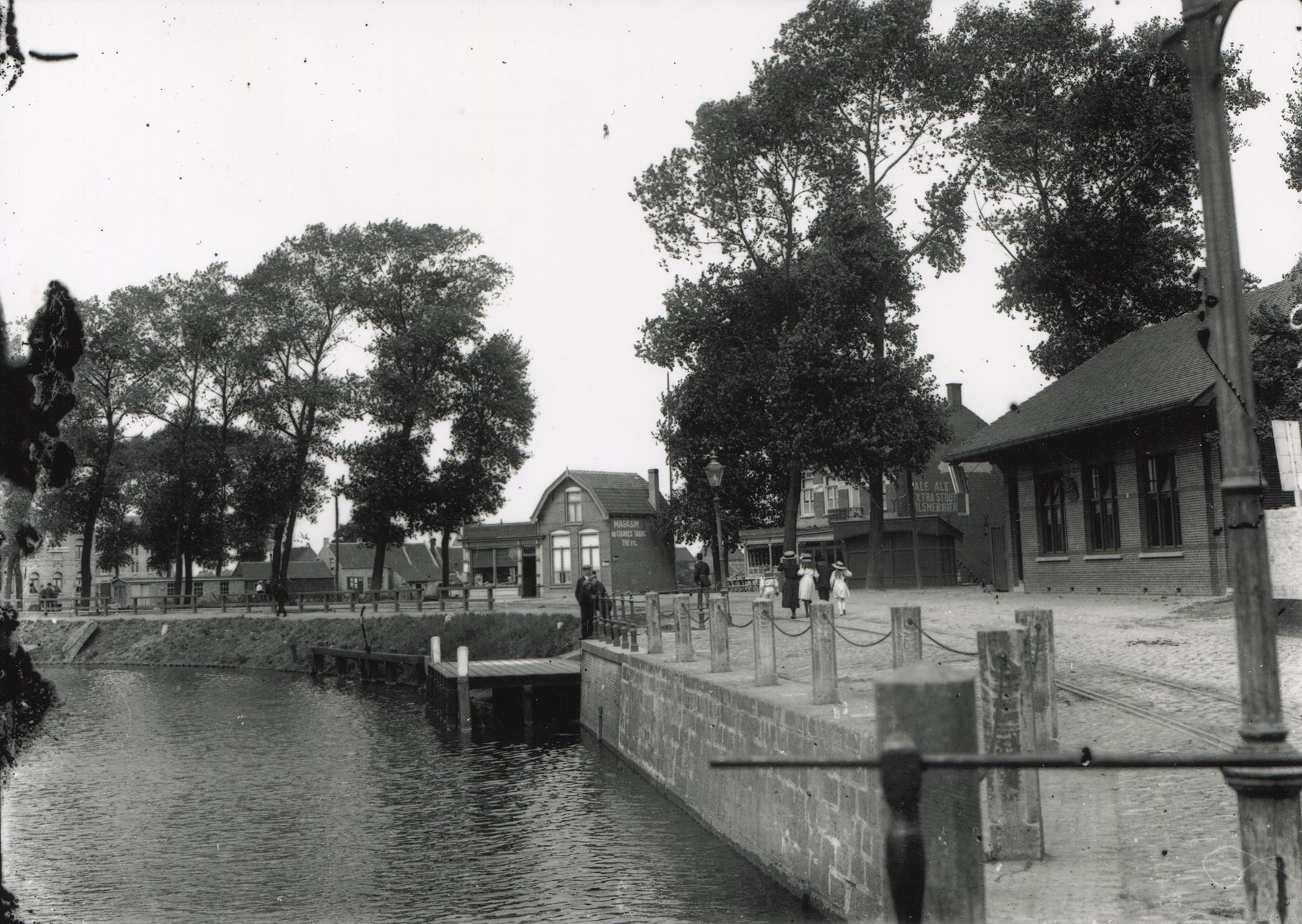
Photo from around 1900 that clearly shows the pre-war situation near the Kaai. The Walplein did not exist yet. Hotel Central is on the left, the water tower in the middle, next to the customs office. The water tower supplied the steam tram with water.
Foto van omstreeks 1900 die de vooroorlogse situatie nabij de Kaai goed weergeeft. Het Walplein bestond nog niet. Links hotel Central, in het midden de watertoren, daarnaast het douanekantoor. De watertoren voorzag de stoomtram van water.

The construction of the Walplein. The old Hotel Central, which emerged virtually unscathed from the Second World War, is still in place. On the right, the new Central appears to be ready. The old Hotel Central was demolished in 1954.
De aanleg en bouw van het Walplein. Het oude hotel Central, dat vrijwel ongeschonden uit de Tweede Wereldoorlog is gekomen, staat nog recht. Rechts lijkt het nieuwe Central gereed. Het oude hotel werd in 1954 gesloopt.
Click on the thumbnails to enlarge / Klik op de miniaturen om te vergroten
For both places, a book was published. The book about Aardenburg is out of stock. You can still buy copies of the book about Sluis, which is available from the publisher Durenkamp Grafimedia. Contact us.
Over beide plaatsen werd een boek gepubliceerd. Het boek over Aardenburg is uitverkocht. Het boek over Sluis is nog steeds te koop via de uitgever Durenkamp Grafimedia. Zo was het | Zo is het Sluis kost € 17,50. Verzendkosten (in Nederland € 7,50) . Stuur een bericht voor meer informatie.