
Shoby Priory – 1970s
“As a kid, living in Grimston, I spend a lot of evenings down at Shoby Priory to play with David and his two sisters, Tom Elliott’s children,” recollected Chris Sharp. “I was born in 1950, so that was in the middle and late 1950s. The Elliotts were tenant farmers and lived in one part of Shoby Priory and the farmworker in the other part.” Tom Elliott was a prizewinning farmer. In the mid-1950s, he won the cup a few times for the best farm between 75 and 200 acres in the Melton and Belvoir Agricultural Society’s Competition.

An article in a 1953 newspaper described Shoby Priory as “a mixed farm with the main emphasis on milk production and the provision of homegrown feedingstuffs. Shoby Priory is a holding of some 166 acres, mainly on boulder clay with some outcrops of sand and gravel. Although the soil is fairly heavy in parts, it is not, so heavy as most of the land in the South of Leicestershire and is not so naturally fertile. Much of the land is naturally slightly short of lime, and potash is also rather short, despite the nature of the soil. Phosphates, on the other hand, are fairly well supplied. The Friesian dairy herd numbers between 33 and 36 head of cows in milk and all herd replacements are bred and reared on the farm.”
Chris continued: “The farm belonged to Kenwynn Madocks Wright, who lived in Saxelby Park. When Tom Elliott retired, Kenwynn took the farm back. He sold Shoby Priory but kept most of the land. In the early 1970s, my wife and I had a memorable evening with the old rector of Saxelby, who was also the vicar in Grimston and the hymn writer, T.C. Hunting Clare. He told all kinds of local stories and talked about the original Shoby, not where it is now, but it was further up the hill on the left. The village population got wiped out during the Black Death, as did another village further on, called Willowes, which disappeared after the plague,” explained Chris. Shoby had a church dedicated to St Michael, which probably disappeared in the middle of the 17th century. Until some time in the late 20th century, a Michaelmas Day service was held on the lawn of Shoby Priory to celebrate the existence of a church.

A 1970s newspaper wrote: “The service was suggested by the Rector of Saxelby (the Rev. T.C.H. Clare), Mr and Mrs T.W. Elliott (who lives at the priory) gladly cooperated, and the Rural Dean (the Rev. C.M.S. Clarke) agreed to take part in the service. Chairs arranged on the lawn accommodated the congregation of about 30. The Rev. T.C.H. Clare preached, and the Rural Dean led prayers and gave the blessing.”
Shoby Priory was first used as an ecclesiastical dwelling under the patronage of Launde Priory during the 12th century, and this is where the title Priory originates. But it was never a priory as such. Shabby Priory was first occupied as a house by the Folvilles of Rearsby. In 1395 the Brooksby family bought Priory House together with the Saxelby Estate.
In 1552 Robert Brooksby, described as a “gentleman of Leicestershire”, inherited Shoby Hall. Brooksby was a confirmed Catholic, and most of his life was devoted to maintaining the faith in Leicestershire, where the rapid march of the Protestants was already crushing the few bands of Roman Catholics scattered around the country. In 1557 the Bishop of Lincoln wrote an express letter to the Government stating that a certain Robert Brooksby of Leicestershire had not been to his parish church nor received Sacrament for a very long time.
When, in 1580, Robert Brooksby heard that a Jesuit priest was to land at London Port, he started to make hurried preparations for a journey to the capital. He was introduced to the Jesuit, and their meeting was the start of a long and close association and the friendship between the Brooksby family at Shoby and the society of the Jesuits.
The Earl of Leicestershire received a letter in 1581 from a certain Francis Hastings, which read: “The house of one, Mr Bruxby, of Shoby, in your country, ought to be searched, together with the house of Mistress Bruxby, daughter of Lorde Vaux, and widow of Bruxby’s son.”
The first Jesuit priest was followed by many more from France and Belgium, and most of them were making their homes in hideouts in the northeast corner of Leicestershire. Booksby’s wife, Eleanor, and her famous sister Anne Vaux devoted much of their time to providing a succession of the houses for the Jesuits. In 1615 Great Asby Hall was sequestered for Eleanor’s recusancy, and she and her sister likely went to live with Robert at Shoby Hall until his death later the same year.
In 1626 Anne Vaux was listed among the 11 recusants in the Saxelby parish, and Eleanor, who died in 1625, was instructed in the Catholic faith by Father William Wright, who was harboured at Shoby Hall between 1609 and 1615. Using Shoby as his base, Father Wright founded and organised the Jesuit Mission in Leicestershire, Derbyshire, and Nottingham counties. By 1621 he had eight colleagues to help him in his mission. Not long after Winifred Brooksby had inherited Shoby Hall in 1615 at the age of 13, the Roman Catholic story of Shoby ended with the sale of the building and the estate to a protestant. The old hall was now partly rebuilt and is called Priory Farm, but the building, in fact, was never really a priory. The bottom picture is a gateway preserved from the old hall.
The whole Estate of Saxelby was again sold in 1677 to Heneage Finch, Charles II’s Lord Chancellor. In 1879 William Wright became the owner. Now Shoby Priory is a private house with a fenced gate. But historical features are kept, like the Gothic archway leading to the garden. The gap in the hedge along Shoby Lane, where one of the wooden gates to the pastures around the dwelling is still there. It seems nothing has changed.


On the village
Would you like to add your story and recollection? Leave a comment at the bottom of this page or send a message.
More pictures

Would you like to add pictures? Send a message.
Domesday Book
Shoby was a settlement in Domesday Book, in the hundred of Goscote and the county of Leicestershire.
It had a recorded population of 14 households in 1086.
Land of Earl Aubrey (of Coucy)
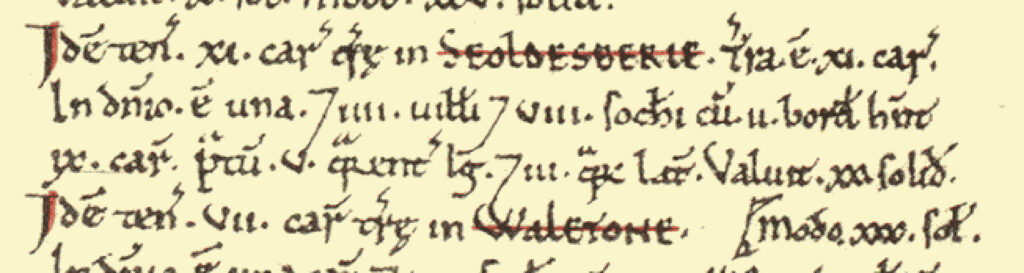
- Households: 4 villagers. 8 freemen. 2 smallholders.
- Ploughland: 11 ploughlands. 1 lord’s plough teams. 9 men’s plough teams.
- Other resources: Meadow 5 * 3 furlongs.
Valuation
- Annual value to lord: 1 pound 10 shillings in 1086; 1 pound when acquired by the 1086 owner.
Owners
- Tenant-in-chief in 1086: Earl Aubrey (of Coucy).
- Lord in 1086: Ralph of Chartres.
- Lord in 1066: Harding (son of Alnoth).
Links
Would you like to add a link? Send a message.