Main Street
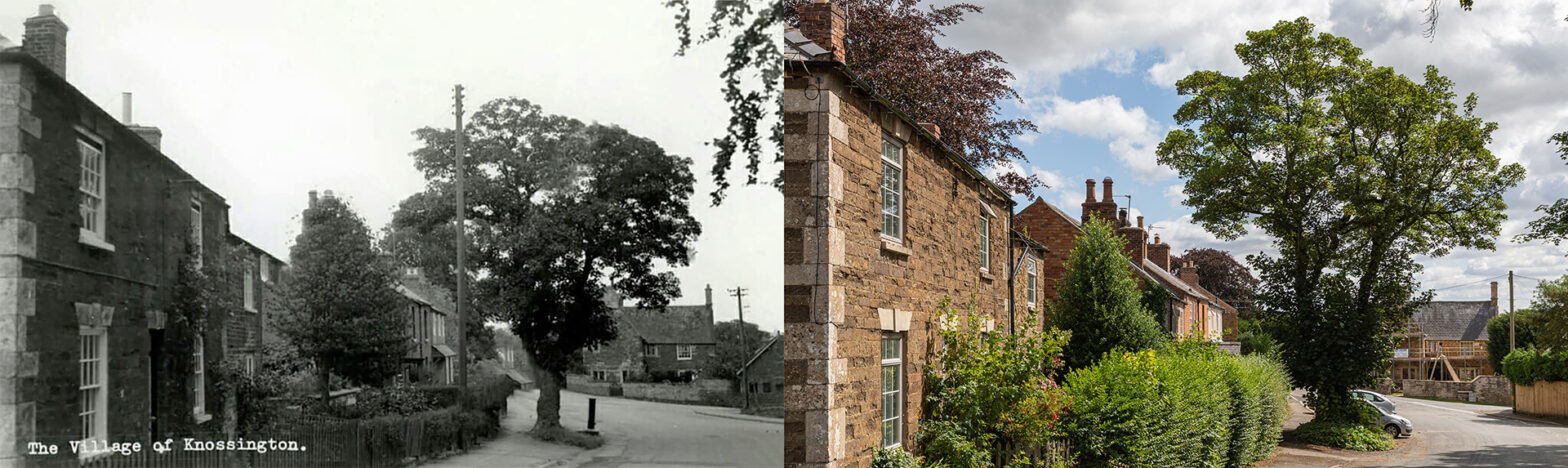
Looking like a spider missing three legs, five roads radiate from Main Street in Knossington, a village at the outer southeast corner of the Melton Mowbray borough. In both pictures, the old postcard and the new photo, the view of The Hollow, a street leading to Oakham Road, is obscured by a tree. Even after more than half a century the tree still claims all the attention. About 100 yards along The Hollow, Cold Overton Road starts heading north. The rather steep descending Braunston Road is on the right-hand side of The Walnuts, the house at the back to the right of the tree. Further to the right, next to the outbuilding, Owston Road begins. The house on the left, Stoneleigh Farm lies at the corner to Somerby Road.
Along the left side of Main Street, both pictures show the same houses, starting with the old farmhouse at the corner. Next are Sycamore Cottage and Alder Cottage, followed by three unnamed houses, all five terraced. Further on there seems to be a gap, but a small ornate stone house with a front garden was erected on the site around 1910, after an inn, called the Greyhound, was demolished. As can be seen on a 1900s postcard, The Greyhound was a 17th-century stone structure with a thatched roof and a gable-end facing the road. Now, the only public house in the village is the Fox and Hounds along Somerby Road. Two houses are left on Main Street. The penultimate building is a yellow ironstone house named The Knoll House. Above the road at the end of the street stands an early-19th-century house called The Whalebones. Its name is derived from the jawbones of a whale which, until the end of the 1950s, formed an arch above its entrance gate.
The Walnuts formerly known as Walnut Tree House, probably built in the 1610s with early and late 19th century additions and alterations, is said to have been the home of the Peck family in the early 19th century. It was reputed to have a beam dated 1570 with the initials of Henry Peck. The house is currently in full restoration. When taking the picture a stonemason was crafting ironstone blocks to fit one of the chimneys. Stonemasonry is said one of the oldest activities and professions in human history. To conclude, nearly in front of the old central tree stood the public water pump of the village. It is still there in the remake picture, but it has been moved a bit to the back and is obscured by a car.




On the village
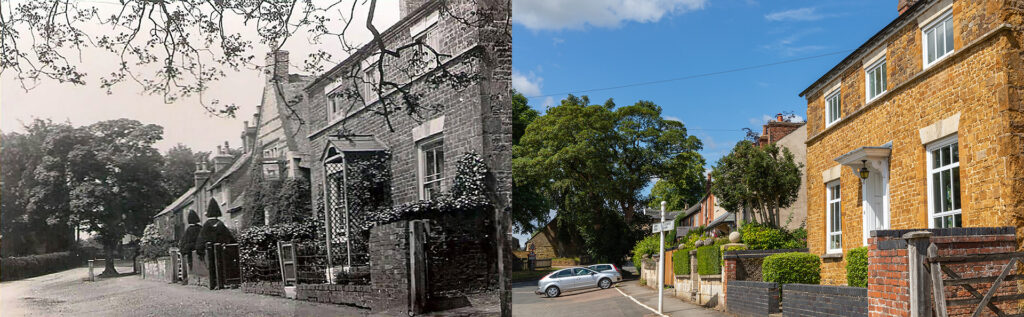
About half the houses in Knossington are built of ironstone or limestone; the remainder, many of which date from the early 19th century, are of brick. No evidence of medieval construction has been found. One of the earliest houses is probably that standing southwest of the churchyard, known since about 1950 as the Old Manor House.
More pictures
Domesday Book
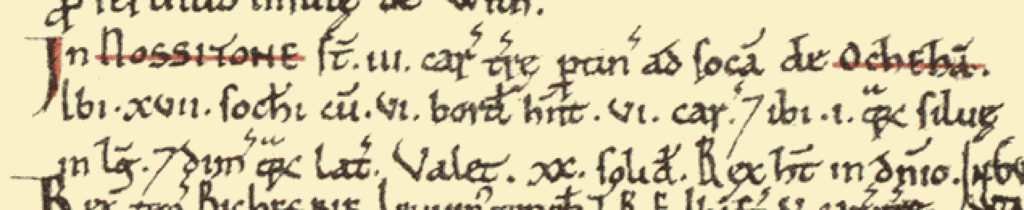
Knossington was a settlement in Domesday Book, in the hundred of Martinsley, mentioned in the chapters for Leicestershire and Rutland.
It had a recorded population of 31 households in 1086, putting it in the largest 40% of settlements recorded in Domesday, and is listed under 2 owners in Domesday Book.
- Land of King William
- Households: 17 freemen. 6 smallholders.
- Ploughland: 6 men’s plough teams.
- Other resources: Woodland 1 * 1.5 furlongs.
Valuation
- Annual value to lord: 1 pound in 1086.
Owners
- Tenant-in-chief in 1086: King William.
- Lord in 1086: King William.
- Lord in 1066: King Edward.
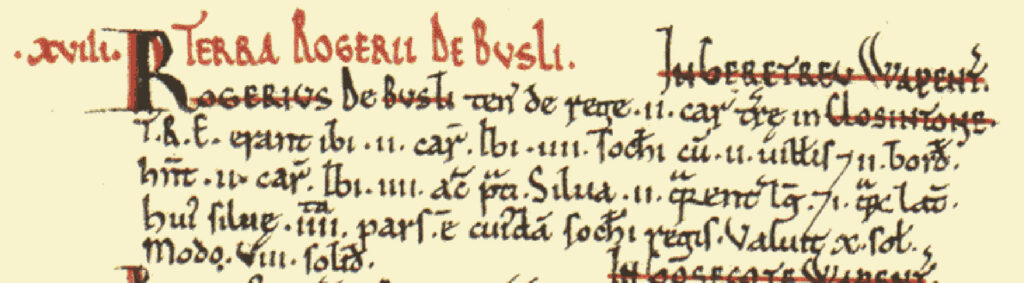
2. Land of Roger of Bully
- Households: 2 villagers. 4 freemen. 2 smallholders.
- Ploughland: 2 ploughlands. 2 men’s plough teams.
- Other resources: Meadow 4 acres. Woodland 2 * 1 furlongs.
Valuation
- Annual value to lord: 8 shillings in 1086; 10 shillings when acquired by the 1086 owner.
Owners
- Tenant-in-chief in 1086: Roger of Bully.
- Lord in 1086: Roger of Bully.
Links
- British History Online – Knossington in A History of the County of Leicestershire: Volume 5, Gartree Hundred. Originally published by Victoria County History, London, 1964.