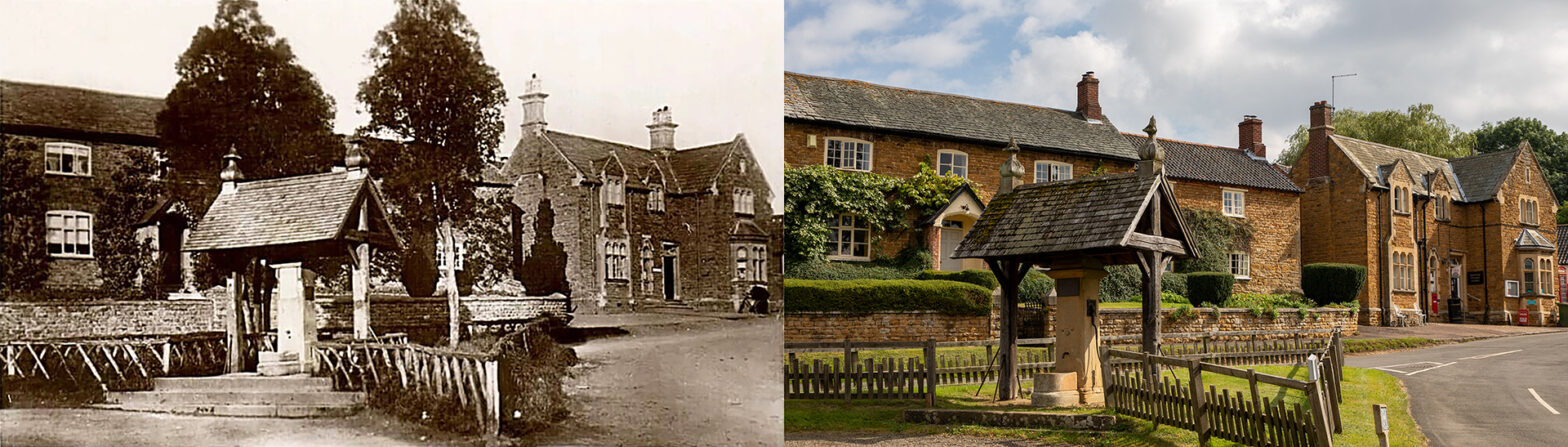
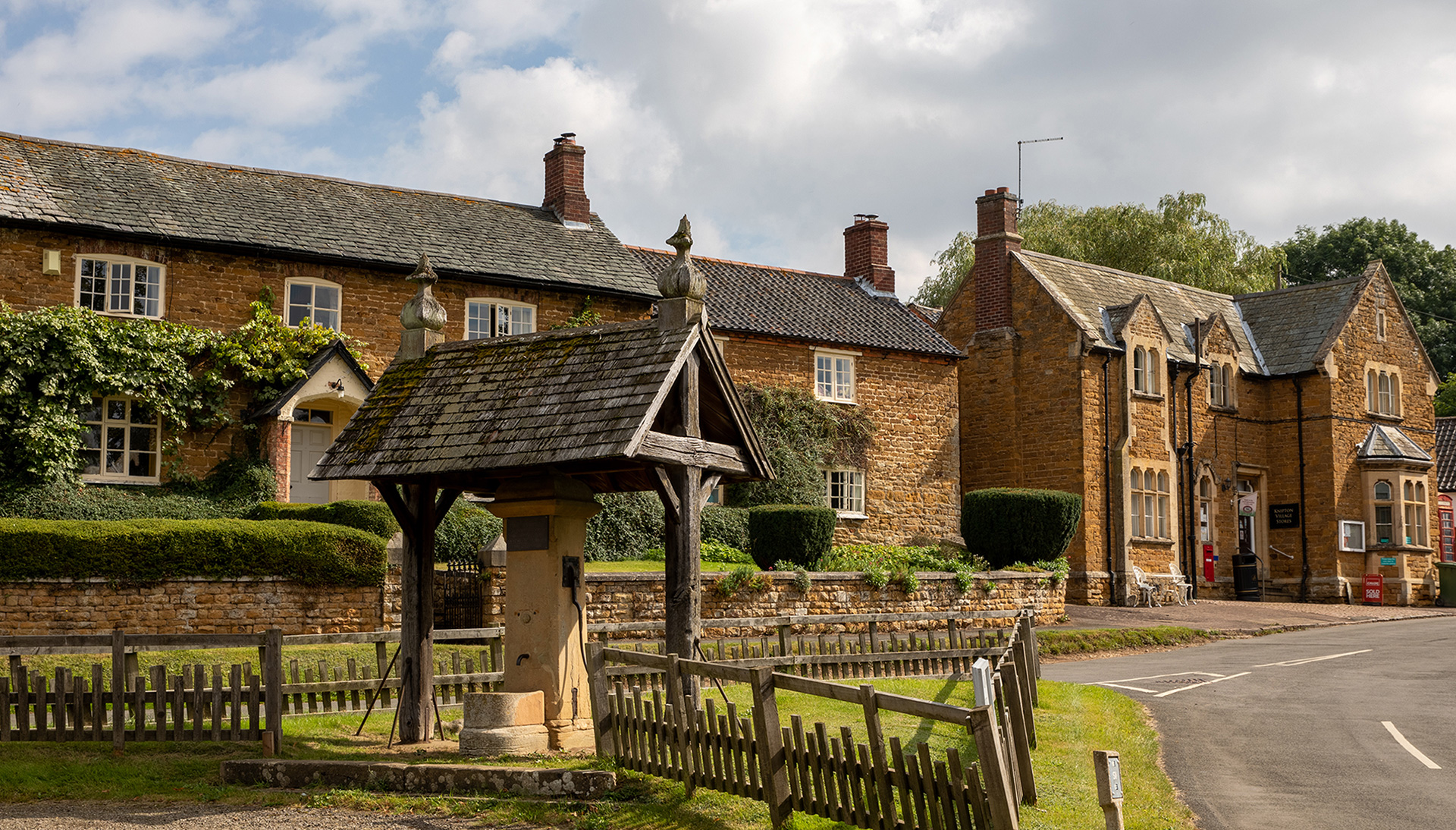
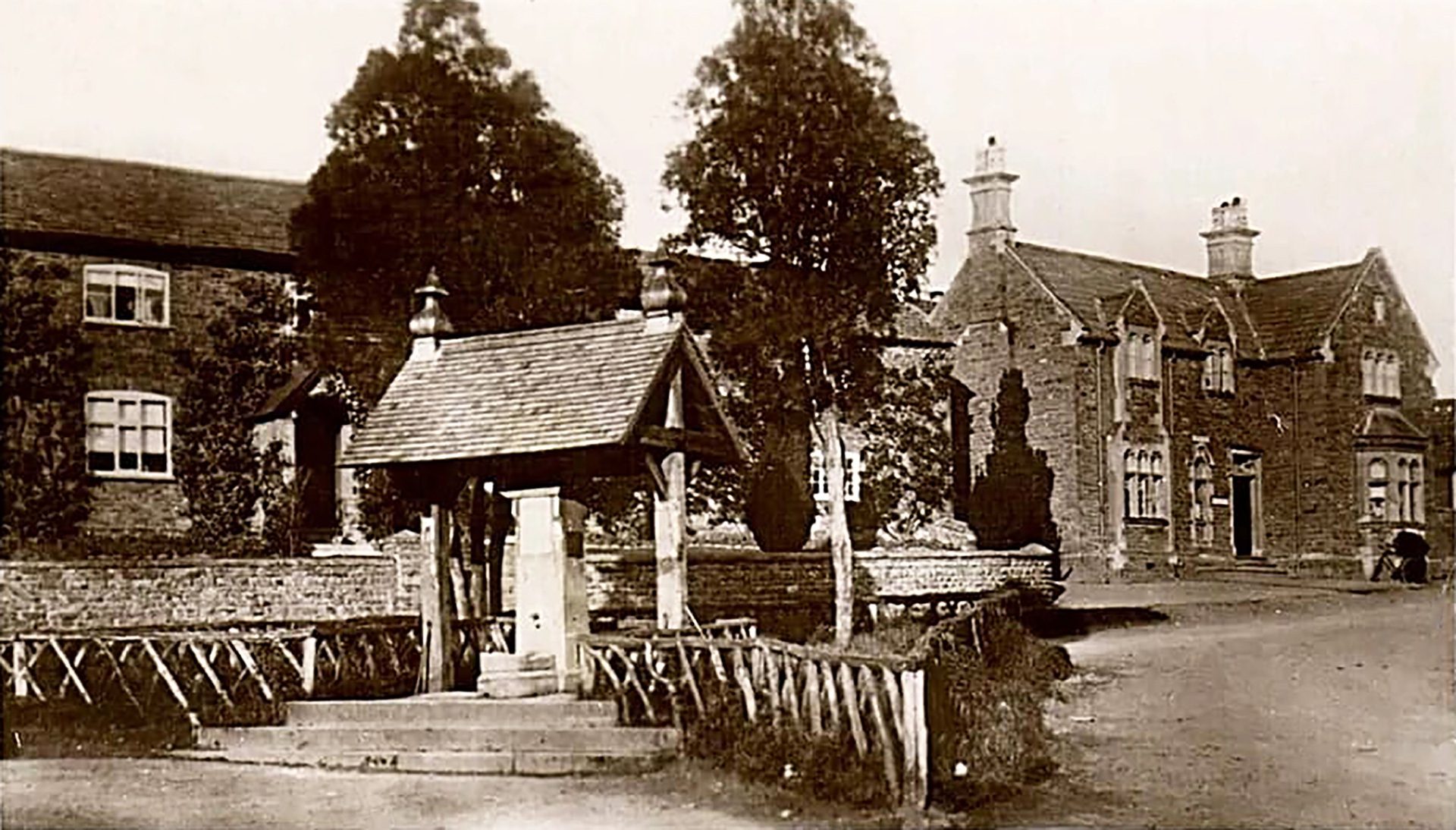
Main Street – 1910s
Knipton in the Vale of Belvoir is often called one of the prettiest villages in England. The houses clustered around the heart of the village are all Belvoir Estate property, except for one, The Cottage near the War Memorial on Belvoir Road. For a village with a population of around 120, it has quite some facilities: a bowls club at the end of Finns Lane, a cricket ground with an active cricket club (senior and junior teams), a village hall, a pub, a hairdresser and a village shop with a post office. The latter, run by Jonathan and Shirley Holdford, is the real heart of the village.
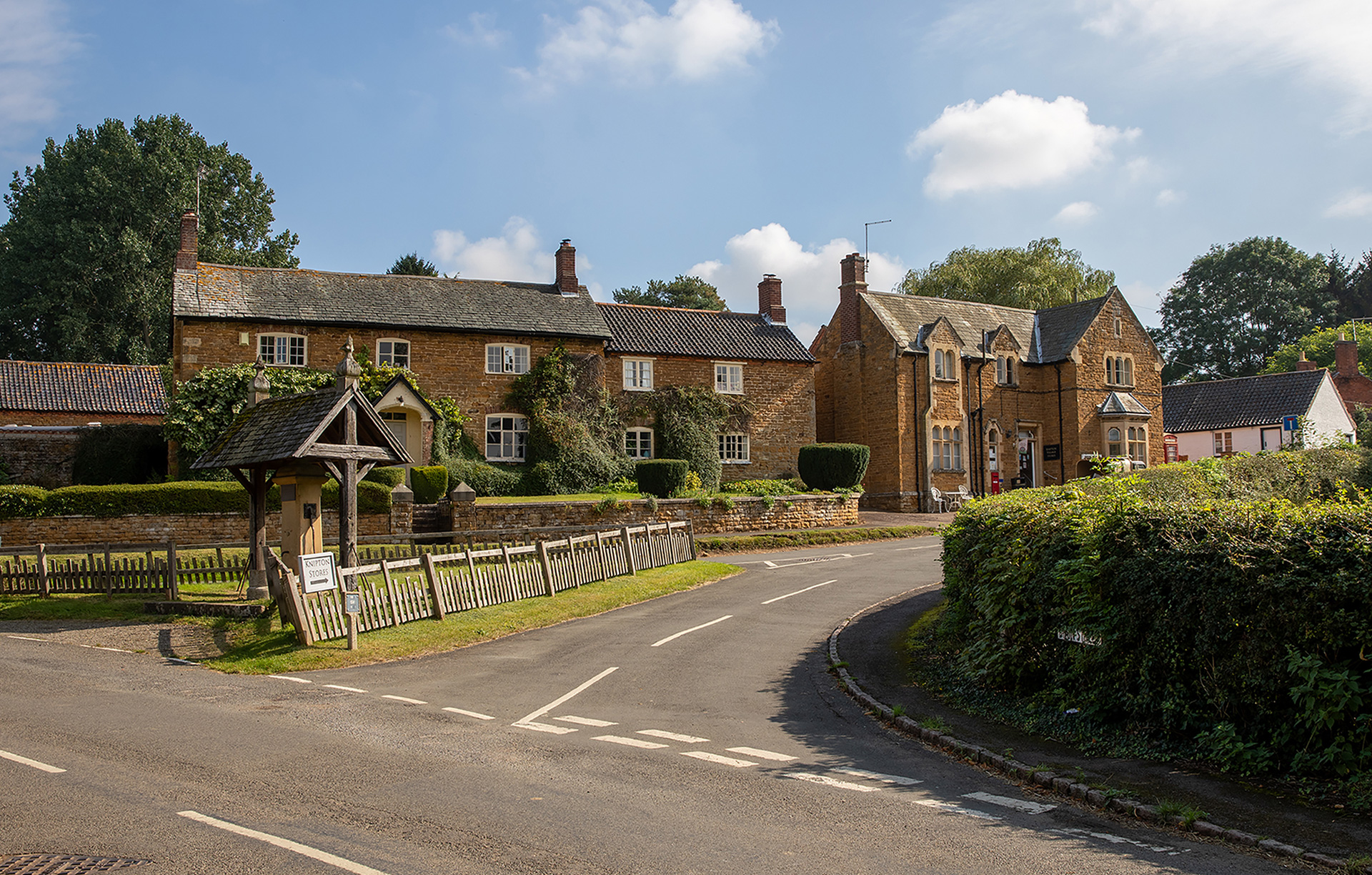
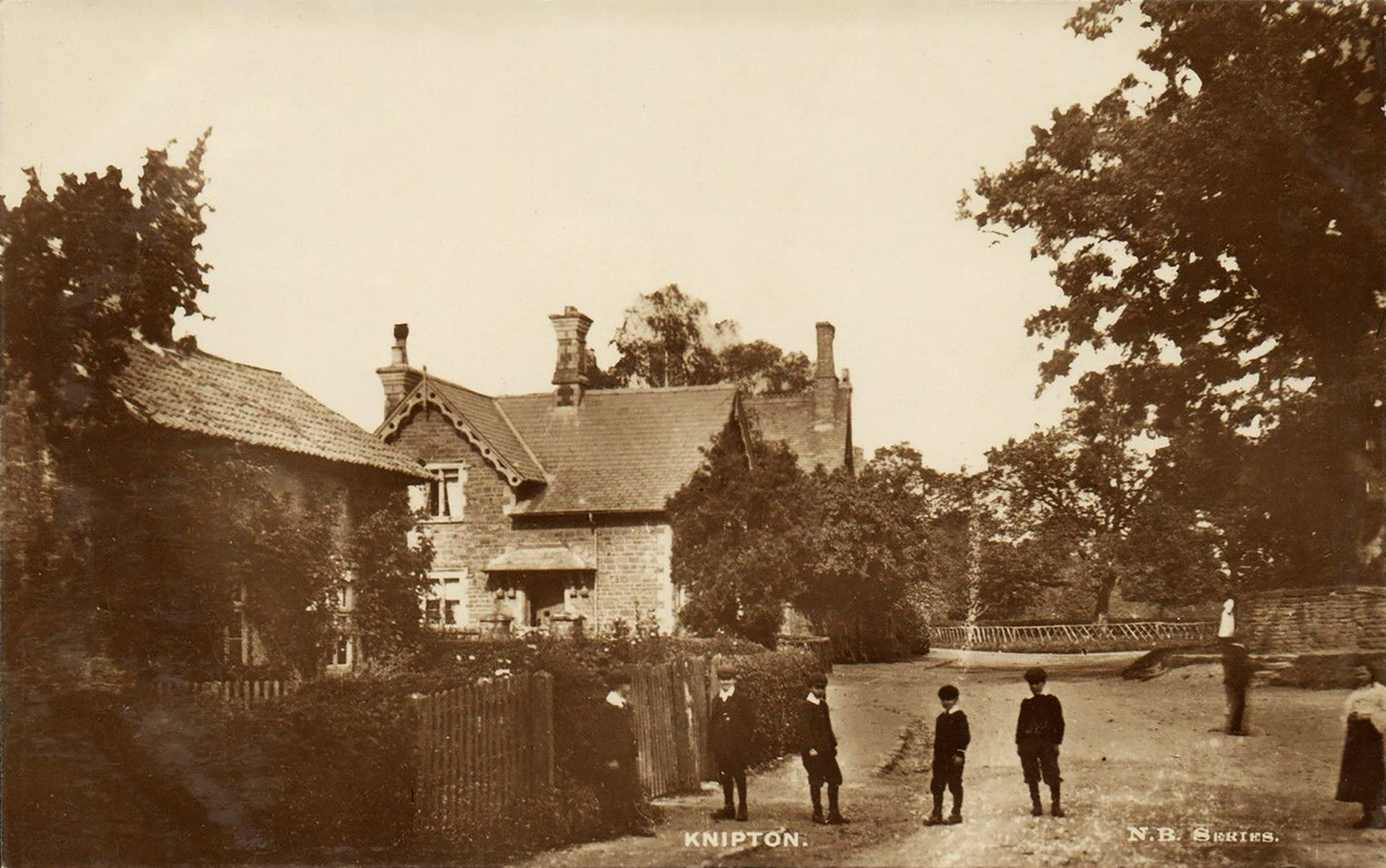
The post office building, dated around 1870, has hardly changed. The second chimney has gone, and a red post box which was set into the wall in the centre front. On the picture’s edge, you can spot a classic K6 telephone kiosk designed in 1935 by Sir Giles Gilbert Scott. Sharon Morrison Baksh recalled: “We used to live in Main Street when Erica and her husband Alan Garratt ran the shop and post office.” Since 2008 the shop has made news headlines twice. There was a successful robbery in August 2019, leaving Jonathan and Shirley ‘shaken’ after two armed men wearing masks attacked them. Eleven years earlier, two men with Samurai swords also made a raid. The 68-year-old then postmaster Alan threw a bottle of sherry at them as they ran away, leaving him with slash wounds.
Vine House, a late 18th-century building of coursed ironstone and roof of graded Swithland slate, is located at the left-hand side of the pictures. Here also, changes are minimal: new windows and a slightly more expansive gabled brick porch. The two trees on the green at the back of the village pump have gone. The parish council commissioned the restoration of the sheltered pump to celebrate the millennium. “I have spent many hours at the pump”, said Richard Hart. Tim Warwick, who lived at the Gatehouse for a long time, said before he died last year: “In the 1950s and early 1960s, the sign for the village shop, indicated the Marquis of Granby, the local inn further on Main Street.” It was closed in the 1960s. The present-day village pub, The Manners Inn, along Croxton Road was once a private house named The Red House.
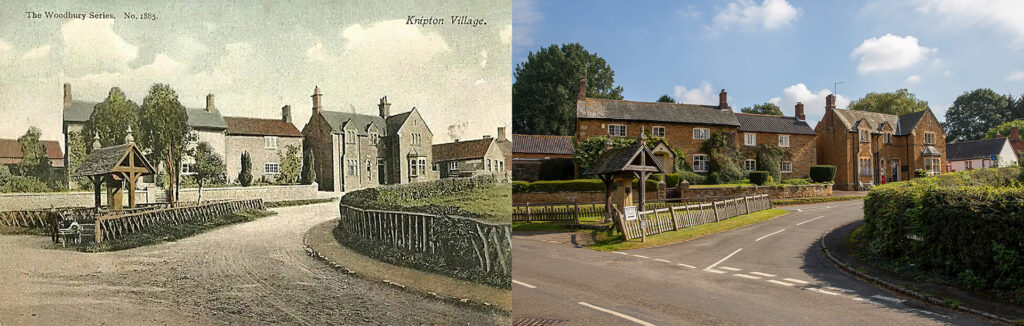
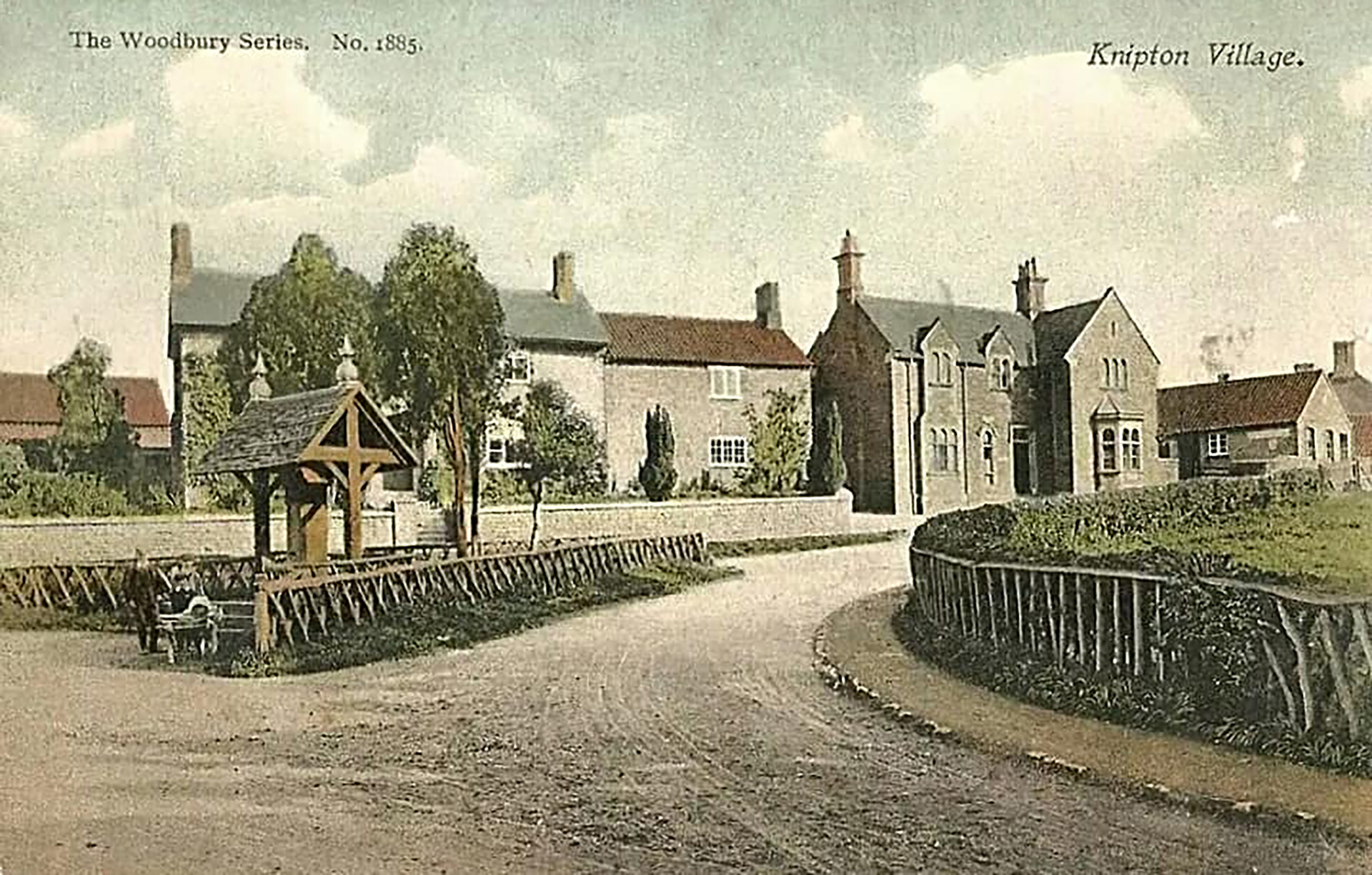
The nicely recoloured postcard gives a broader view of Main Street and the junction with Belvoir Road.
Belvoir Road – 1905s
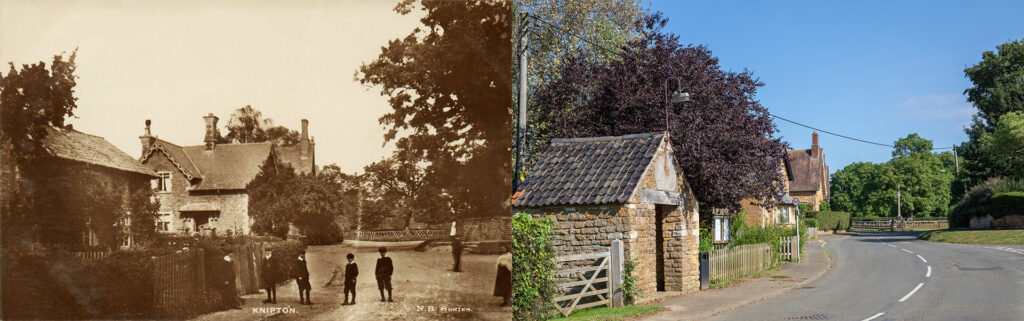
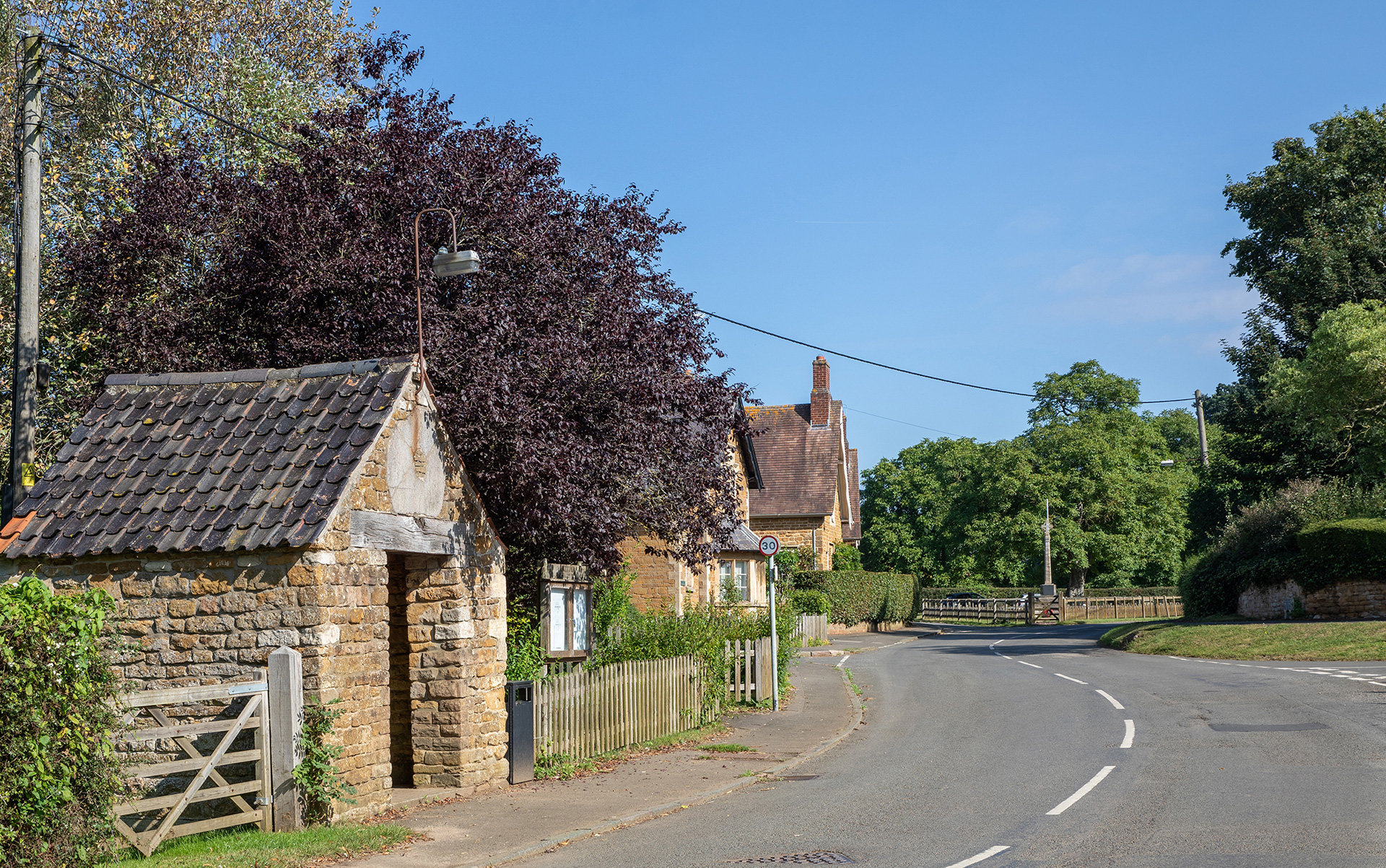
The pictures with a view on Main Street are taken opposite the village pump, at the bus shelter along Belvoir Road on the left-hand side of the remake picture of Belvoir Road. ”I remember waiting at the bus shelter with my son for the school bus to Croxton Kerrial”, recalled Sharon Morrison Baksh. Gordon Jackson concluded: “This sounds odd, but stand up comedian Freddie Starr did a televised comedy sketch in front of that stone bus shelter. It must have been 25 years ago.
The first cottage on the left in the old picture is gone. “The cottage in the corner, the one that’s gone, is called Landyke”, recalled Richard Hart. “The cottage was named after my father’s Labrador kennel breed name. We lived at Granby farm in the village. Aunties Dorothy, Betty and Ida, who was blind, lived there. We had an old wooden windup phone on the wall with a dial that had an extension to the cottage. “The larger house behind Landyke, near the War Memorial, is known as The Cottage”, told Joanne Allen, “and was lost by one of the late Dukes in a card game and remains the only estate house privately owned in the village.” The Cottage was home to Mrs Walters, the primary school teacher at Knipton, before moving to Oxfordshire after her retirement.
Knipton Memorial Cross, all the way back in the new picture, stands in a small memorial garden enclosed by a wooden fence, in the southern end of the triangular green at the junction of Croxton Road and Nursery Lane. The monument is about 15 feet tall and comprises a stone wheel-head cross with floral terminals rising from a circular column. The war memorial was raised in remembrance of the men of Knipton who died in the First World War. The names of those who died in the Second World War were added. The First World War inscriptions and names have been renewed.
On the village
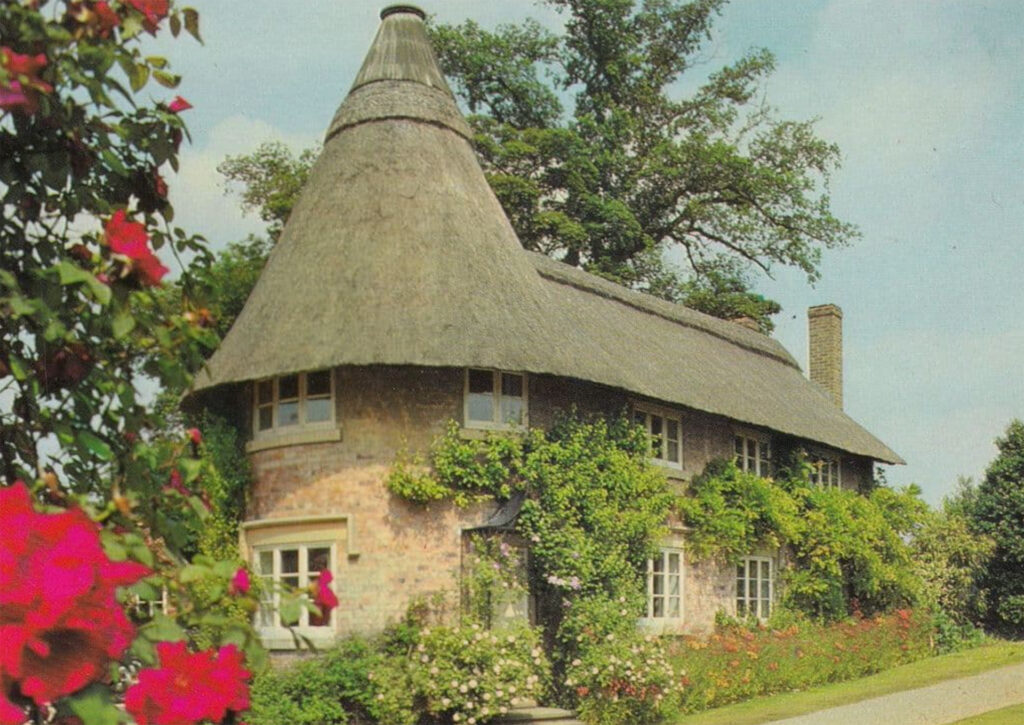
Reservoir Cottage is one of the village’s so-called cottages ornés (French for ‘decorated cottage’), dating back to a movement of rustic stylised cottages of the late 18th and early 19th centuries. During the Romantic movement, some sought to discover a more natural way of living instead of the formality of the preceding Baroque and Neoclassical architectural styles. They often feature well-shaped thatch roofs with ornate timberwork.
Stephen Giles recollected: “Reservoir Cottage was the home of Lord John Manners the brother of the late 10th Duke of Rutland. In Plungar there was a man who died a few years ago called Dougie Wellbourn who had lived in the same house in Plungar for most of his life. Dougie told me he had worked on the estate for Lord John and in retirement had been his gardener at Reservoir Cottage. He said Lord John had once given him a bottle of whisky because it had been given to him but was not the brand he prefered himself.”
More pictures
Domesday Book
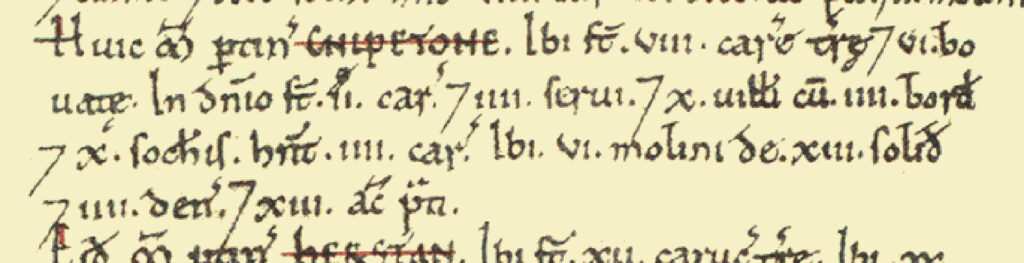
Knipton was a settlement in Domesday Book, in the hundred of Framland and the county of Leicestershire.
It had a recorded population of 33 households in 1086, putting it in the largest 40% of settlements recorded in Domesday, and is listed under 2 owners in Domesday Book.
1. Land of King William
- Households: 10 villagers. 10 freemen. 4 smallholders. 4 slaves.
- Ploughland: 2 lord’s plough teams. 4 men’s plough teams.
- Other resources: Meadow 13 acres. 6 mills, value 13 shillings and 2 pence.
Owners
- Tenant-in-chief in 1086: King William.
- Lord in 1086: Hugh son of Baldric.
- Lord in 1066: Earl Morcar.
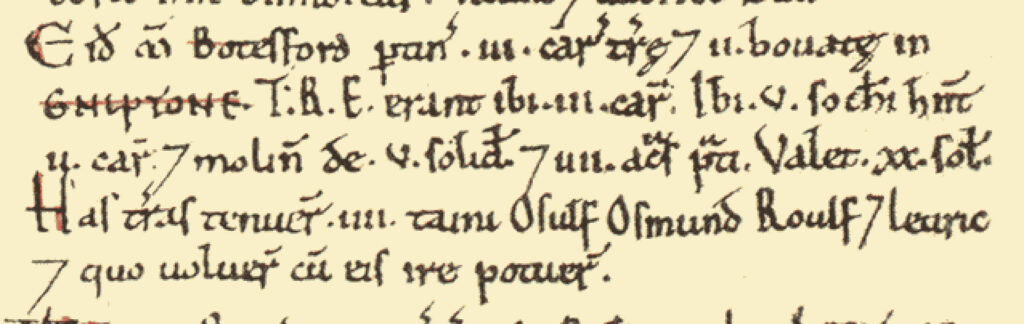
2. Land of Robert of Tosny
- Households: 5 freemen.
- Ploughland: 3 ploughlands. 2 men’s plough teams.
- Other resources: Meadow 4 acres. 1 mill, value 5 shillings.
Valuation
- Annual value to lord: 1 pound in 1086.
Owners
- Tenant-in-chief in 1086: Robert of Tosny.
- Lord in 1086: Robert of Tosny.
- Lords in 1066: Leofric <of Bottesford>; Osmund (Benz); Oswulf (son of Frani); Rolf.
2 responses to “Knipton”
The cottage that Richard Hart identifies as “Landyke” may, I think, be where my grandfather lived. Vague memories of it being opposite the pump and a visit, perhaps in the early 1960’s, but my older sister says not. 1921 census lists Grandad Harry Marriott, wife Rose and their children George, Cecil, Doris, Walter (my Dad aged 4), and Raymond. Can anyone confirm I wonder?
I remember George Marriot when I was a child living in Knipton. I also vaguely remember a cottage where the bus shelter now stands and my Mum telling me Marriots lived there