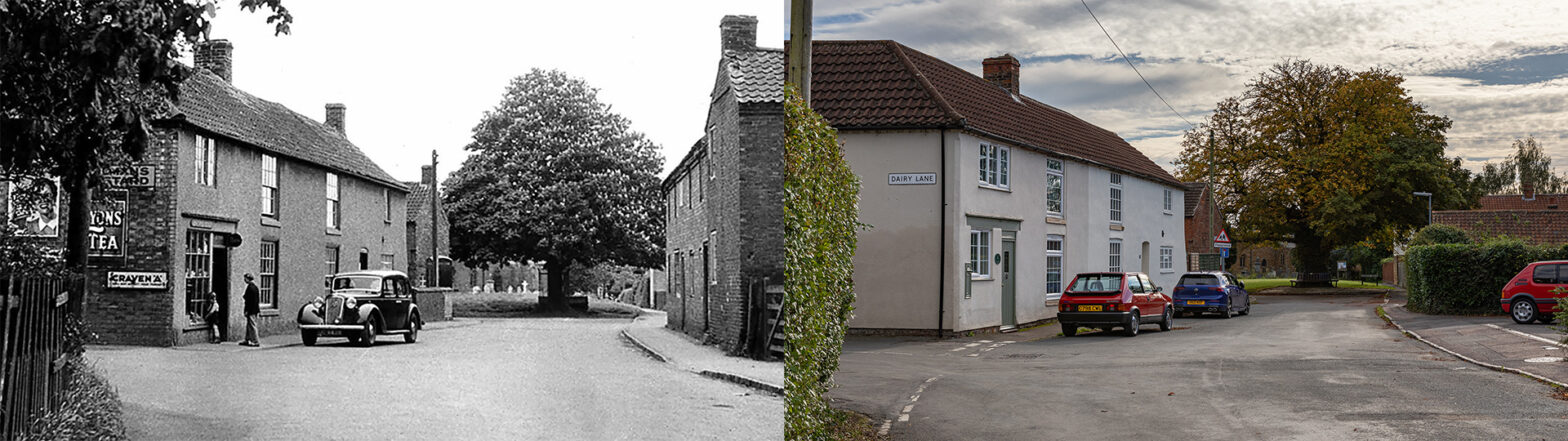
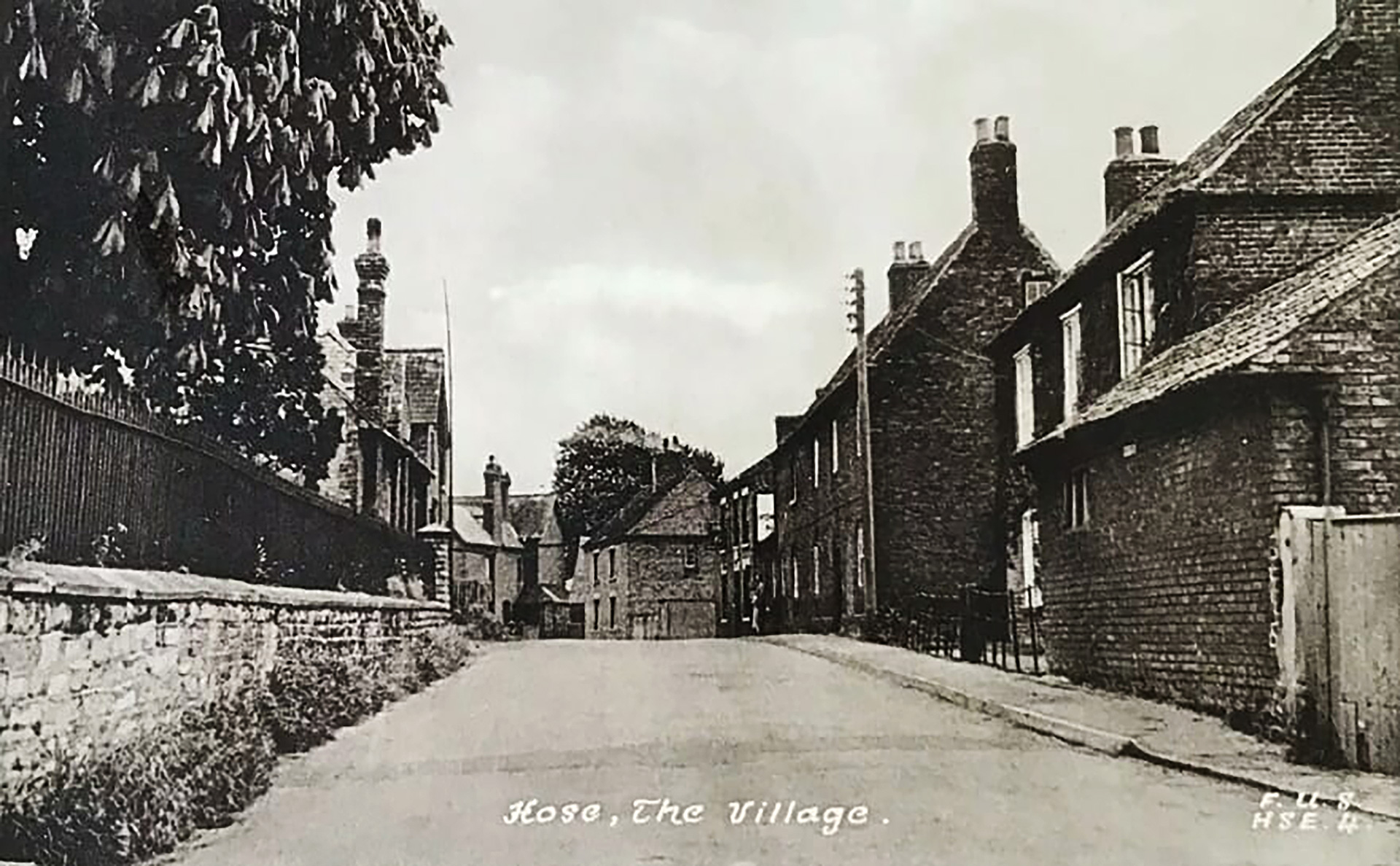
The Grn – Early 1940s
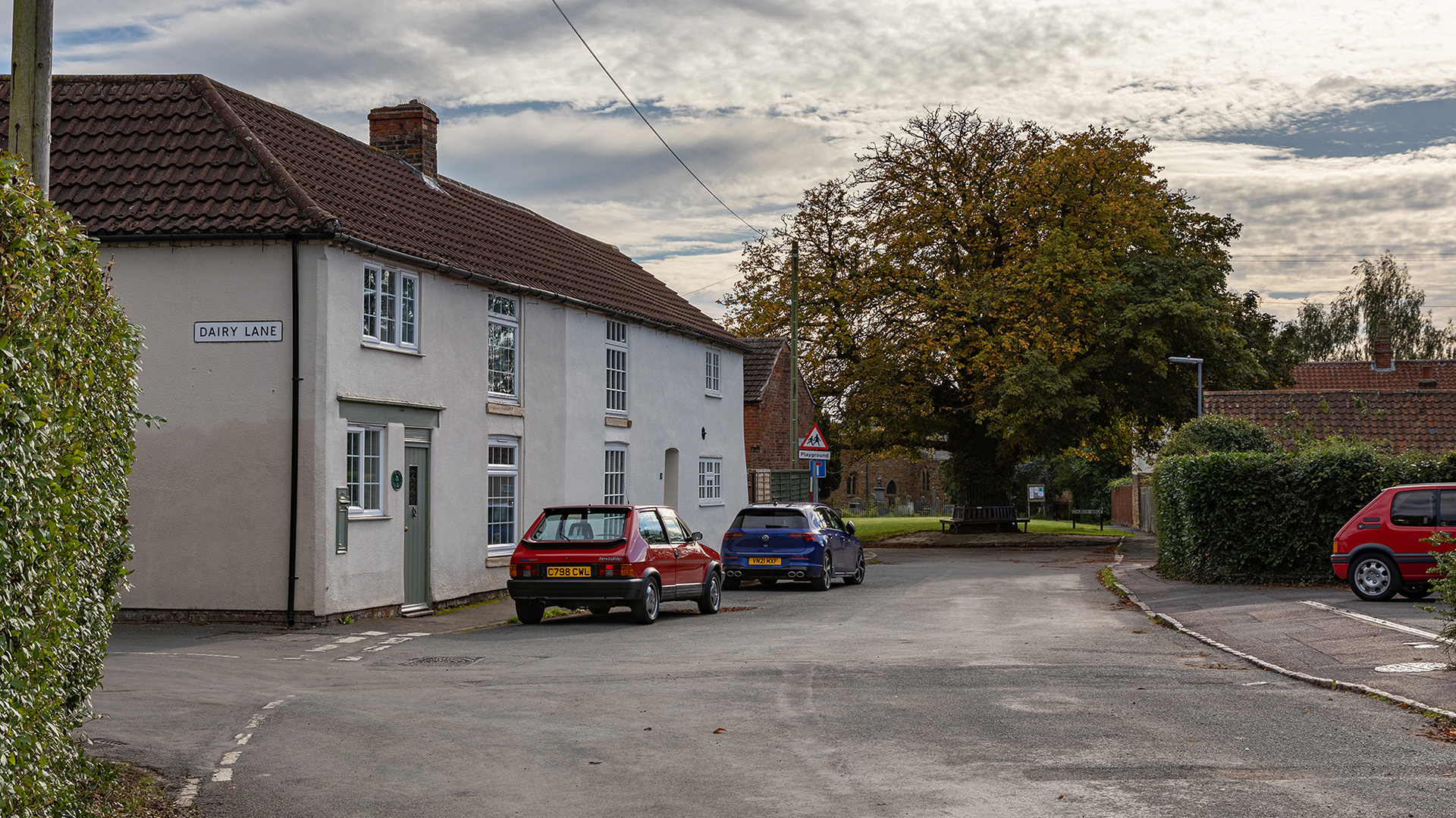
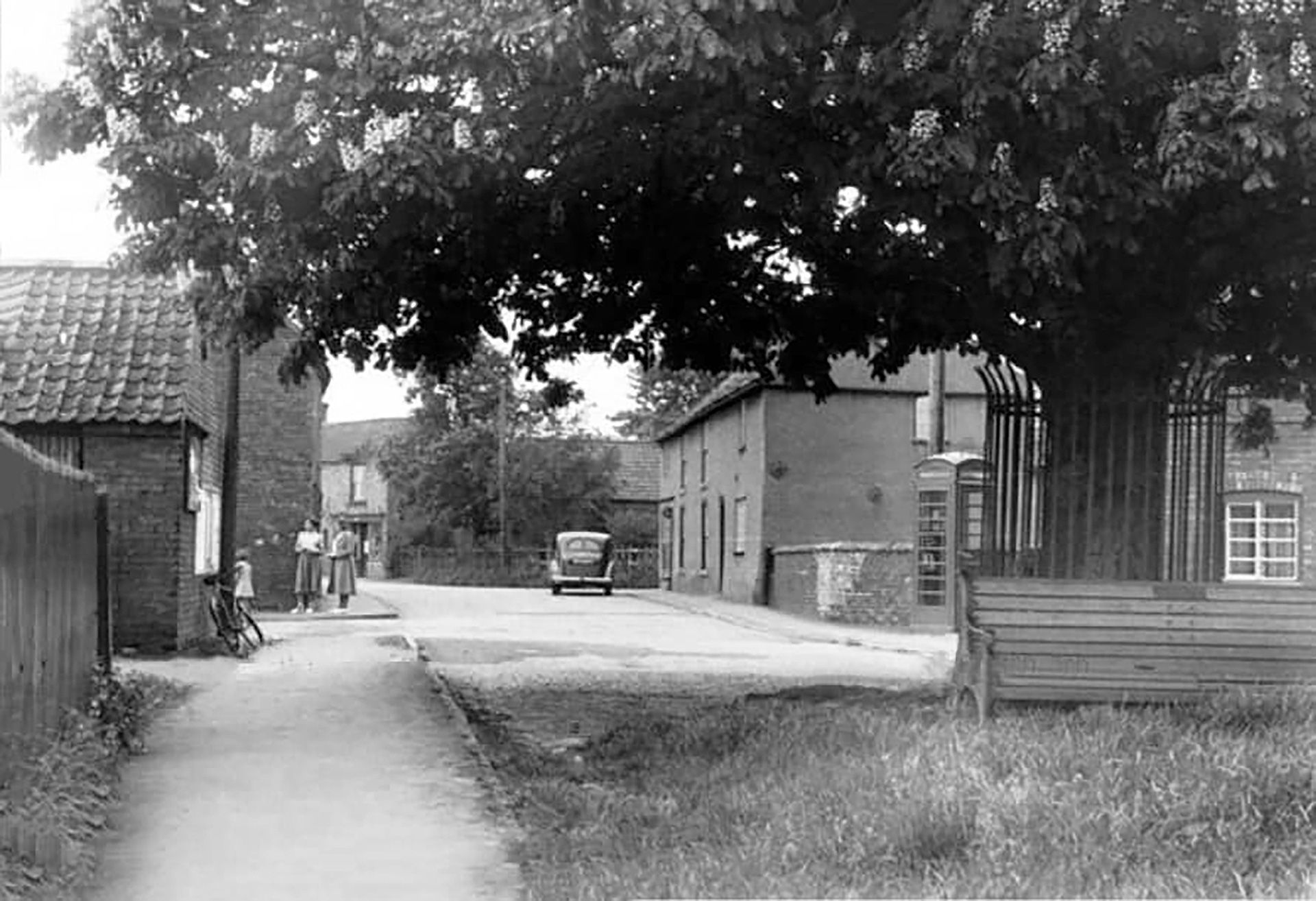
For already more than twenty years, each Friday morning, Jim Fisher and Geoff Mabbott have met to discuss Hose’s history. They are the village’s historical conscience. The old postcard shows the end of Main Street, now named The Grn (without the two e’s). On the left is Dairy Lane. “It is so named because close to the junction with Harby Lane, there was a dairy factory which was supplied by more than ten farms in the village, as part of Long Clawson Dairy”, said Jim.
The building on the left was the Post Office, and also one of the village shops. The publicity signs are pretty easy to read, although the picture with the woman is a mystery. “Craven A was a British cigarette brand, introduced in 1921. Lyons Tea is one of Ireland’s biggest and best-loved tea brands”, explained Jim. Geoff continued: “Colman’s is original English mustard. One of the mustard family members, Colonel Coleman, who in the 1930s purchased Scalford Hall, was nicknamed Colonel Mustard.” Jim added “Years ago, the stucco came off the outer wall of the shop, and you could see a painted sign with the letters ROP, the acronym for Russian Oil Products. ROP sold not only petrol but also paraffin. The latter you could buy in the store, where people bought everything they needed: boots, shirts, groceries, and fruit. Before, the building was a pub. Some said it was called The Sun, some said it was called The Rising Sun. A railing outside was attached to the building, where pubgoers used to tether their horses when they went for a pint.” The Post Office closed about 20 years and became a dwelling.
ROP, Russian Oil Products (Moorgate, London) was an independent distributor of motor spirit. The company was established in 1925, for distribution of petrol imported from Russia. In 1948 Regent Oil acquired Russian Oil Products which gave the company a ready-made distribution network although it was unlikely that oil would be imported from Russia.
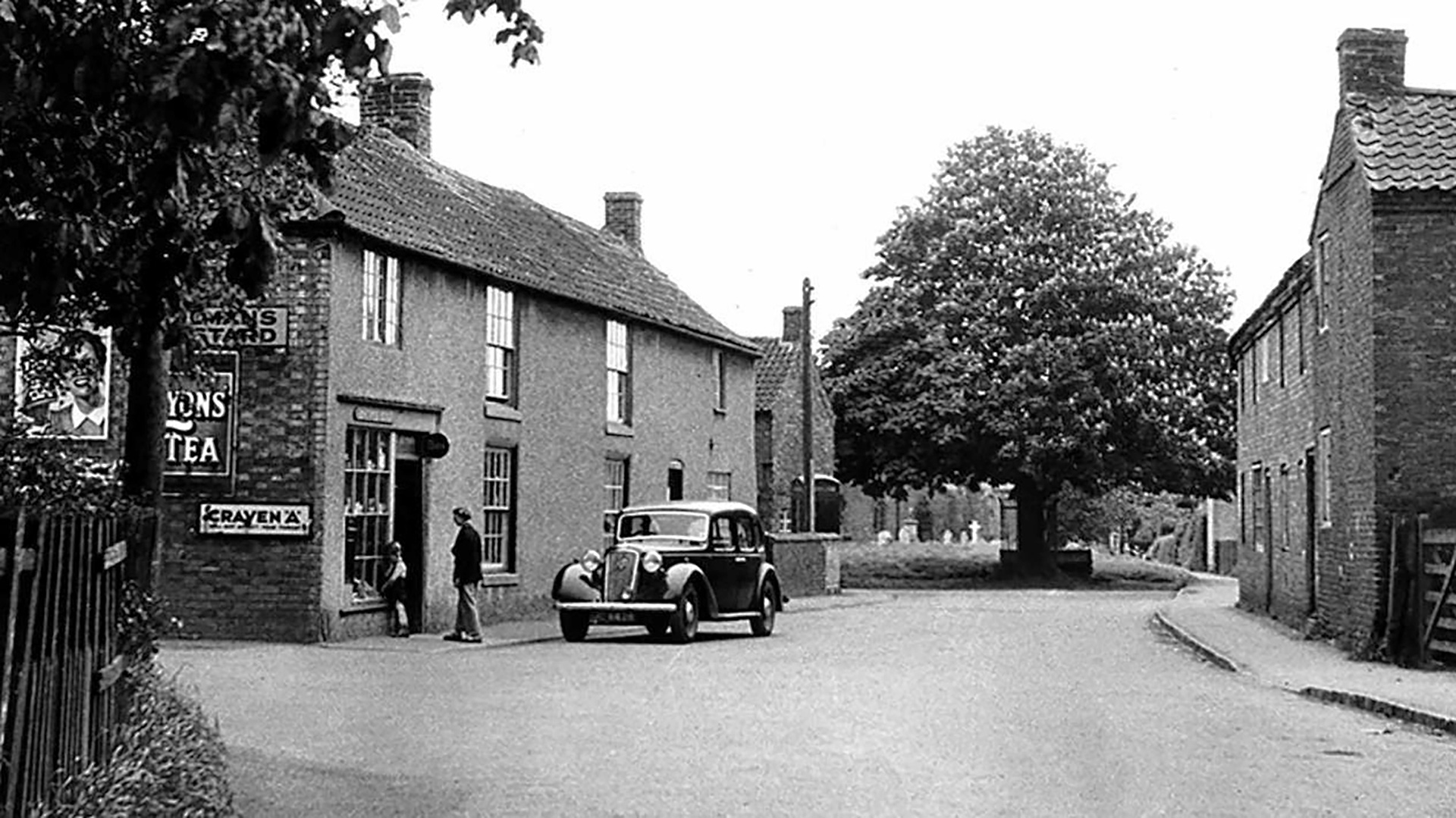
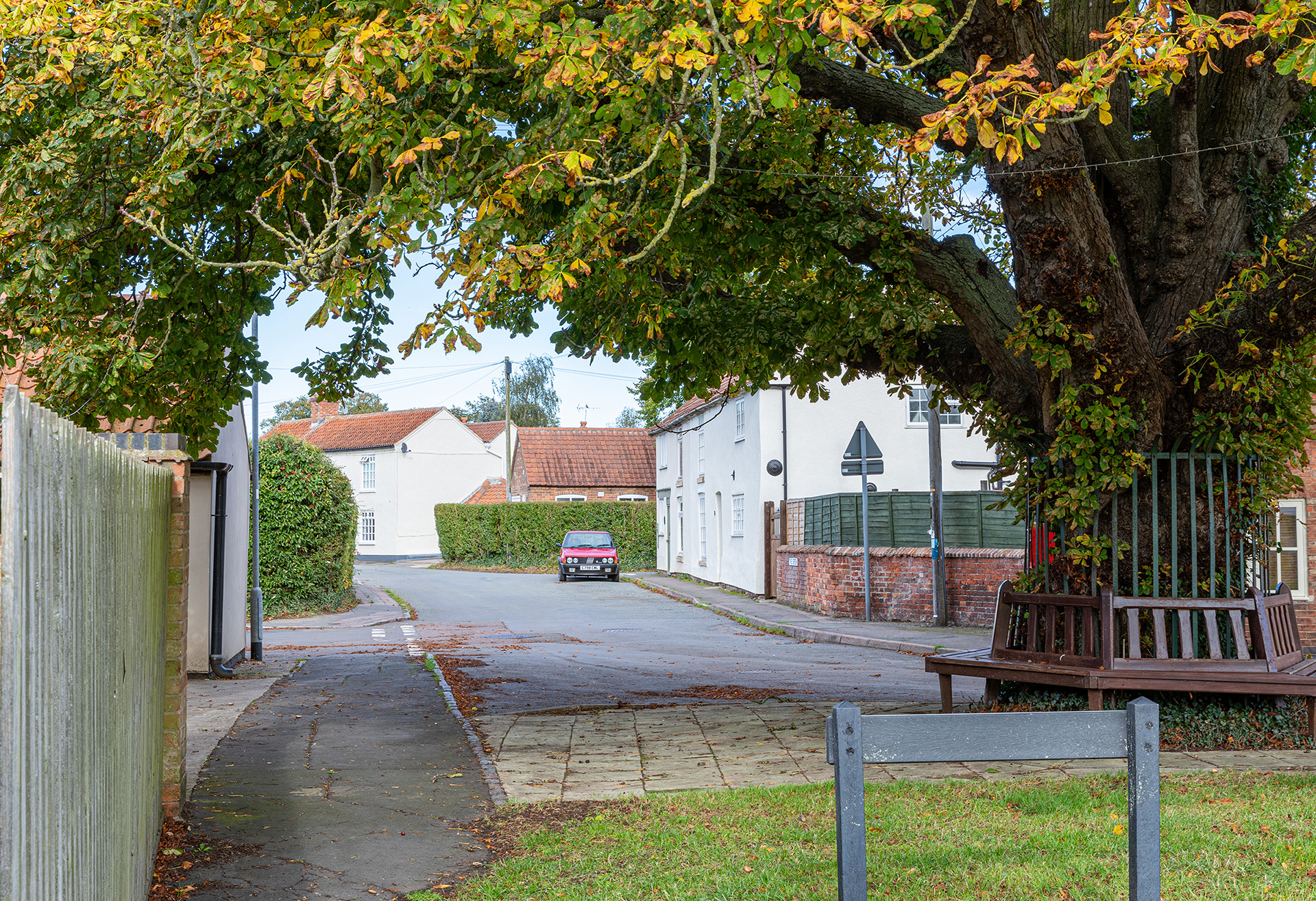
Geoff recollected: “The horse chestnut or conker tree was planted in 1897 for Queen Victoria’s Diamond Jubilee, and after more than 120 years, its trunk is as large as the metal tree guard. It is nearly grown through the rails.” Behind the houses on the right-hand side of the postcard was the bakehouse and bakery. Geoff continued: “The two houses on the right were taken down in the 1950s because they were all derelict. The old photograph was taken in the late 1940s. The car in the old picture is an Austin.”
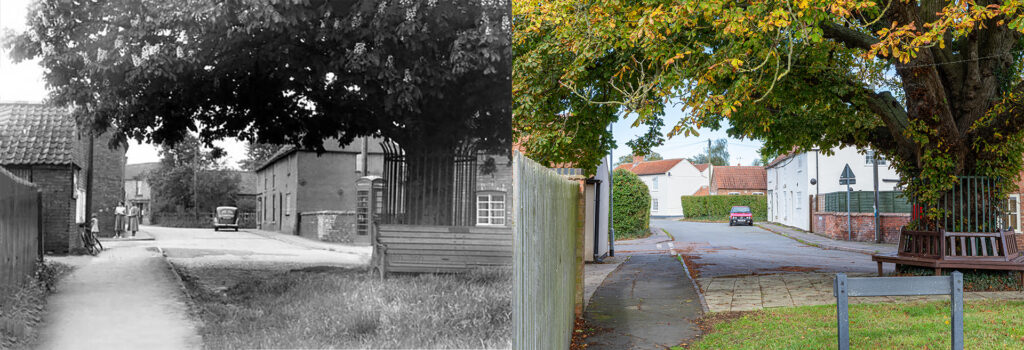
Is the same Austin in this postcard, taken from the other side of the horse chestnut tree? Possibly. On the left behind the wooden fence lies the old vicarage. “There I was born”, said Geoff, “in the shadow of the horse chestnut tree in bloom in the old picture. That must have been taken early May.” “It is the second old vicarage, built close to the church on what is now Church Walk”, added Jim. The old and new photographs are taken from that path, that runs up to St Michael & All Angels Church on Bolton Lane.
The first building on the left is the bakehouse, and further on, the two earlier mentioned derelict houses. At the back, the now whitewashed, was Hirsh shop. He was a bus driver. Next is the old Post Office. Geoff continued: “Hidden by the horse chestnut tree trunk is a part of two cottages dead opposite the church entrance. They were built in 1625 as single cottages when King James I was on the throne. They made two-story in 1934.”
On the right-hand side of the tree lies a unique green space with a playing field. Jim explained: “When most of the Belvoir Estate in the village was sold in 1923, the executors of the Duke of Rutland donated the old vicarage garden to the Hose residents. Since then, it is administered by trustees.”
Bolton Lane
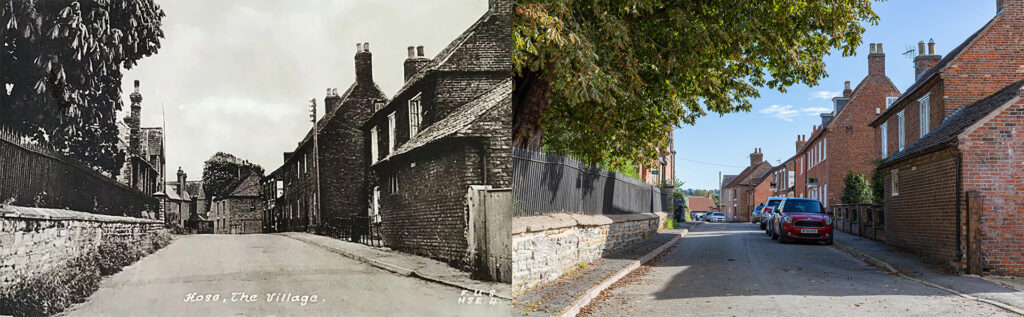
Bolton Lane looks like an extraordinary name in a village. Geoff explained: “We are not sure what is the origin of that street name. All I can say is that the houses on the bottom of the street, when you come into the village, were known as Bolton Cottages. Probably somebody with the name Bolton lived there.”
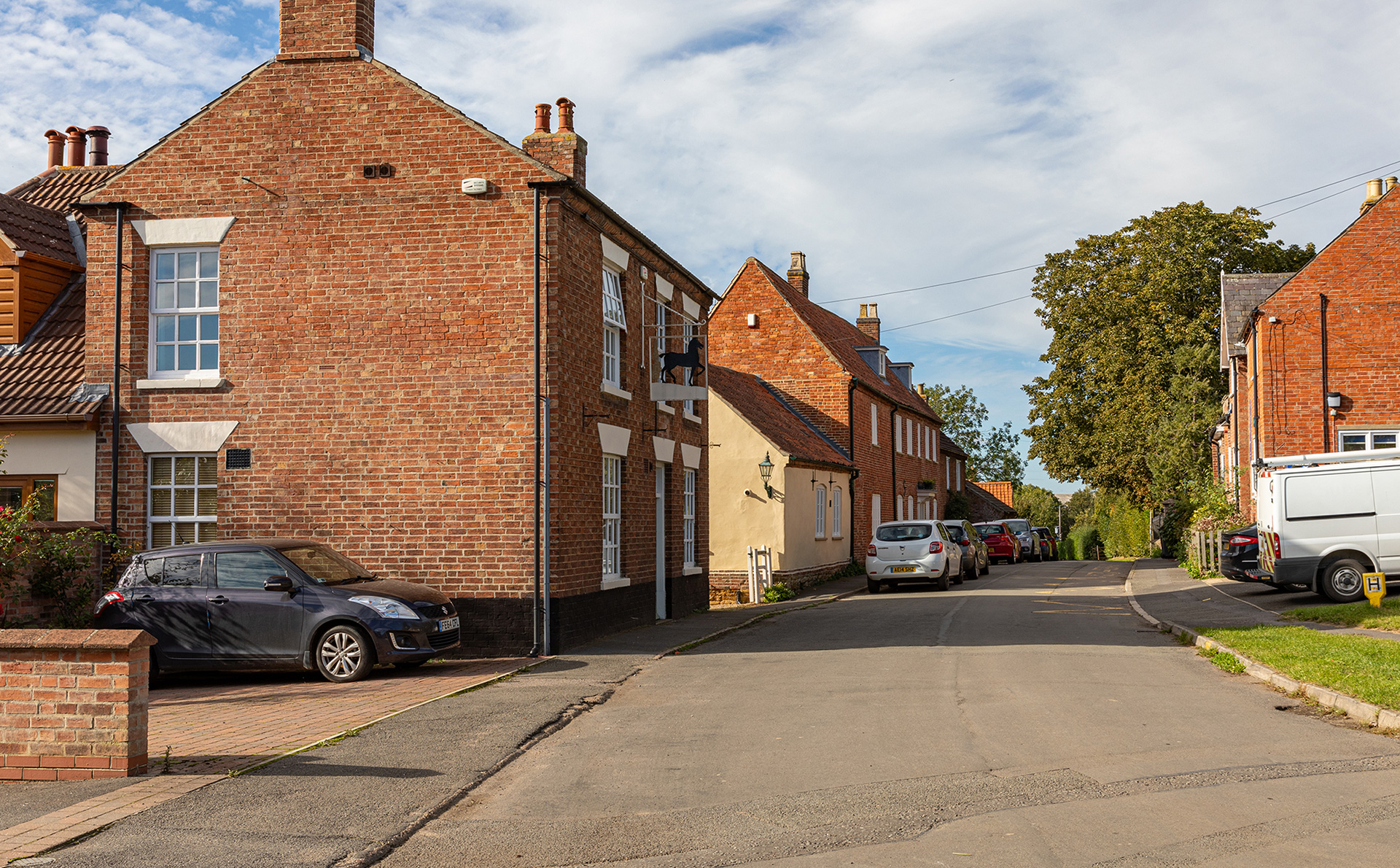
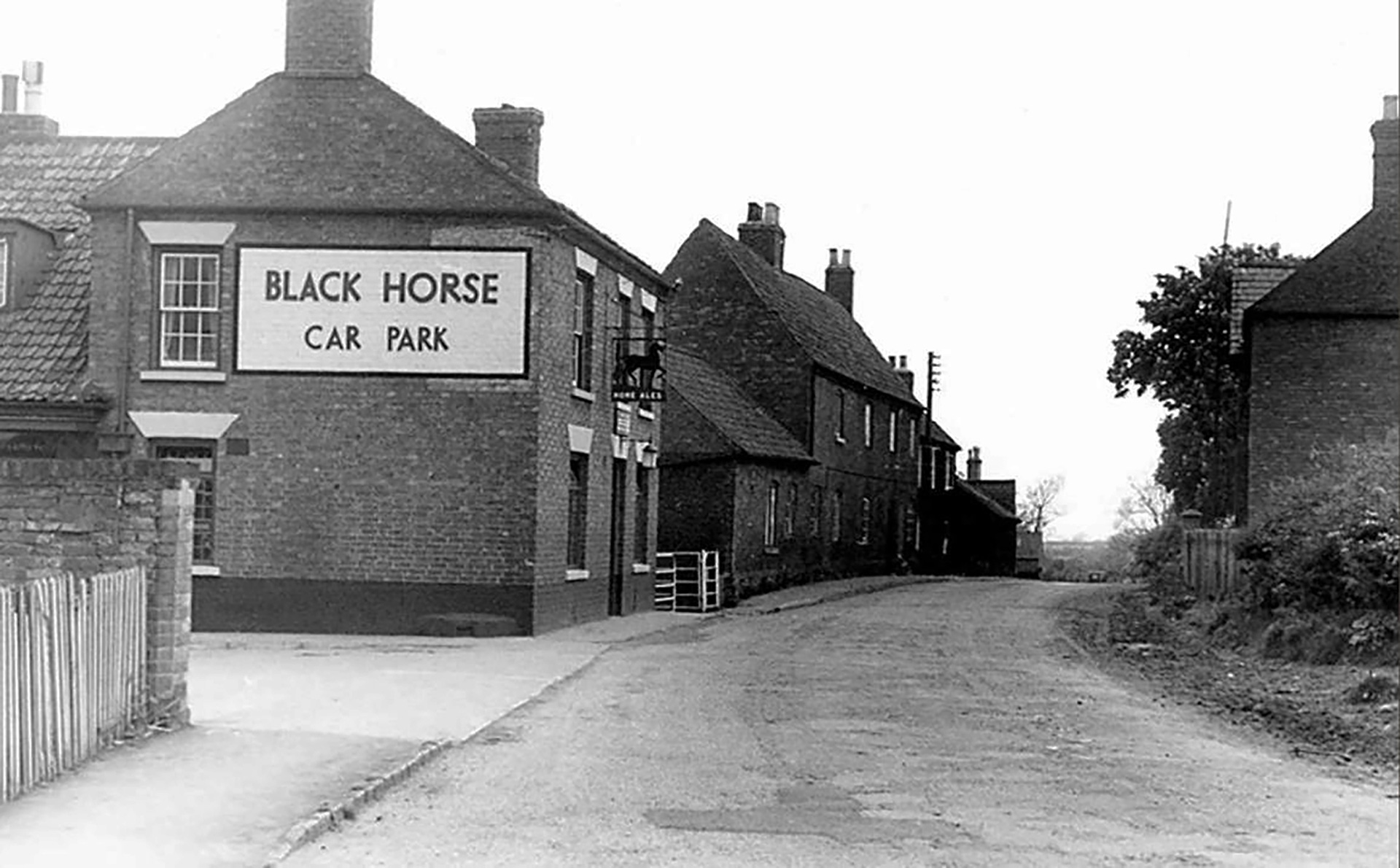
On the left side, you can see the old railings of Saint Michael and All Angels Church. Adjacent to the church is the village primary school and at the back on the left was Mayfield Farm, which got demolished around 2000 and four properties were built. To the right, in front is The Farm, a working farm in the heart of the village. The farmhouse got built on the brink of the 1800s and has an originally attached pump. Both house and pump are a Grade II listed feature. The Farm was formerly part of the Duke of Rutland’s Belvoir estate. Next is what is called the Old Farmhouse, also Grade II listed, built in the early 18th century. And further on was the Black Horse, a public house.
Geoff starts counting: “Gong back before the war, there were 13 people with little diaries in the village and several bigger farms: Mayfield, Wayfields Farm, The Farm, Stubbs Farm,…”
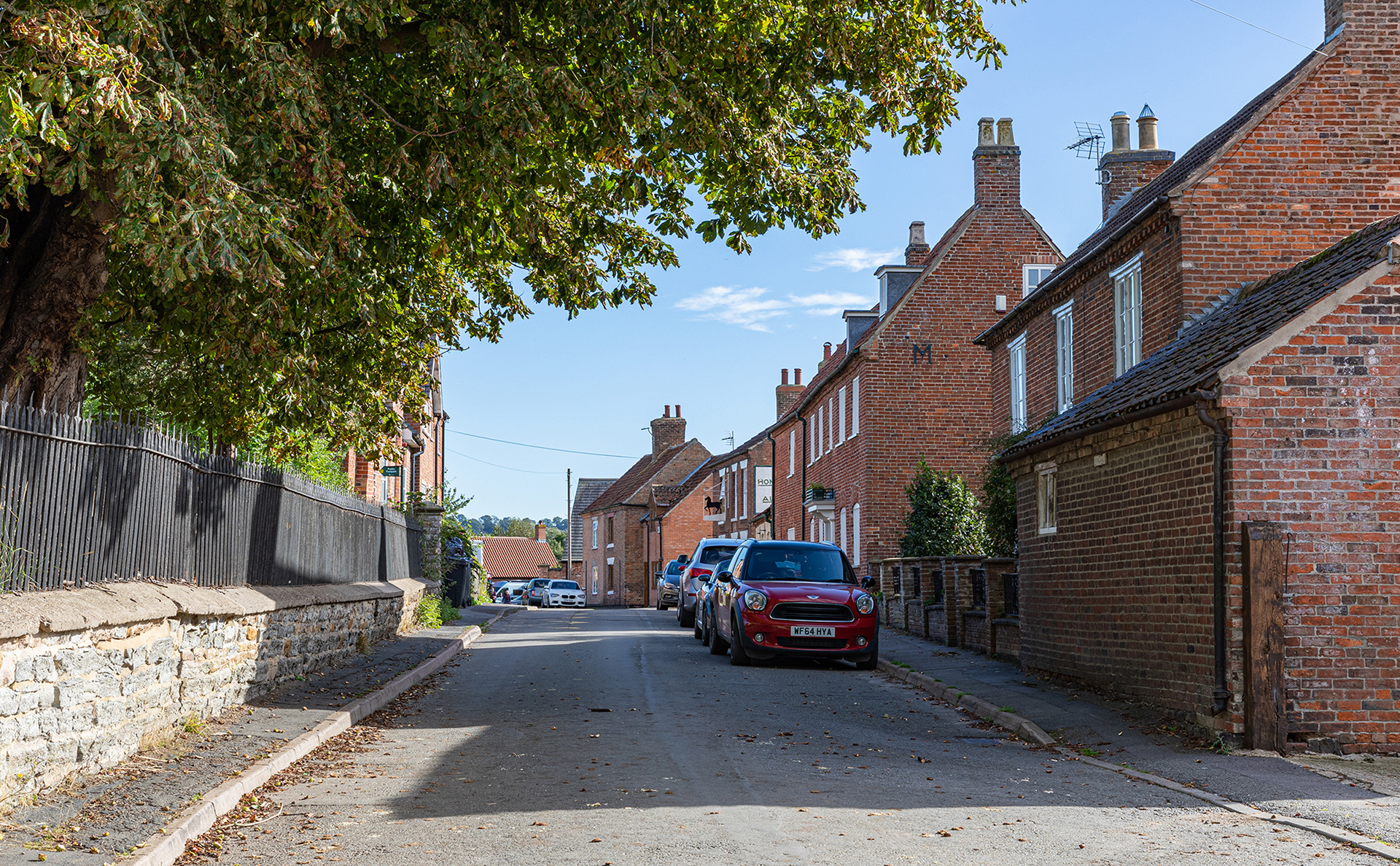
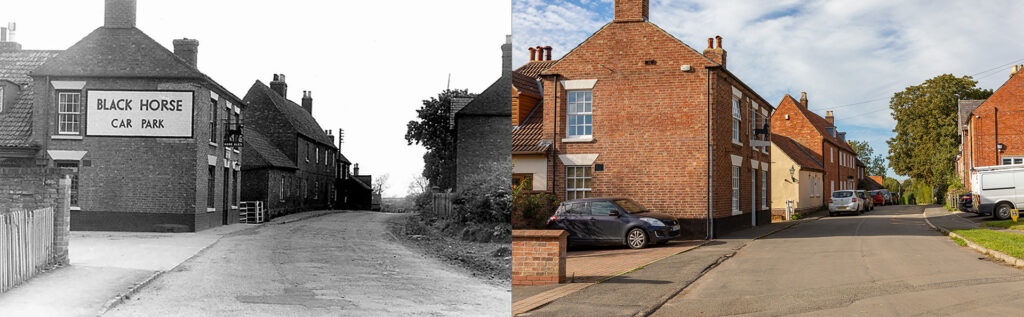
“The Black Horse closed around ten years ago”, remembered Geoff, “and it was vacant for a long time because there is a law that you can’t dispose of a license for several years before it can be sold as a private house.” On the other part of Bolton Lane, there is the Rose & Crown that is still open Asking if there wasn’t any competition between the two pubs, Jim answered with a laugh: “Some people went to the Black Horse and wouldn’t go to the Rose & Crown, and the other way round. And the rest of the village was wearing the path out between the two.”
Junction Bolton Lane and Harby Lane
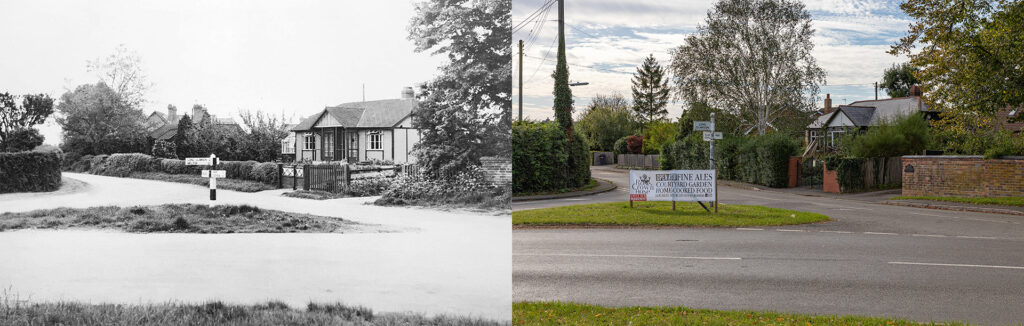
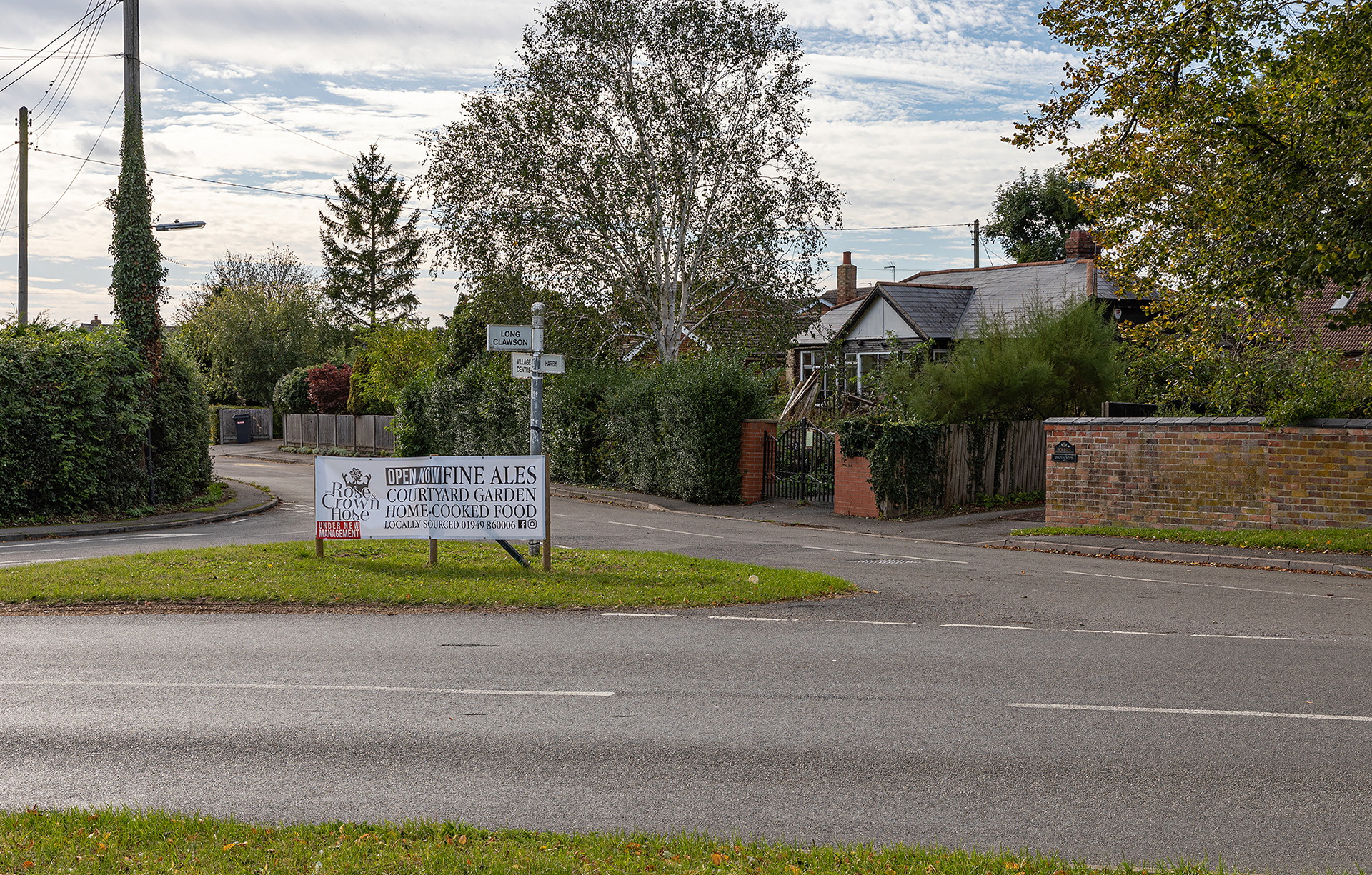
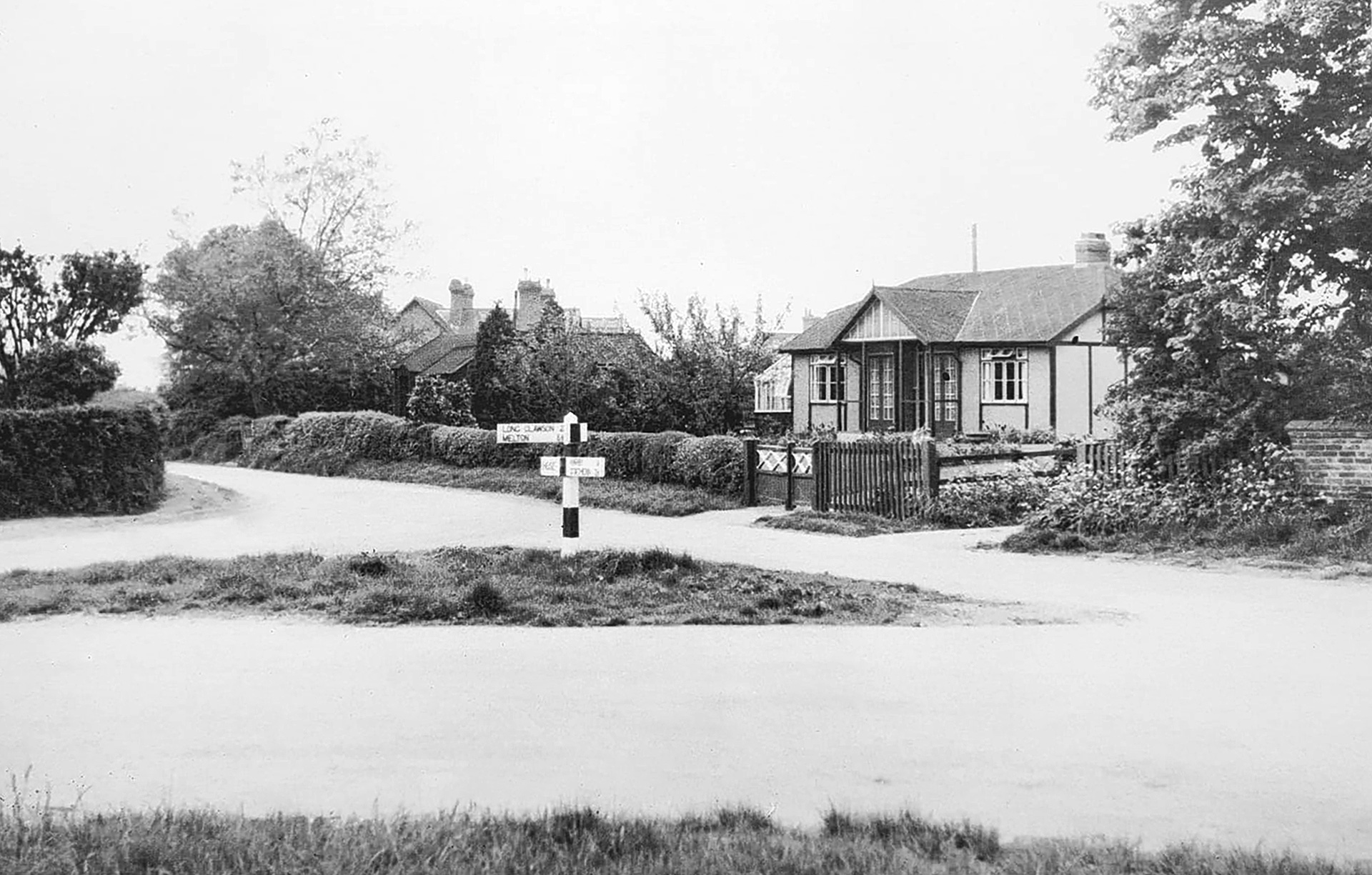
Jim told: “Where the signpost is there used to be a horse chestnut tree, planted the same time as the tree on the village green. An American service vehicle flattened it the Second World War during the blackout.” To the right, there is a lovely house, The Cedars. “That is where I live”, said Sara Thomas. “and I would be very interested to see the photos you have taken.” Jim recollected: “Next to it was a path going from the Spindle Croft to the green, and that was the way you got into the church in the past.” To the left are houses built in the late 1960s. “That land was given to the village by Ms Gibbs for the Hose Village Hall. That was way before the war, but for years nothing happened. Ultimately in the 1960s, somebody had the idea to sell that land for building, so they could build the village hall on the other side of the road, on the allotments. It was opened in 1969”, said Jim. The bungalow will be demolished. Sarah Added: “We know little about the bungalow next door, but planning is underway to build two or three houses on there after we opposed 4 three-storey houses. So another year and it will look completely different again.”
On the village
Geoff told: “As a village in the Vale of Belvoir, Hose is Old English for hills and refers to its position by the escarpment of the Leicestershire Wolds.”
More pictures
Would you like to add pictures? Send a message.
Domesday Book
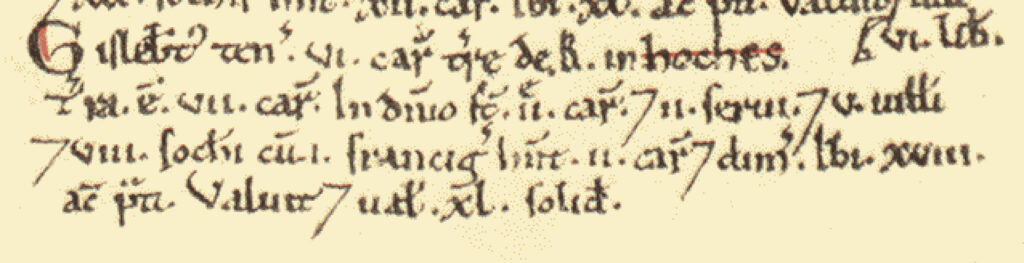
Hose was a settlement in Domesday Book, in the hundred of Framland and the county of Leicestershire.
It had a recorded population of 71 households in 1086, putting it in the largest 20% of settlements recorded in Domesday, and is listed under 6 owners in Domesday Book.
1. Land of Robert of Tosny
- Households: 5 villagers. 8 freemen. 2 slaves. 1 Frenchmen.
- Ploughland: 7 ploughlands. 2 lord’s plough teams. 2.5 men’s plough teams.
- Other resources: Meadow 18 acres.
Valuation
- Annual value to lord: 2 pounds in 1086; 2 pounds when acquired by the 1086 owner.
Owners
- Tenant-in-chief in 1086: Robert of Tosny.
- Lord in 1086: Gilbert (son of Turold).
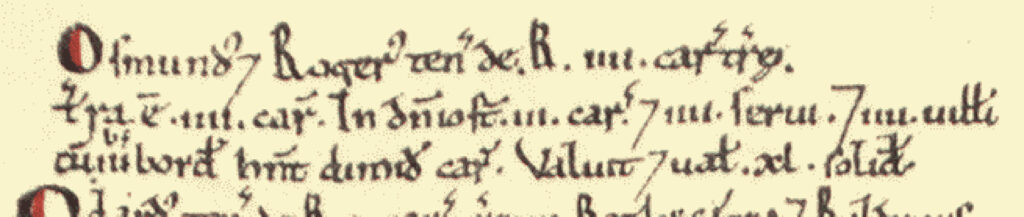
2. Land of Robert of Tosny
- Households: 4 villagers. 3 smallholders. 4 slaves.
- Ploughland: 4 ploughlands. 3 lord’s plough teams. 0.5 men’s plough teams.
Valuation
- Annual value to lord: 2 pounds in 1086; 2 pounds when acquired by the 1086 owner.
Owners
- Tenant-in-chief in 1086: Robert of Tosny.
- Lords in 1086: Osmund (Benz); Roger (of Bosc-le-hard).
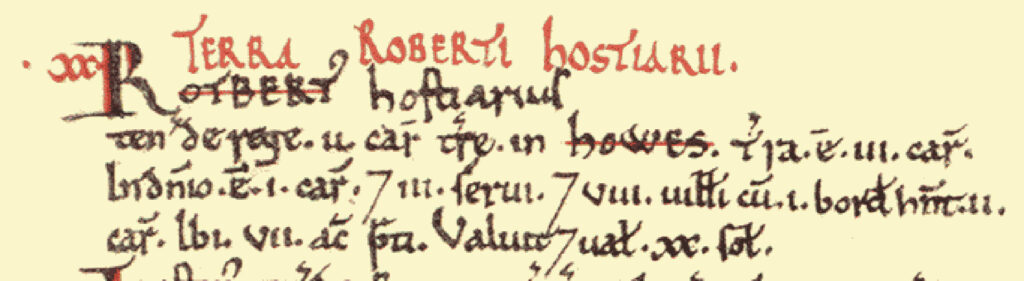
3. Land of Robert son of William
- Households: 8 villagers. 1 smallholder. 3 slaves.
- Ploughland: 3 ploughlands. 1 lord’s plough teams. 2 men’s plough teams.
- Other resources: Meadow 7 acres.
Valuation
- Annual value to lord: 1 pound in 1086; 1 pound when acquired by the 1086 owner.
Owners
- Tenant-in-chief in 1086: Robert son of William.
- Lord in 1086: Robert son of William.
- Lords in 1066: Auti; Ernwy.
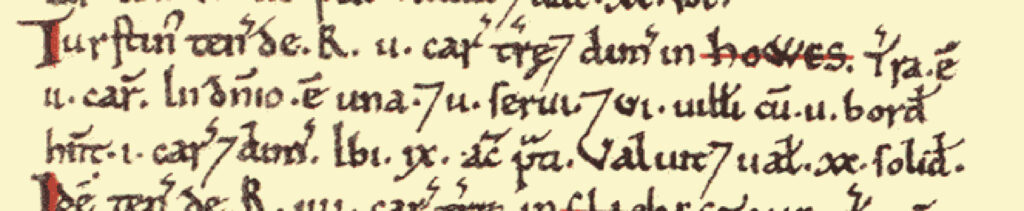
4. Land of Robert son of William
- Households: 6 villagers. 2 smallholders. 2 slaves.
- Ploughland: 2 ploughlands. 1 lord’s plough teams. 1.5 men’s plough teams.
- Other resources: Meadow 9 acres.
Valuation
- Annual value to lord: 1 pound in 1086; 1 pound when acquired by the 1086 owner.
Owners
- Tenant-in-chief in 1086: Robert son of William.
- Lord in 1086: Turstin.
- Lords in 1066: Auti; Ernwy.

5. Land of Robert son of William
- Households: 8 villagers. 1 smallholder. 3 slaves.
- Ploughland: 3 ploughlands. 1 lord’s plough teams. 2 men’s plough teams.
- Other resources: Meadow 7 acres.
Valuation
- Annual value to lord: 1 pound in 1086; 1 pound when acquired by the 1086 owner.
Owners
- Tenant-in-chief in 1086: Robert son of William.
- Lord in 1086: Robert son of William.
- Lords in 1066: Auti; Ernwy.

6. Land of Robert son of William
- Households: 6 villagers. 2 smallholders. 2 slaves.
- Ploughland: 3 ploughlands. 1 lord’s plough teams. 1.5 men’s plough teams.
- Other resources: Meadow 9 acres.
Valuation
- Annual value to lord: 1 pound in 1086; 1 pound when acquired by the 1086 owner.
Owners
- Tenant-in-chief in 1086: Robert son of William.
- Lord in 1086: Turstin.
- Lords in 1066: Auti; Ernwy.
4 responses to “Hose”
I really found that interesting, I was born in what was 3 Harry Lane in 1949
Thank you for your comment, Denise. You probably mean Harby Lane, no?
I used to live in the Old Farm House (Probyns)
Hello Clare,
You can share your memories in the comments if you like.
Regards,
Estelle