
For a year, photographer and history researcher Estelle Slegers Helsen has wandered around Lochaber in the footsteps of W.S. Thomson MBE (1906-1967). Estelle has made a series of remakes roughly 70 years after Thomson originally depicted the landscape. She has talked to local people along her journey and now Estelle will be taking you to the different places in Lochaber. This is article #9.
Loch Shiel and the Glenfinnan Monument
These days, Glenfinnan, situated at the head of Loch Shiel, is one of Scotland’s most well-known tourist hotspots, where history meets fantasy. Between the end of the 1940s and the 1950s, the Scottish photographer W.S. Thomson frequently travelled on the ‘Road to the Isles’ from Fort William to Mallaig, then still a single-track road.
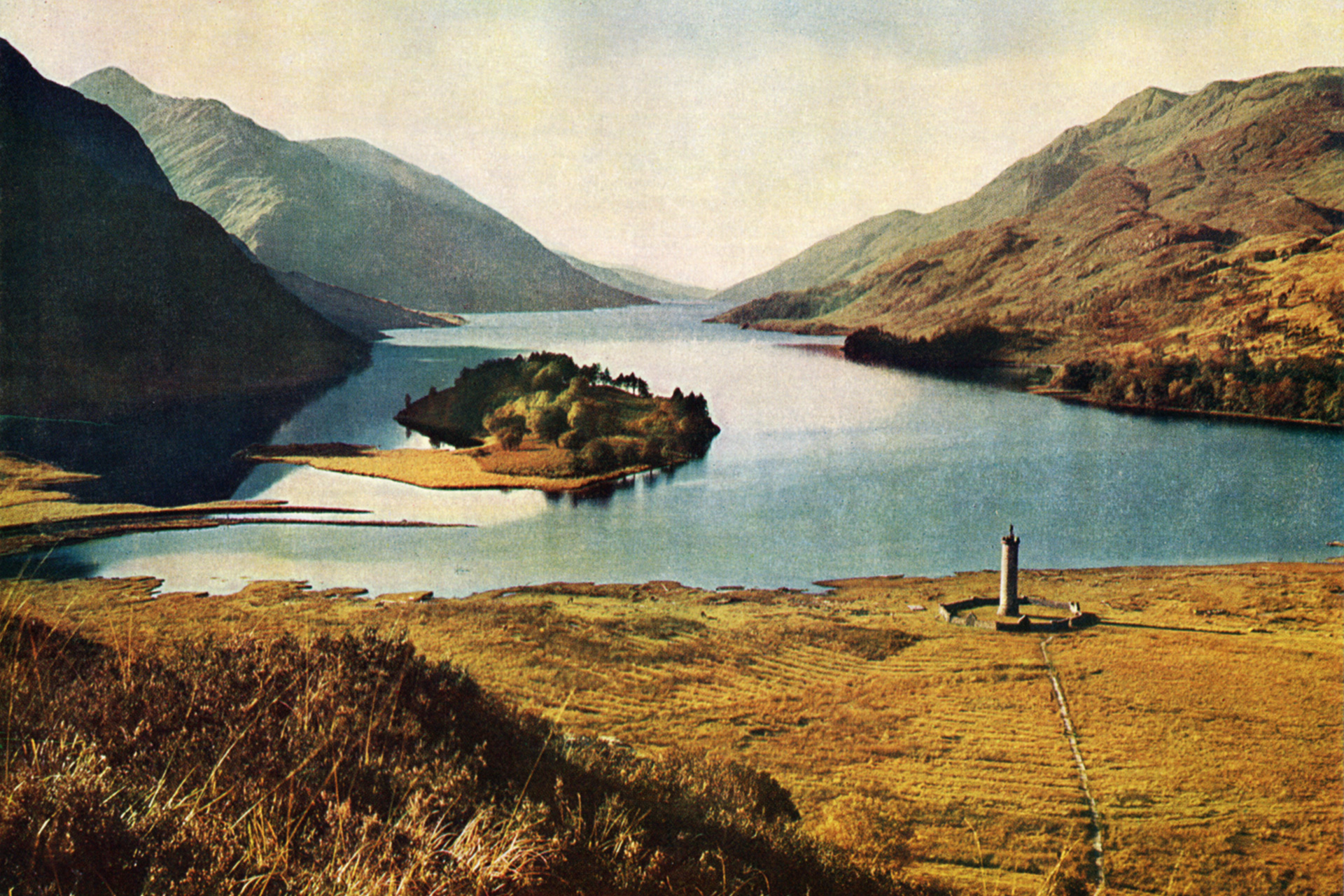
For Thomson, the Glenfinnan Monument, built in 1815 by a minor branch of the Clan Donald to commemorate the raising of the standard of Bonnie Prince Charlie, MacMaster of Glenalandale, on 19 August 1745, was the perfect excuse to take a break in Glenfinnan, climb a short way uphill and photograph a historical scene. So far, I have found nearly ten different black and white and colour photos focussing on the 59-foot tower designed by the Scottish architect James Gillespie Graham, the elongated Loch Shiel and the surrounding hills on the north and south banks of the loch.
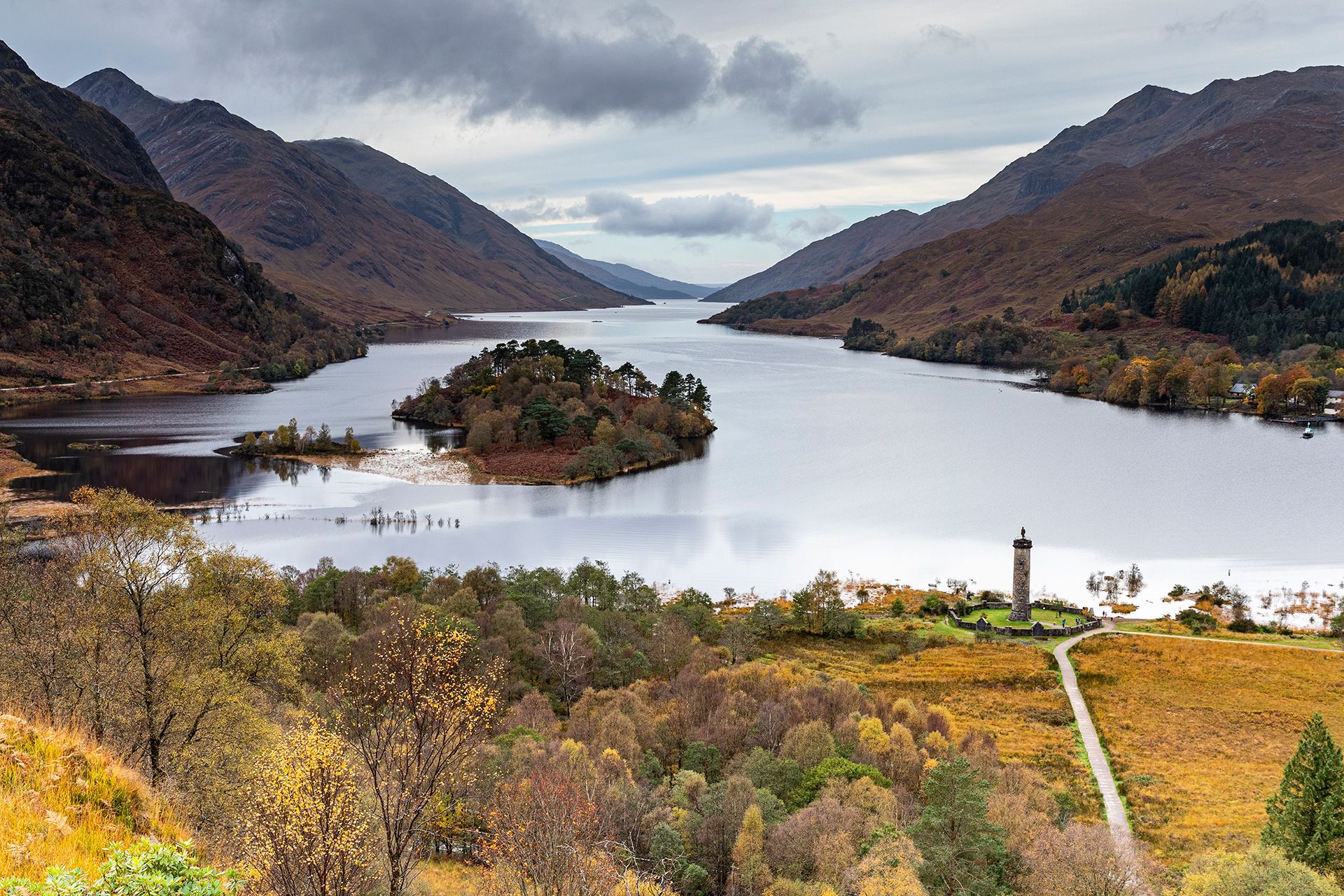
The scene is one of the first remakes I worked on after starting the Lochaber Series in late October 2021. I am one of many people following the short trail to the Glenfinnan Viewpoint on this cloudy morning. And I am the only one to leave the track and go uphill before reaching the viewpoint to point my camera towards the Glenfinnan Monument, not the Glenfinnan Viaduct.
The explanation for why everyone else is heading for the viaduct is simple. The monumental 21-arched viaduct constructed by Sir Robert McAlpine between 1897 and 1898 has come to prominence since the fantasy film ‘Harry Potter and the Chamber of Secrets’ was released in 2002. In this film, West Coast Railways, the operators of the Jacobite steam train, provided the steam engine and carriage for the Hogwarts Express, which featured in the Harry Potter films. So, when The Jacobite is scheduled to cross the viaduct, hordes of Potter fans congregate for snapshots and selfies.
Minutes after the train disappears out of sight, leaving only a steam plume, everyone returns in a seemingly never-ending queue to the car park; everyone except me, who is looking for another spot where Thomson stood to take another shot of the same scene, but from a different angle.
When returning to the Glenfinnan Monument Visitor Centre a few hours later, I meet Karen Clark of the National Trust for Scotland for an interview with the monumental tower as a backdrop.
‘The monument behind me has been in our care since 1938,’ she explains, although Karen only recently joined the NTS staff. ‘I like to tell people that the reason I am here is not so much to do with the viaduct that is connected to a certain wizard, but because of a monument commemorating all the lives lost during the Jacobite uprising, when Bonnie Prince Charlie came over from France to reclaim the Kingdom for his father.’ For Karen, it is not about us versus them but about ‘we’.
When I climb the tower late in the afternoon, I find myself at the top in the company of the statue of an unknown Highlander, which was added to the tower in 1835. The sky is blue, but the sun has descended too far over Loch Shiel for another remake.
Let’s have a further look at the then-and-now photographs.
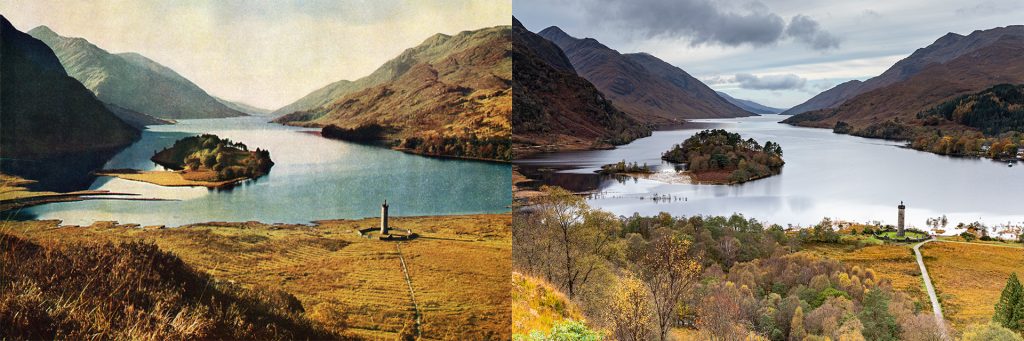
On the left of both photographs, Callop River runs into Loch Shiel. In one of Thomson’s black and white photographs, printed in Let’s See. Mallaig and the Road to the Isles, the steamer, the Clanranald II (see Acharacle story), is nearing Glenfinnan Pier.
Lord Morton allowed the pier to be built a few hundred yards upstream of Callop River, at the northeast end of the loch, because Macdonald of Glenalandale objected to the construction of a pier in deep water below his house in Glenfinnan, where it would have been in the heart of the hamlet. In the remake, a modern pier is visible on the far right.
As far as I am aware, the island of Eilean Ghleann Fhionainn, just off the banks of Loch Shiel, has no particular history. More and taller trees have covered the island in the 70 years between the two photos.
In general, many more trees have been planted as part of a regeneration plan and dominate the landscape, particularly to the left of the Glenfinnan Monument and the first hill on both sides of the loch.
In the remake, it looks like the Glenfinnan Monument is sinking into the freshwater Loch Shiel, the longest loch in Scotland to have retained a natural overflow without any regulation of its water level. But no, it has been raining a lot in the weeks before the remake. Thomson’s photograph was printed in his pictorial book The Highlands in Colour, published in 1954 by Oliver and Boyd, based in Edinburgh, who also produced Colourful Scotland, two years later.
Move the slider to discover what changed.
Then (left) – Early 1950s © W.S. Thomson – Loch Shiel and the Monument of the ‘45 Rebellion. Published in Highlands in Colour (1954), p. 37
Now (right) – October 2021 © Estelle Slegers Helsen – Loch Shiel and the Glenfinnan Monument, tribute to the Highlanders who fought for the Jacobites during the 1745-uprising. Published in Travel in Time. Lochaber, Scotland (New Traces, 2022), p. 19

Travel in Time – Lochaber Series is supported by the West Highland Museum and the Year of Stories 2022 Community Stories Fund.
Estelle has published a 64-page book with 30 side-by-side then-and-now pictures, which you can find in local shops or buy online. More information available here.