
Main Street – 1920s
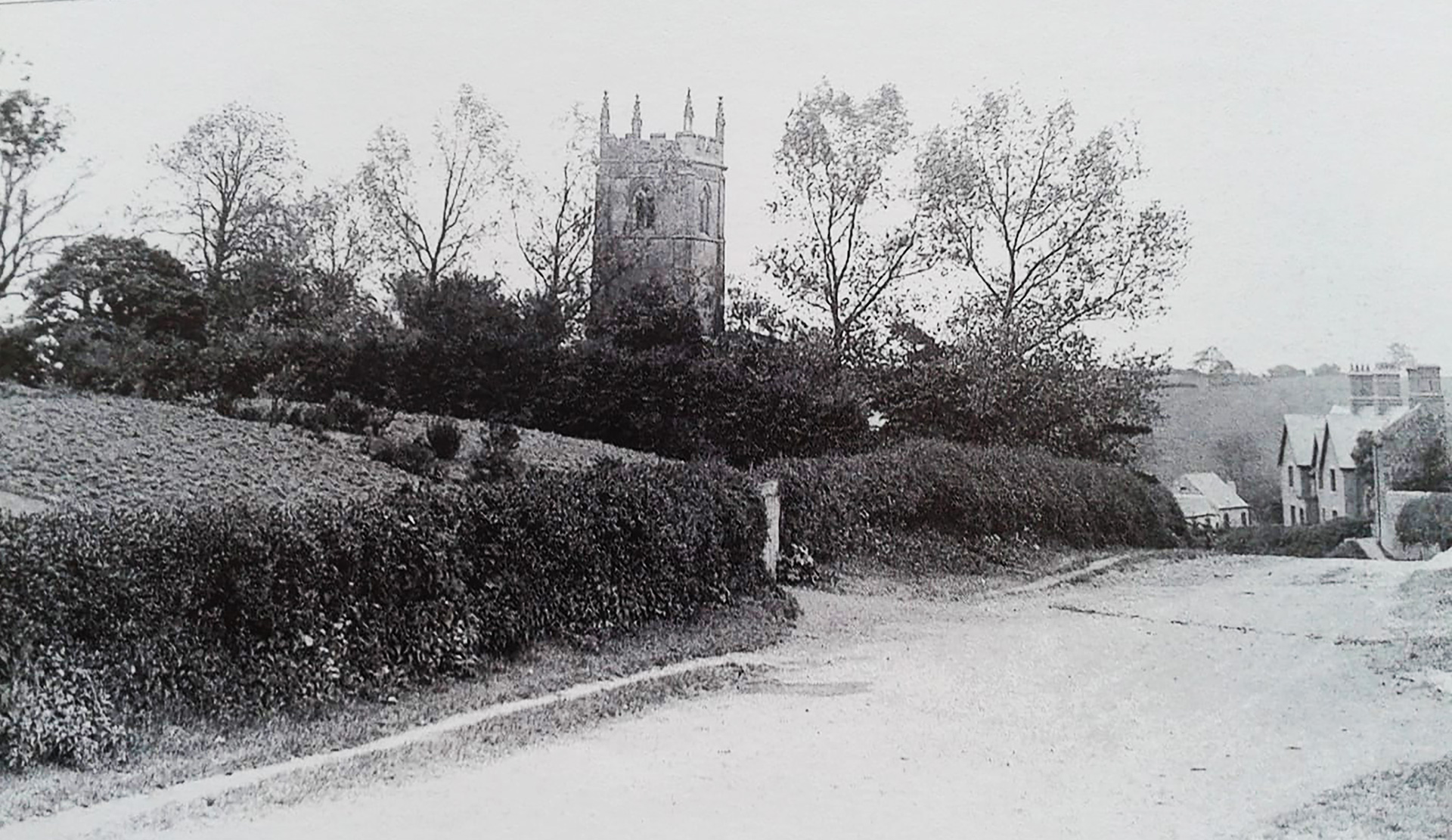
Freeby is primarily a tranquil one-street village with a building style commensurate with estate management. On the lefthand side of the photographer’s location, set upon a bank, is Sykes Row, a terrace of six houses. The red brick and decorative window arches match a series of semi-detached cottages, named Woodbine Cottage, Rosewood Cottage and Rustic Cottage, dotted along the snaking street.
Further on the left, also on a rise, lies St Mary’s Church. In today’s remake, bushes, conifers and pampas grass obscure the view on the church, built with ironstone and limestone. Much of the building is in Early English Style. The tower was built early 14th century, and the clerestory, along with the raising of the chancel, is dated 15th century.
Along the street, which dips into the broader fields, on the right-hand side is a classic K6 telephone kiosk, Coys Farm House, with a built-in Royal Mail post box and a set of three cottages, Highfield Cottage and Primrose Cottages.

Further on, but no more visible in the photos, lies the United Reformed Church, the only property in the village that doesn’t belong to the Freeby estate. Before the early 1970s, the chapel-like building was the Congregational Church, founded in 1665, one of the oldest in the country. Its most famous preacher was the independent minister and evangelical poet Isaac Watts (1674-1748). In 1696, the non-conformist cleric was appointed minister to the Hartopp family of Stoke Newington and Freeby. Watts wrote 600 hymns, among them Jesus Shall Reign Where’er the Sun and O God, Our Help In Ages Past. For sure, the Freeby landscape triggered his imagination.

St Mary’s Church
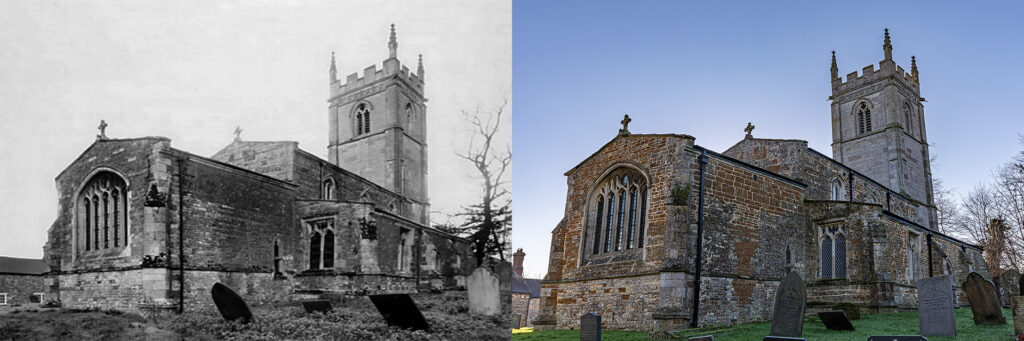
In the 1980s, cracks started appearing in the almost 700-year-old St Mary’s Church. At the turn of the century, the historic building was in a poor state of repair. The structure was considered unsafe, and it was closed. The parishioners from the village of 40 people couldn’t possibly raise enough cash to restore it. English Heritage offered £132,000, but the restoration bill would by far exceed that amount, so no action was taken. On top of that, a survey published a few years later, in 2010, by that same organisation was not good reading. The soil underneath St Mary’s had started sinking. Churchwarden Mel Greaves said: “We were in despair, and we did think the church was going to be knocked down. But at the last moment, in 2015, the Churches Conservation Trust stepped in and restored our 14th-century church. In the early autumn of 2016, St Mary’s Church was reopened after 13 years. A satisfied Rev Kevin Ashby said: “The roof was in danger of falling in, the walls were in danger of falling out, and bat droppings covered the floor. It looked like the Addams Family home.” The restoration also involved protecting a maternity roost for Natterer’s bats. £450,000 was spent, paid by contributions from English Heritage, the Churches Conservation Trust and the Church of England.


On the village
In 1227 the Despenser family came to Freeby. The notorious Hugh Le Despenser was the gay friend of the gay King Edward II. “The short reign of Edward II is commonly seen as a disastrous period in English history,” states the English Heritage website. The king’s downfall was due in part to his reliance on his ‘favourites’, Piers Gaveston and Hugh Despenser, who were rumoured to be his lovers.” It led to the deposition and death of King Edward II and Despenser’s wife Elinore, the niece of the King, becoming Lord of the Manor of Melton in 1328, temporarily dispossessing the Mowbrays. The site of the Despenser manor is generally agreed to have been northeast of St Mary’s Church, just to the rear of the present late-17th century manor house.
Eventually, the Hartopp family had the lordship on Freeby, although they were on the Cromwellian side in the Civil War and were leading non-conformist worshippers in the area.
The estate was sold in the 1800s to Daniel Thwaites of the Lancashire based brewery and passed to his daughter Elma Amy, Robert Armstrong Yerburgh’s wife. In 1897, the trustees set up a limited liability company known as Woodfold Estates, still managing the Freeby estate.
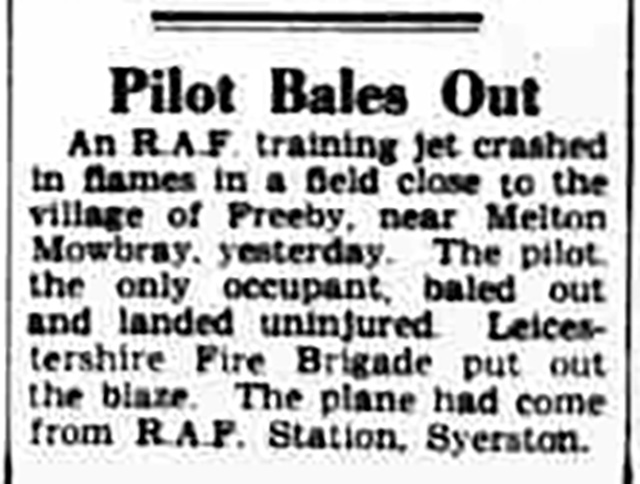
A search in newspaper archives unearthed a short article on an RAF training jet crash in late spring 1960.
Would you like to add your story and recollection? Leave a comment at the bottom of this page or send a message.
More pictures
No additional pictures.
Would you like to add pictures? Send a message.
Domesday Book
Freeby was a settlement in Domesday Book, in the hundred of Framland and the county of Leicestershire.
It had a recorded population of 18.1 households in 1086 (NB: 18.1 households is an estimate, since multiple places are mentioned in the same entry).
Land of Geoffrey of la Guerche
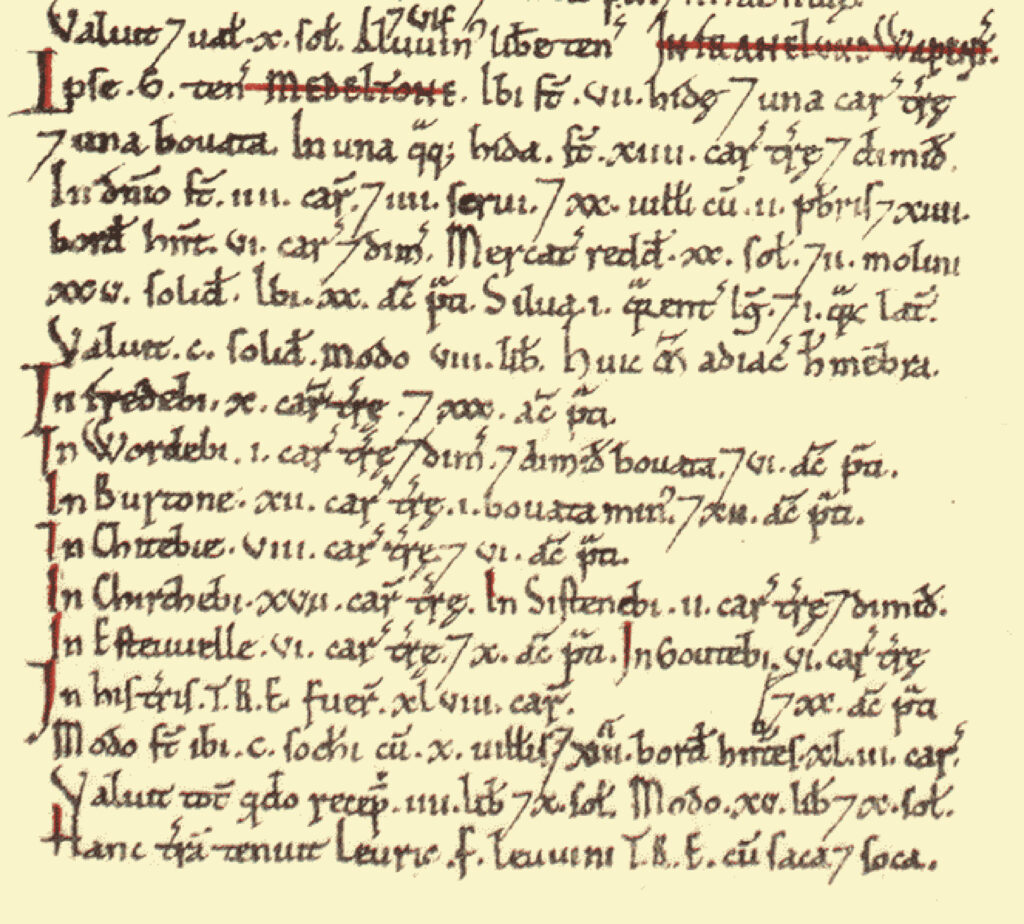
- Households: 30 villagers. 100 freemen. 27 smallholders. 4 slaves. 2 priests.
- Ploughland: 48 ploughlands. 4 lord’s plough teams. 49.5 men’s plough teams.
- Other resources: Meadow 104 acres. Woodland 1 * 1 furlongs. 2 mills, value 1 pound 5 shillings.
Valuation
- Annual value to lord: 23 pounds 10 shillings in 1086; 9 pounds 10 shillings when acquired by the 1086 owner.
Owners
- Tenant-in-chief in 1086: Geoffrey of la Guerche.
- Lord in 1086: Geoffrey of la Guerche.
- Lord in 1066: Leofric (the noble) son of Leofwin.
Links
Would you like to add a link? Send a message.