Photographer and historical researcher Estelle Slegers Helsen has been wandering around Lochaber in the footsteps of the Scottish photographer W.S. Thomson MBE (1906-1967). Since 2021, she has taken photographic remakes for roughly 75 years after Thomson initially captured the landscape and has talked to local people along her journey. This is article #20

In Thomson’s first publications of his Let’s See series, published in the late 1940s, about a dozen photographs highlight views of Glen Nevis, one of Scotland’s most iconic glens. Most photos, taken from the Youth Hostel up to Upper Glen Nevis, ‘where the road ends’, are black and white. Only a few are in colour. The highlighted photograph is an example.
The photo with the man in a typical Scottish outfit looking southeast to Sgùrr a’ Mhàim (left) and Stob Bàn was printed as a postcard, taken early 1950s. Of course, the question arises: ‘Who is this man?’
I get in touch with Ewen A. Cameron of the Glen Nevis Estate. He says: ‘I have spoken with my elder brother, and we understand the kilted man in the older postcard picture is very likely Mr W S Thomson himself, although neither of us can say definitely.’
Ewen continues: ‘The group of beech trees, now mixed trees, showing across the river, is an old burial ground with a low wall surround. The location, where the river is very broad and therefore shallow, would have made it convenient to cross, especially if carrying a coffin. There were ancient habitations and signs of tilling ground near the burial ground and other locations in the glen.’
So the question remains…
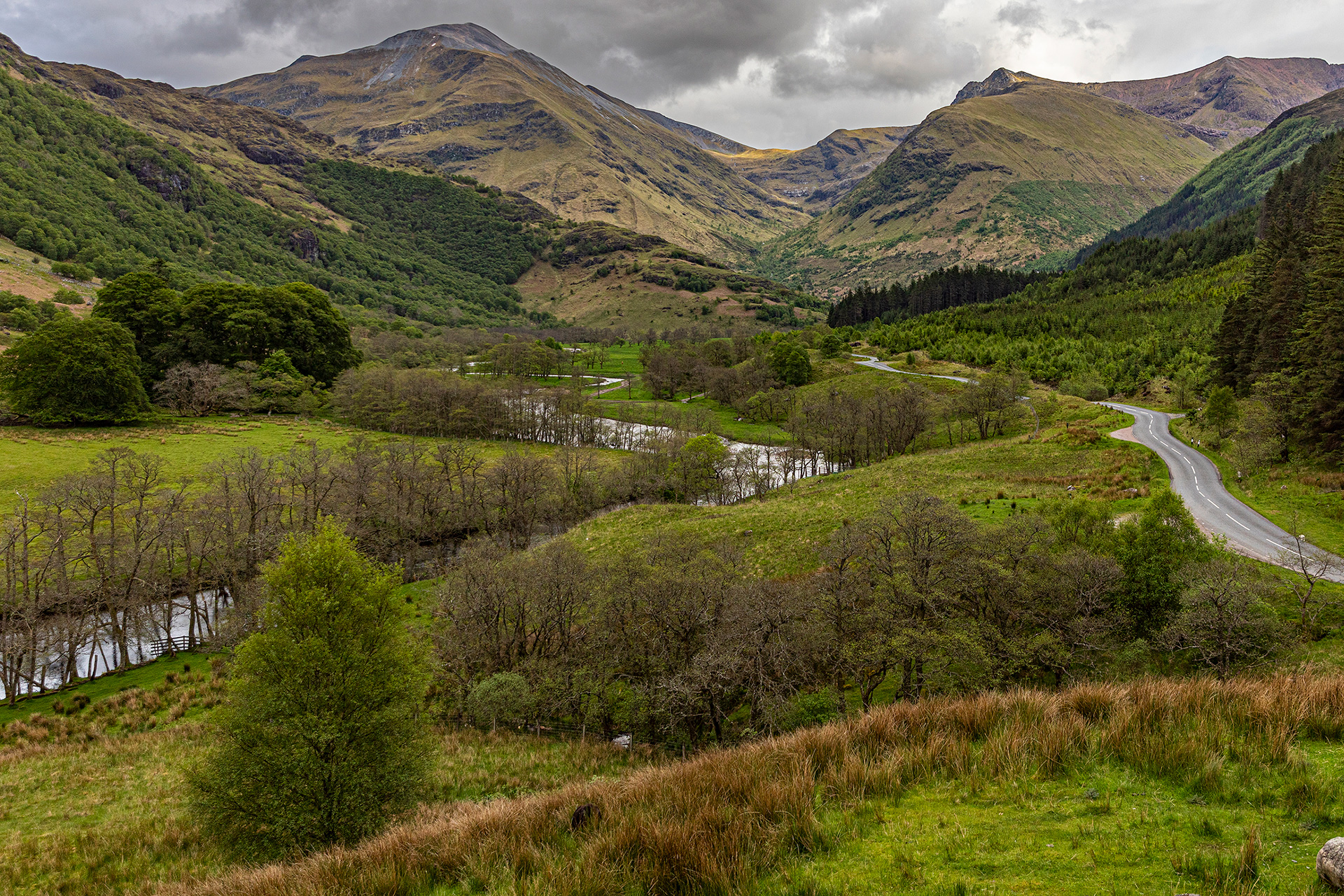
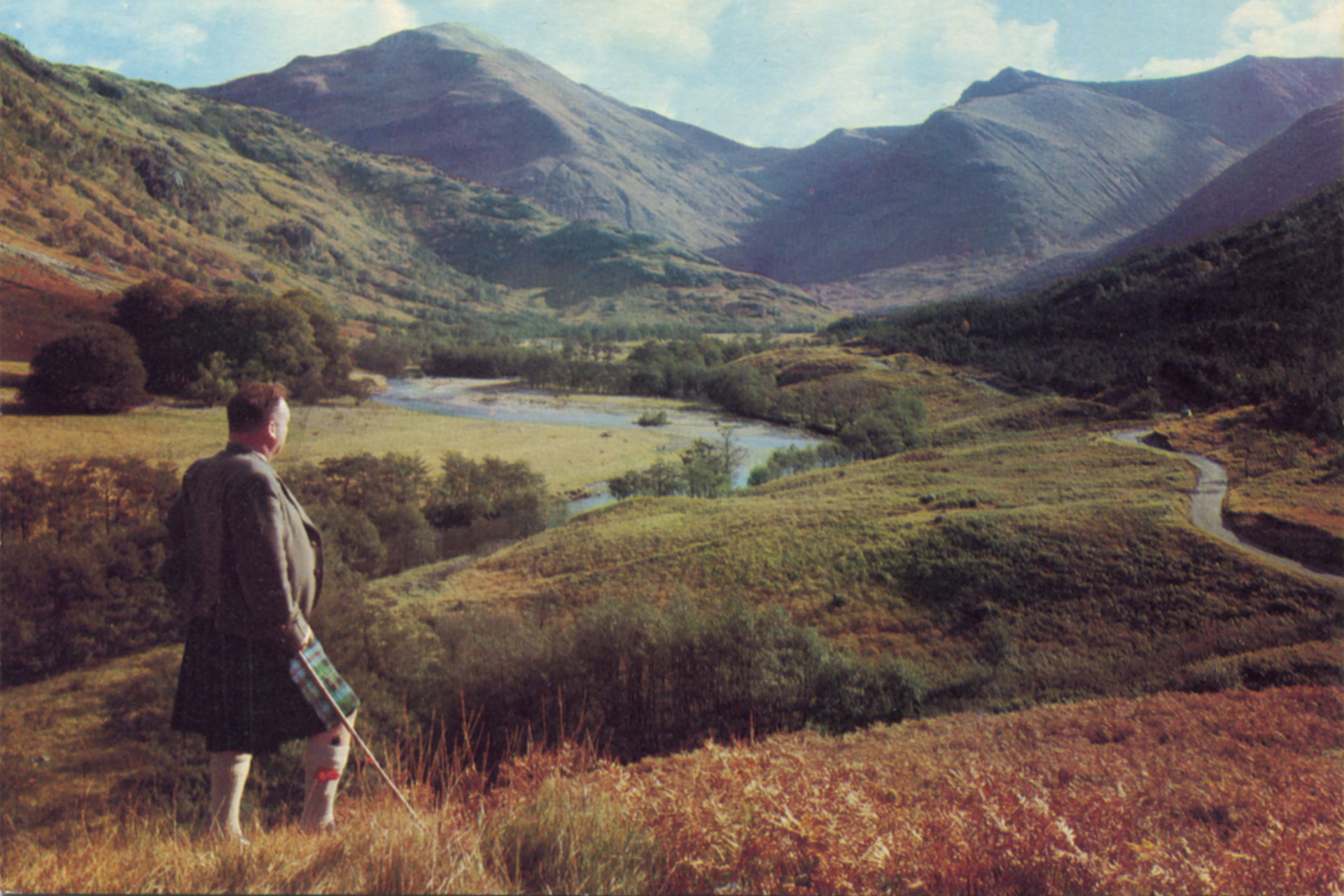
Move the slider to discover what changed.
Then (left) – Early 1950s © W.S. Thomson – Glen Nevis, near Fort William, Inverness-shire, one of the finest glens in Scotland. The view is looking south-east to Sgurr a’Mhaim (3601 ft.) and Stob Ban (3274 ft.) peaks of the Mamore Forest. Printed and published as postcard #3473 by J. Arthur Dixon, Ltd., Inverness.
Now (right) – May 2022 © Estelle Slegers Helsen – View looking south-east to Sgùrr a’ Mhàim and Stob Bàn. Published in Travel in Time. Lochaber, Scotland (New Traces, 2022), p. 11.
In early 1945 W.S. Thomson settled in a dwelling called Earnisaig at 3 Cameron Square in Fort William with his wife Elizabeth and their two young children, Alastair and Fiona. After five years on Orkney, it allowed Thomson to reconnect with his mountaineering friends and simultaneously shift his photography work towards capturing landscapes, his true passion.
On New Year’s Day 1946, the photographer was one of the founding members of the Lochaber section of the Junior Mountaineering Club Scotland at a meeting held at Kingshouse, Glen Coe. The section members preferred the name Lochaber Mountaineering Club, as it is also remembered by most of the older mountaineers in the area.
Both names are mentioned on a series of Annual Dinner menu cards from 1951 to 1965 as part of the archive of the late Jim Ness, a known figure in the Lochaber mountaineering scene. Almost all cards are illustrated with a W.S. Thomson colour photograph on the front.
Mick Tighe, who is deeply rooted in Scottish mountaineering and is the founder/curator of The Scottish Mountaineering Collection, sent a digital copy of the Minute Book of the Lochaber Mountaineering Club running from December 1956 to September 1968, which unveils W.S. Thomson as an active member.
Over the years, Thomson shared his ideas, made suggestions and used his network outside mountaineering to benefit the group but was never a key figure.
One of the topics discussed during most general and committee meetings was the urge to improve the mountain rescue team in the area in terms of training, equipment and safe places in the mountains.
Maintenance became necessary once the shelter huts were in place, and vandalism was an issue. At the December 1960 Annual General Meeting, ‘Mr Wm.S. Thomson suggested that a Notice be affixed to the shelter huts telling people what the huts were for, i.e. saving life.’
At the end of 1960, an ongoing discussion started for a permanent club room where rescue mountain gear could be stored. The Minute Book unveiled that Thomson came up with a proposal because he was also a Fort William Rifle Club member. At the end of 1962, a small room at the Rifle Range was inspected and found suitable for mountain rescue gear storage. The keys were deposited at the police station.
During these two years, Thomson was vice president of the Lochaber Mountaineering Club. In September 1962, he resigned from the club somewhat unexpectedly because he was moving to Edinburgh.
Like in the remake, taken from a knoll not far from where the village of Lanark in the film Braveheart (1995) was constructed, the man becomes a tree and vanishes in history.
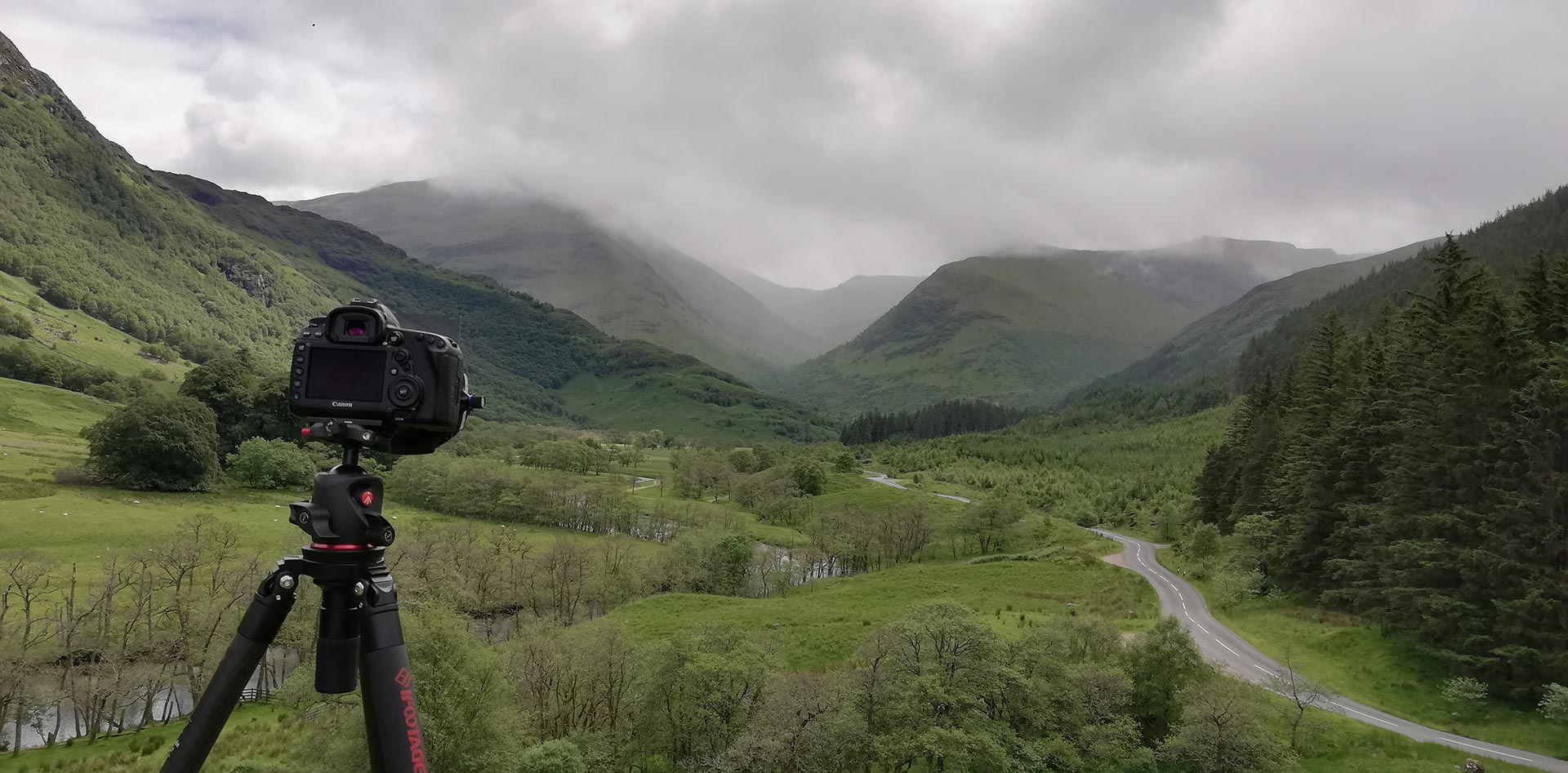
Where I stood for the remake.

Travel in Time – Lochaber Series is supported by the West Highland Museum and the Year of Stories 2022 Community Stories Fund.
Estelle has published a 64-page book with 30 side-by-side then-and-now pictures, which you can find in local shops or buy online. More information available here.
