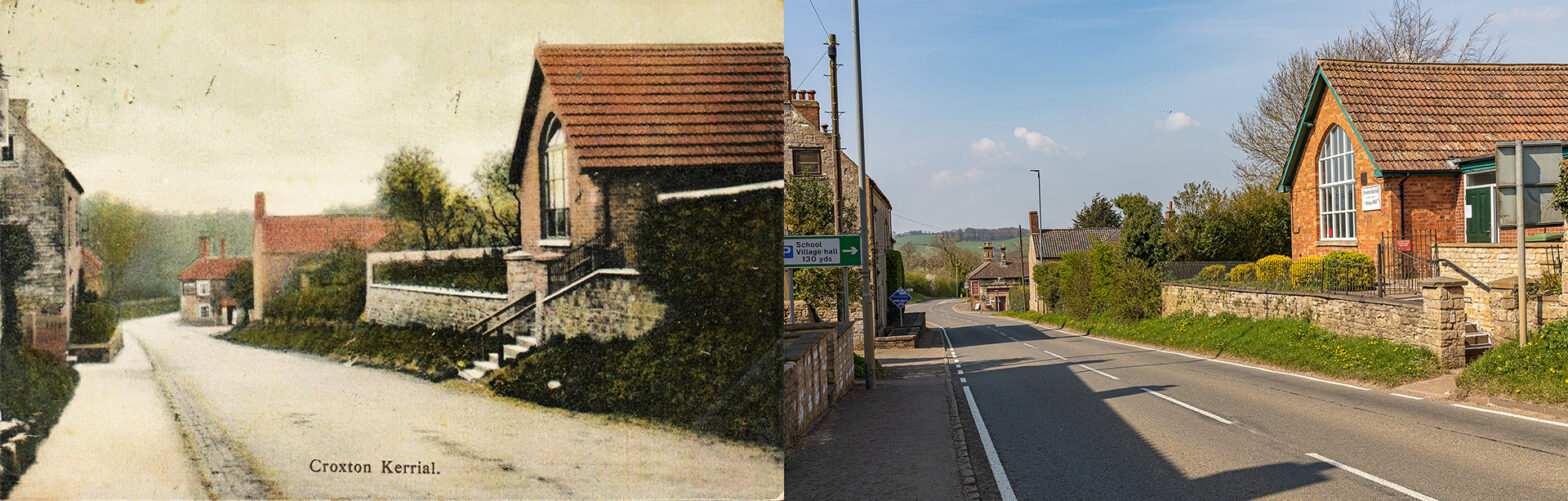
Main Street – 1916
The outline has hardly changed in more than a century. For sure the traffic got busier and speeding along the main A607 remains a problem in Croxton Kerrial. Avoiding being blown away by the passing lorries, I keep an eye out behind me. I can understand if drivers ask why my camera is set on the fringe of the pavement, nearly on the road, looking for the old photographer’s spot.
On the left is Hillside Farmhouse, one of only a few Grade II listed buildings in the village. Down to the right is the village pub, The Geese and Fountain. “It will always be The Peacock Inn to me”, says Jenny Elizabeth full of nostalgia. The original name is linked to the Dukes of Rutland, having a peacock as their Manners family crest In 1916 the publican was Robert Knott. “The Duke’s Belvoir Estate sold off the pub in 1922, so it hadn’t been in his hands for over 90 years”, explains Nick Holden. “The pub had been closed for four years and it was run down inside and out.” Nick reopened in 2015 with a new name after consulting the villagers. “The geese are identified with those which the Botterills farmed here for many years. The fountain is a picturesque referral to the water spout on the A607 towards Waltham on the Wolds, which is part of a historic water supply scheme, using spring water from a nearby hill.”
Kim Ranns explains: “The house you can see in front of the pub, Moors Farmhouse, was Belvoir Estate owned, as were most of the village properties and land up to the beginning of the 20th century.” Lesley Beauchamp adds: “It was the farmhouse of the Stannages, an old farming family of the village, who were there for many years.” Then came the Howles. “I have lived in the farmhouse for nearly 40 years”, says Jean Howle. In between the pub and Moors Farmhouse, there is School Lane.
In front on the right sits the Village Hall, a late Victorian building. “It was purpose-built in about 1900”, says Kim. “My late dad used to be caretaker of the village hall for many years”, adds Jenny. “I went to many a do there and even had my wedding reception in the village hall.” Wondering why the village hall steps are changed, Kim gives the answer. “That was done post World War II when they straightened of the road from Melton. The village lost the sheep wash, just beside the water spout, and three houses on the corner where the doctor’s surgery is. This leaves what is now a layby.”


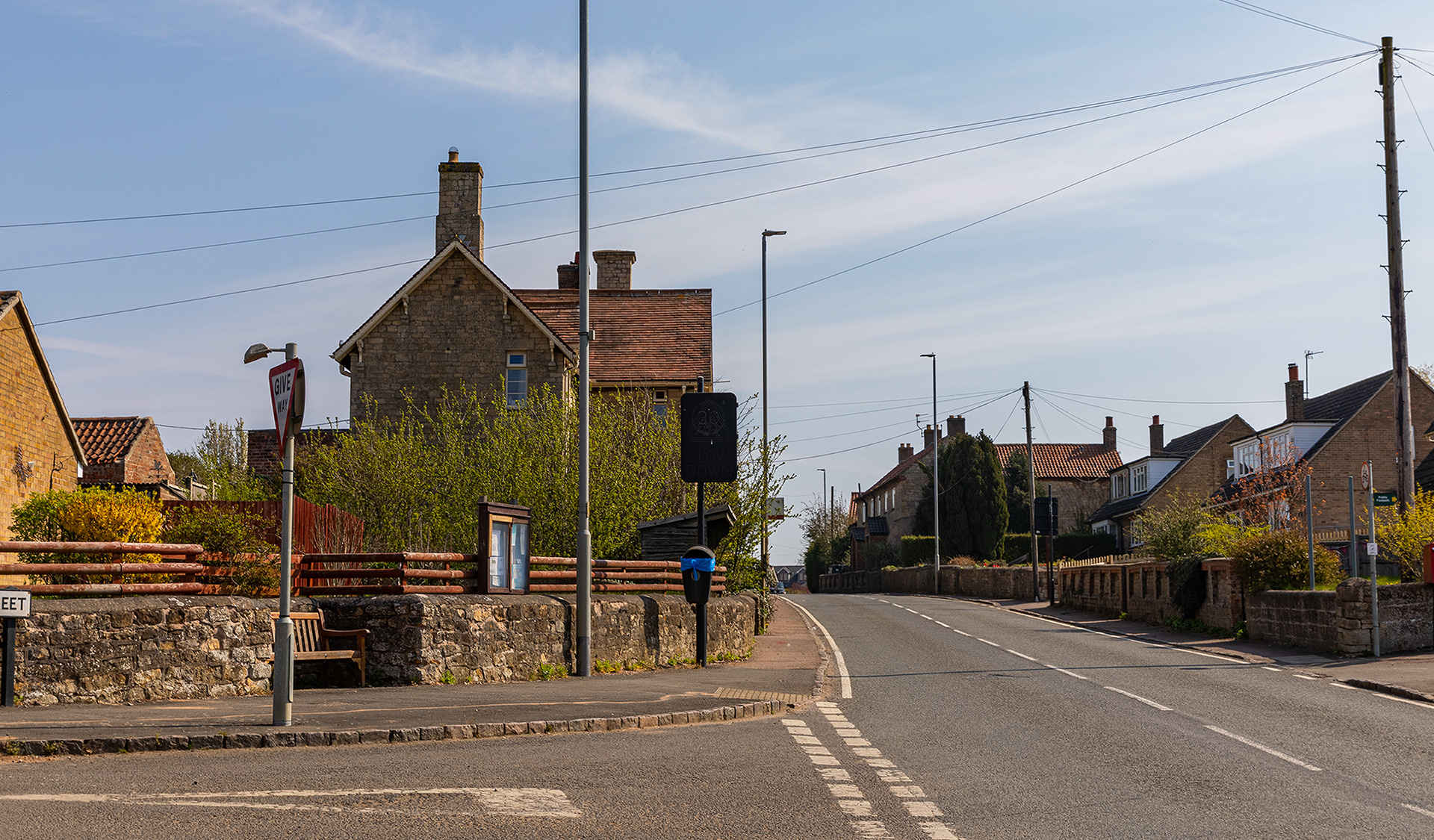
Main and Middle Street

The thatched cottages on the corner are history and were replaced by a bungalow. Jenny Elizabeth tells I need to speak to het mother. “Her family lived in one of the thatched cottages. She is 85 and has lived in Croxton Kerrial all her life.”

Middle Street
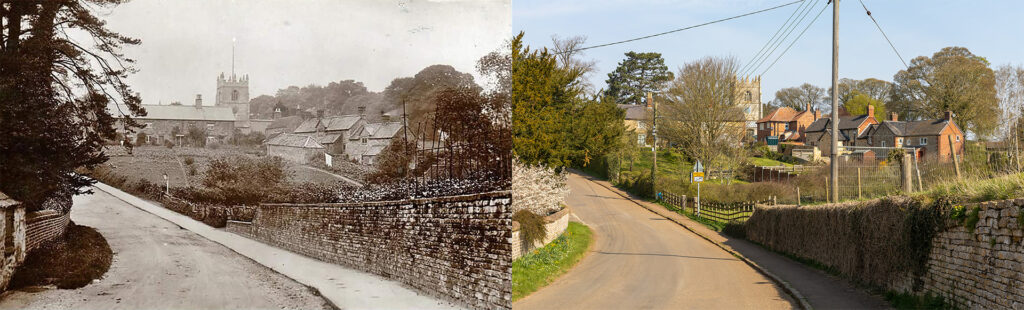
The stone wall along what is now a pasture, a place where sometimes hundreds of white geese of the Botteril’s farm can be spotted, is still there. The trees on the right of the village church just seem 100 years older. The altered and extended houses in front of the trees are on Church Lane. “Mr Hassle lives in the bottom house that he extended 30 to 35 years ago. The next one up is Mrs Bevan’s. The one on the left opposite the church was ‘Auntie May’ a relative of Mr Farnsworth. The Hills lived in the Vicarage. It must be 40 years ago when they moved there”, knows Petula Price.
The picture is taken near the corner of Thorpes Lane and Middle Street. Petula remarks: “In my memory, Thorpes Lane would have been known as Scott’s Lane because Mrs and Miss Scott lived there.”


On the village
On the origin of the name of Croxton Kerrial Tony Connolly of the Croxton Kerrial Heritage Trust writes: “Our village name is particularly interesting as it has three different national origins in it. Croxton is both Saxon and Danish (Viking), deriving from the Scandinavian personal name Krokr, meaning bent or crooked and the Saxon word tun, meaning a settlement, thus Krokr’s village. It is likely that Krokr, who may have had a crooked back or have just been dishonest, was one of the Great Heathen Army which swept across the Anglo Saxon Kingdom of Mercia (the East Midlands) bringing death and devastation in 878 and taking the village by force, and driving out or killing the original owner of the land.”
Tony continues: “After the Norman Conquest in 1066, the manor of Croxton passed through various hands until it came into the possession of the Criol family in 1239. So you might be right in thinking that we now have the final village name Krokstun Criol or Croxton Kerrial as it finally became. Not quite. Bizarrely, the first suffix added to Croxton was ‘Saracene in 1202, for some known reason. The Kerrial suffix was first recorded in 1247, though as Kiriel, and then intermittently until 1629 when it became permanent. One intrusion was after the dissolution of the monasteries when the de Roos family (now the Manners) owned the manor and the village was recorded with suffix Roose in 1590 and Rosse in 1611. However despite this attempted takeover, the Kerrials held out and whilst having only held the manor for around one hundred years of its 1200 year history, they are still with us today.”
Domesday Book
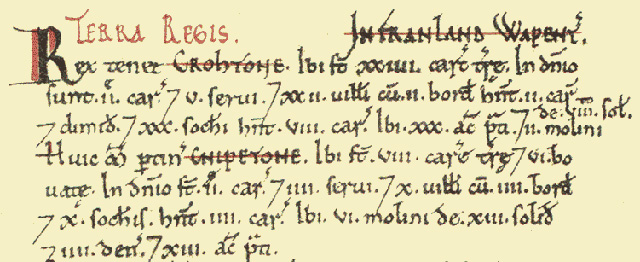
Croxton [Kerrial], spelt as Crohtone was a settlement in the hundred of Framland and the county of Leicestershire. It had a recorded population of 59 households in 1086, putting it in the largest 20% of settlements recorded in Domesday.
Land of King William
- Households: 22 villagers. 30 freemen. 2 smallholders. 5 slaves.
- Ploughland: 2 lord’s plough teams. 10.5 men’s plough teams.
- Other resources: Meadow 30 acres. 2 mills, value 8 shillings.
Owners
- Tenant-in-chief in 1086: King William.
- Lord in 1086: Hugh son of Baldric.
- Lord in 1066: Earl Morcar.
Links
- Croxton Kerrial Heritage Trust
- British History Online – House of Premonstratensian canons: The abbey of Croxton Kerrial in A History of the County of Leicestershire: Volume 2. Originally published by Victoria County History, London, 1954.