
For a year, photographer and history researcher Estelle Slegers Helsen has wandered around Lochaber in the footsteps of W.S. Thomson MBE (1906-1967). Estelle has made a series of remakes roughly 70 years after Thomson originally depicted the landscape. She has talked to local people along her journey and now Estelle will be taking you to the different places in Lochaber. This is article #8.
Salen and Loch Sunart
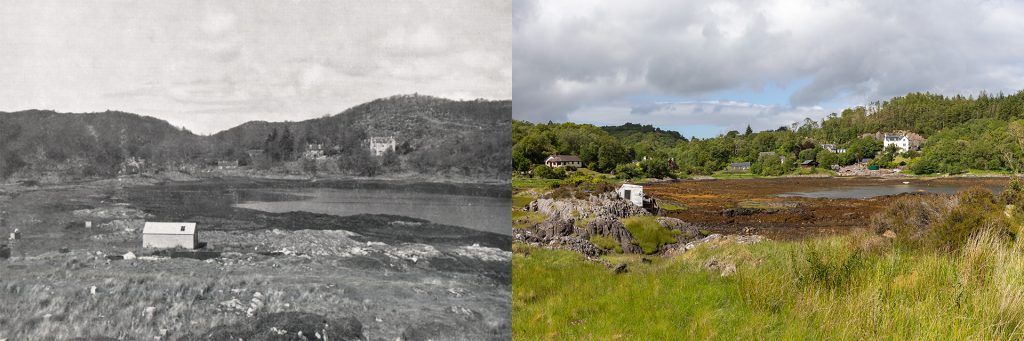
‘I ran Salen Hotel, the second building from the right,’ says Mary Lamont. In Thomson’s photo, taken at the end of the 1940s, and my remake in June 2022, the building on the far right was the Head Forester’s House, called Duncraig. Before the Second World War, when cattle sales were still a regular occurrence, Duncraig was a temperance hotel. ‘The wives would go there to have their tea, and all the men would be in Salen Hotel drinking pints of beer and whiskeys.’
‘When we bought the hotel in 1984, the byre at the back was derelict.’ Mary points at a building just above and to the rear of the hotel in the old photo. ‘It was a horse or cow shed, with a flagstone floor, full of stuff, even an old petrol pump. We converted that barn into our home.’ When her husband suddenly died in 1997, she sold Salen Hotel but stayed in the barn until the late 2000s.
Duncraig dates back to the early 20th century and is about the same age as Salen Hotel, the latter was built by Charles Dunnell Rudd, owner of the Ardnamurchan Estate from 1897 to his death in 1916. However, reference is made to an inn in the late 19th-century Ordnance Survey map.
In the centre of both photos, by the side of the road, is Salen Cottage and it looks like it has never changed. ‘In the 19th century, this building was the Police Station, where Constable Hugh MacLean lived, covering the area from Ardnamurchan Point to Glenuig with only a bike for transport,’ wrote local historian John Dye on the Moidart Local History Group website.
Moving to the left, you can spot Lanith, a fairly new dwelling near a small stream. Uphill of this was the smithy. There the road turns to the south, where the next building, Salen House, welcomes guests for tea and cake. In the past, it was Matheson’s store.
Mary goes a bit further back in time. ‘When my father, Hugh MacKenzie, came back from the war in 1947, he started a tweed and tartan shop in Fort William,’ she says. ‘It was The Highland Homespun on High Street. W.S. Thomson was a good client. My father made his kilts. Thomson’s tartan was blue and black and white and red; a very bright and nice tartan. I remember him as a photographer going to his studio, and in about 1955, he also came to my parent’s in Fort William to take family photos.’
‘My father also delivered suits, jackets and skirts that people living in the area had ordered,’ Mary continues. ‘And, then, as a girl I would travel with my father in the car. He always stopped at Matheson’s, which was something of an Aladdin’s cave, with cases, rafters and oil lamps hanging all over the place. They sold everything; it was the only main store in the area. People would walk from Kentra, five miles from here, to go to this one shop.’
‘In the 1960s, Ross Fraser ran the store; he was the grandson of Rudd’s gamekeeper. Rudd employed many people, a large number of whom came from outside the area,’ wrote John Dye. ‘Adjacent to the store was an older building, used as a feed store, with some wooden stables at the back, later converted into a house, that became the home of Mary Fraser, Ross’ widow, who ran the Post Office downstairs.’
On the opposite side of the street, now a lay-by, were petrol pumps, a paraffin tank and a wooden shed for coal. That shed was dismantled in the late 1980s after the shop closed and was sold.
Next, on the left, was a small quarry, producing stone for the 19th-century buildings in Salen. That is where a relatively new dwelling, Tigh an Dorainn, was erected, several feet above street level, next to Allt an Dorran. The road crosses the small stream over the so-called Parliamentary Bridge, built around the 1830s as part of the link between Salen Pier and Ardtoe Pier.
If you look closely at both photos, the hills at the back and Salen Bay at the front don’t quite match. W.S. Thomson took his shot from a rock where the Lord Provost of Glasgow, Sir William Stevenson Gray, had constructed a log cabin as a retreat. After Sir William died, his daughter knocked it down and built a big house.
In Thomson’s photo, there is a tin shed at the edge of Salen Bay that fell down about two decades ago and was replaced by a garage-like building. I took the remake in front of that building, pointing my camera in the same direction as Thomson’s: to the north, with the small inlet, Salen Bay, to the right.
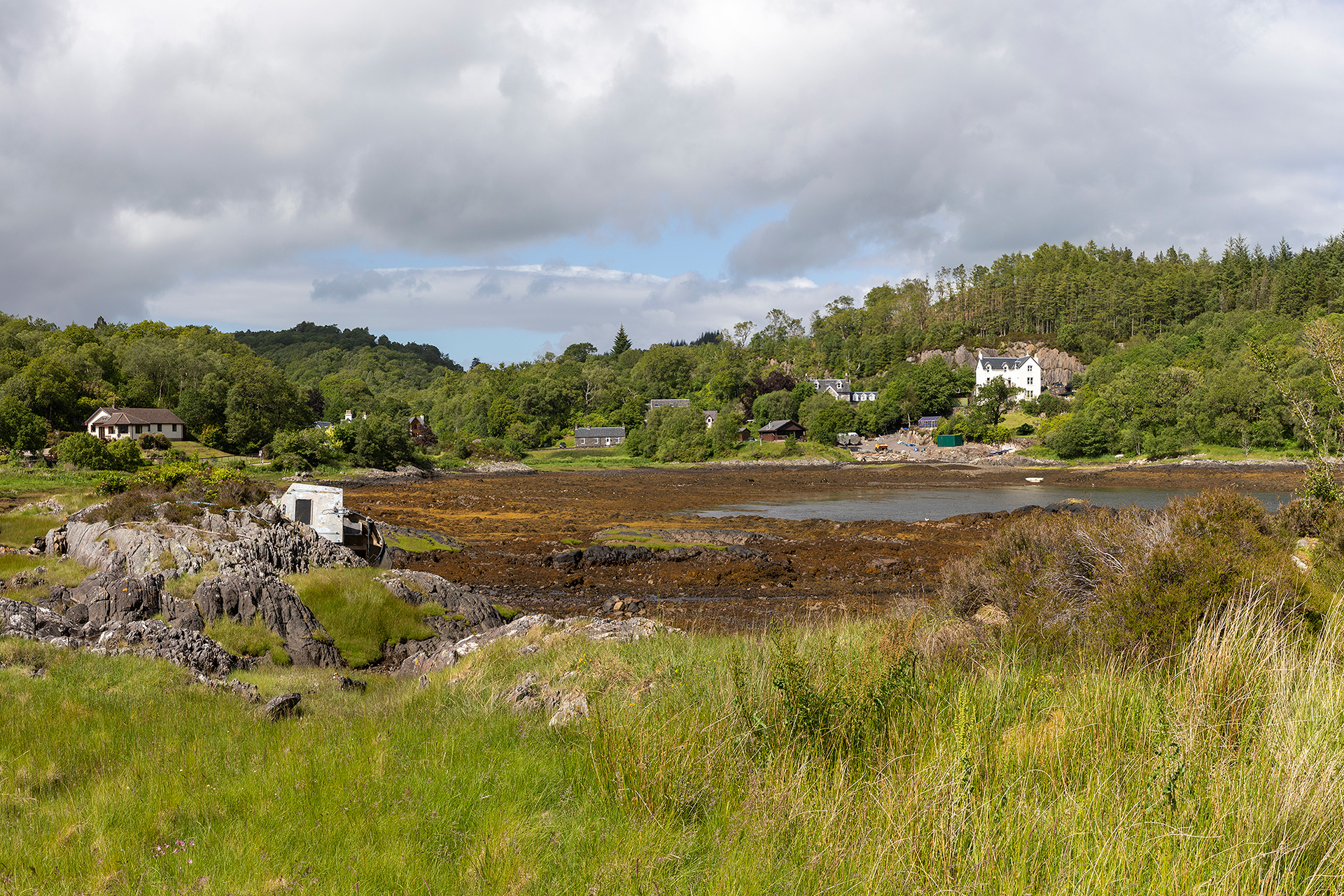
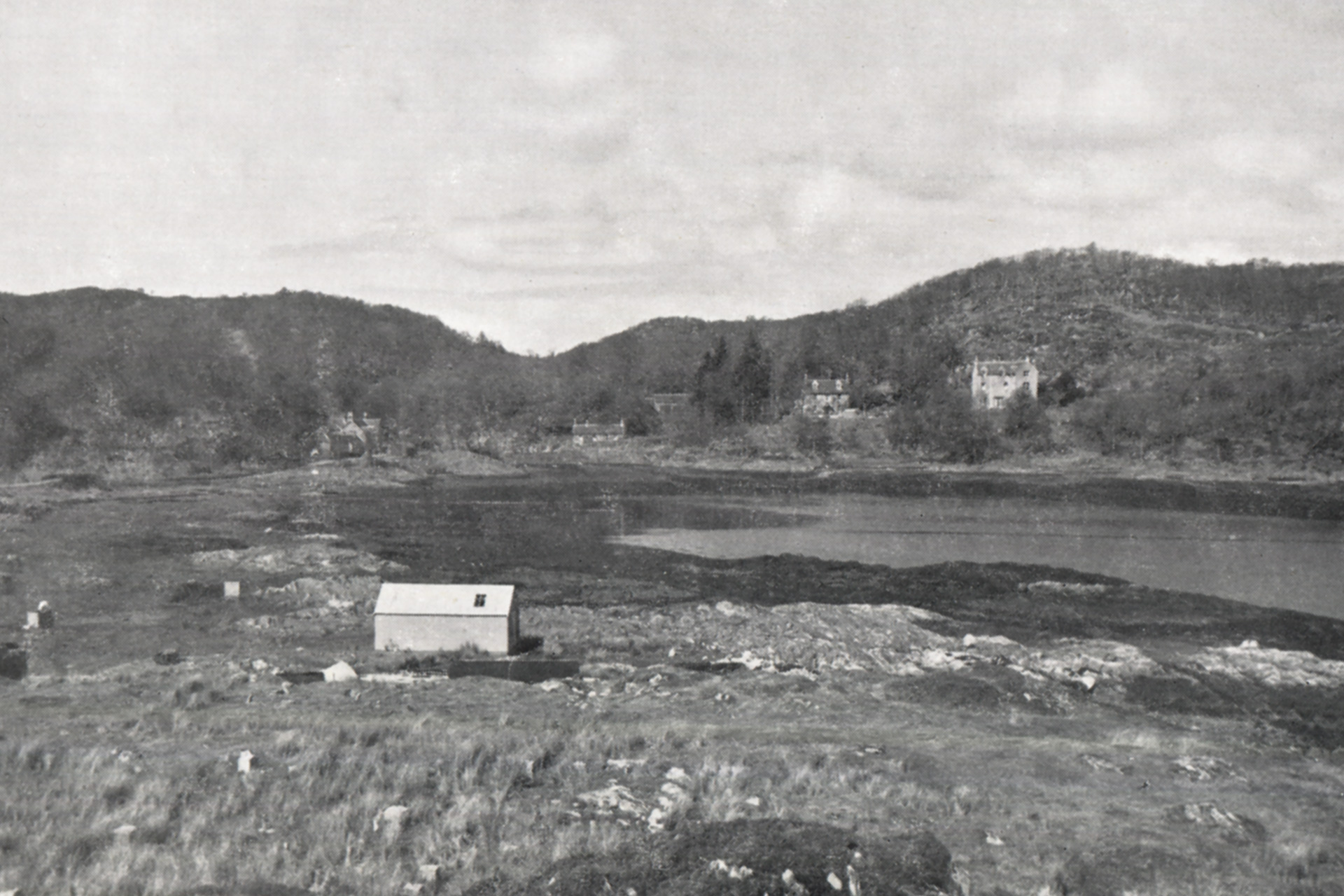
Move the slider to discover what changed.
Then (left) – Late 1940s © W.S. Thomson – Salen and Loch Sunart. Published in Let’s See Ardgour and Ardnamurchan, p. 11
Now (right) – June 2022 © Estelle Slegers Helsen – Salen and Loch Sunart. Published in Travel in Time. Lochaber, Scotland (2022), p. 31

Travel in Time – Lochaber Series is supported by the West Highland Museum and the Year of Stories 2022 Community Stories Fund.
Estelle has published a 64-page book with 30 side-by-side then-and-now pictures, which you can find in local shops or buy online. More information available here.