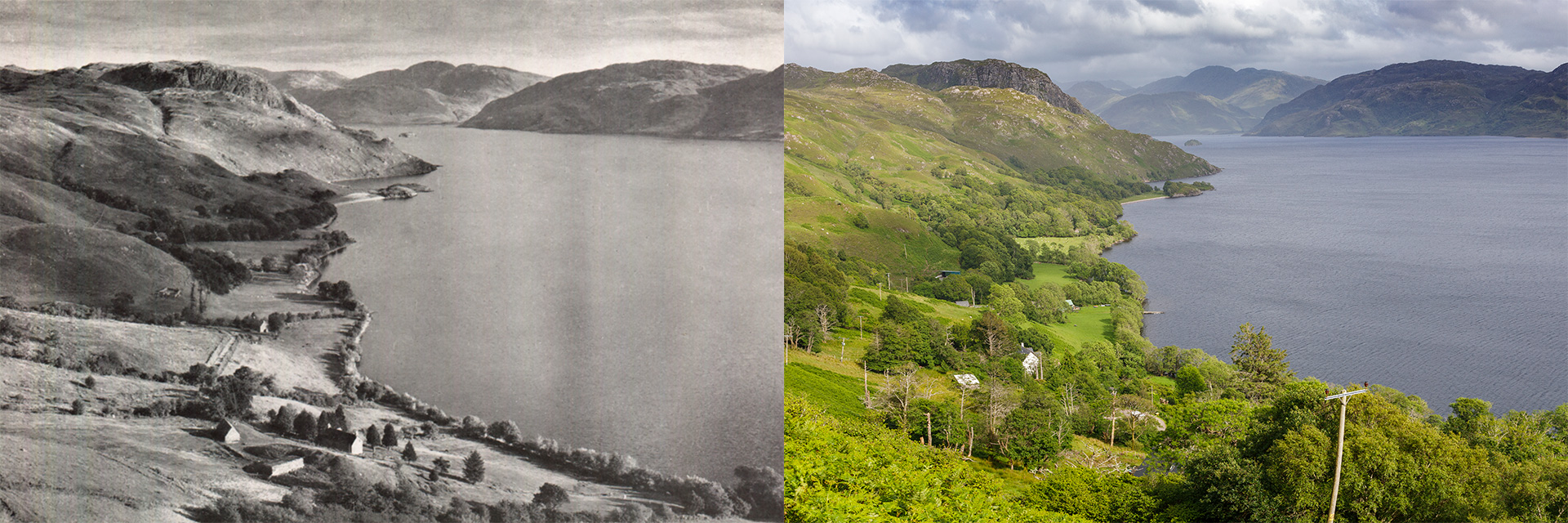
For a year, photographer and history researcher Estelle Slegers Helsen has wandered around Lochaber in the footsteps of W.S. Thomson MBE (1906-1967). Estelle has made a series of remakes roughly 70 years after Thomson originally depicted the landscape. She has talked to local people along her journey and now Estelle will be taking you to different places in Lochaber. This is article #5.
Loch Morar from Bracara
‘Hello Cleo, how are you doing, lass?’ Malcolm asks one of the 50 sheep he keeps on the common grazings. ‘How is your lamb?’ A dog barks in the distance. ‘No, I haven’t anything to eat. You are a good girl.’ Cleo bleats. ‘I know,’ Malcolm answers, ‘we come up here disturbing you.’
Malcolm Poole, born in 1963 and a lifetime resident of Bracara, turns to me and says: ‘Over the past 20 years, the sheep have made a good path, coming down in winter looking for food.’ Malcolm is my guide on a fair but windy Friday afternoon searching for a Thomson hotspot.
More than 70 years ago, it’s very likely that the Scottish photographer scrambled up here with his heavy tripod and cameras, just high enough to get a breathtaking view of Loch Morar, Scotland’s deepest freshwater loch. ‘Yes, there is a monster,’ adds Malcolm. ‘It has been dubbed Morag.’
‘In the past, photographers didn’t climb up high for pictures because most postcard makers went for views that people were more likely to see for themselves,’ believes Malcolm, also curator of the Mallaig Heritage Centre. ‘I know a similar Valentines’ postcard.’
This short hike is a challenge, climbing a 45 degree hill overgrown with tall bracken, which Malcolm calls a plague. Sheep muck taints my hands when I touch the slippery soil looking for support and to prevent myself from sliding down. The path wasn’t designed for humans, and I am not a sheep.
We cross the remains of a fence. ‘That used to go around the village and separate the grazing from the arable,’ Malcolm explains.
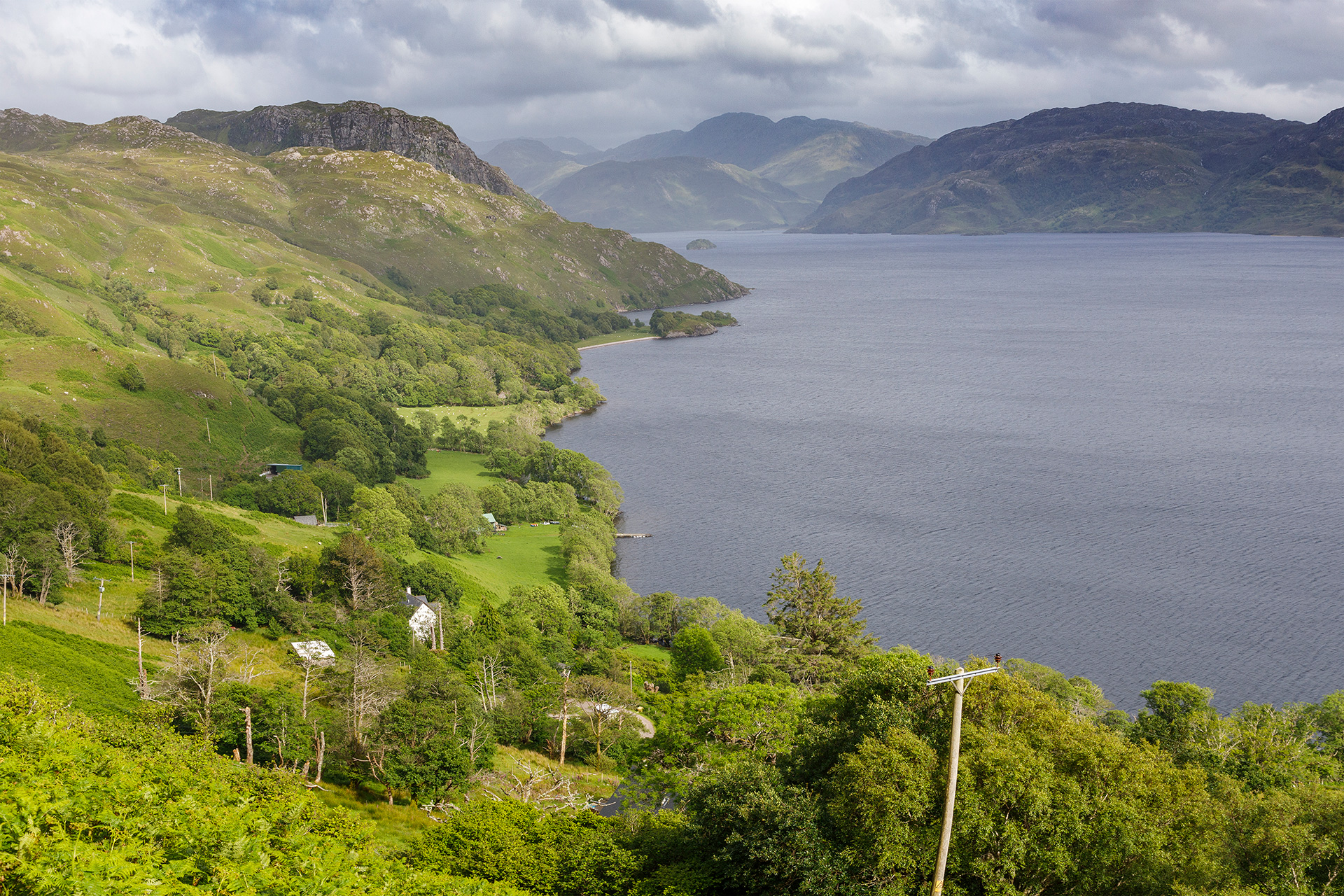
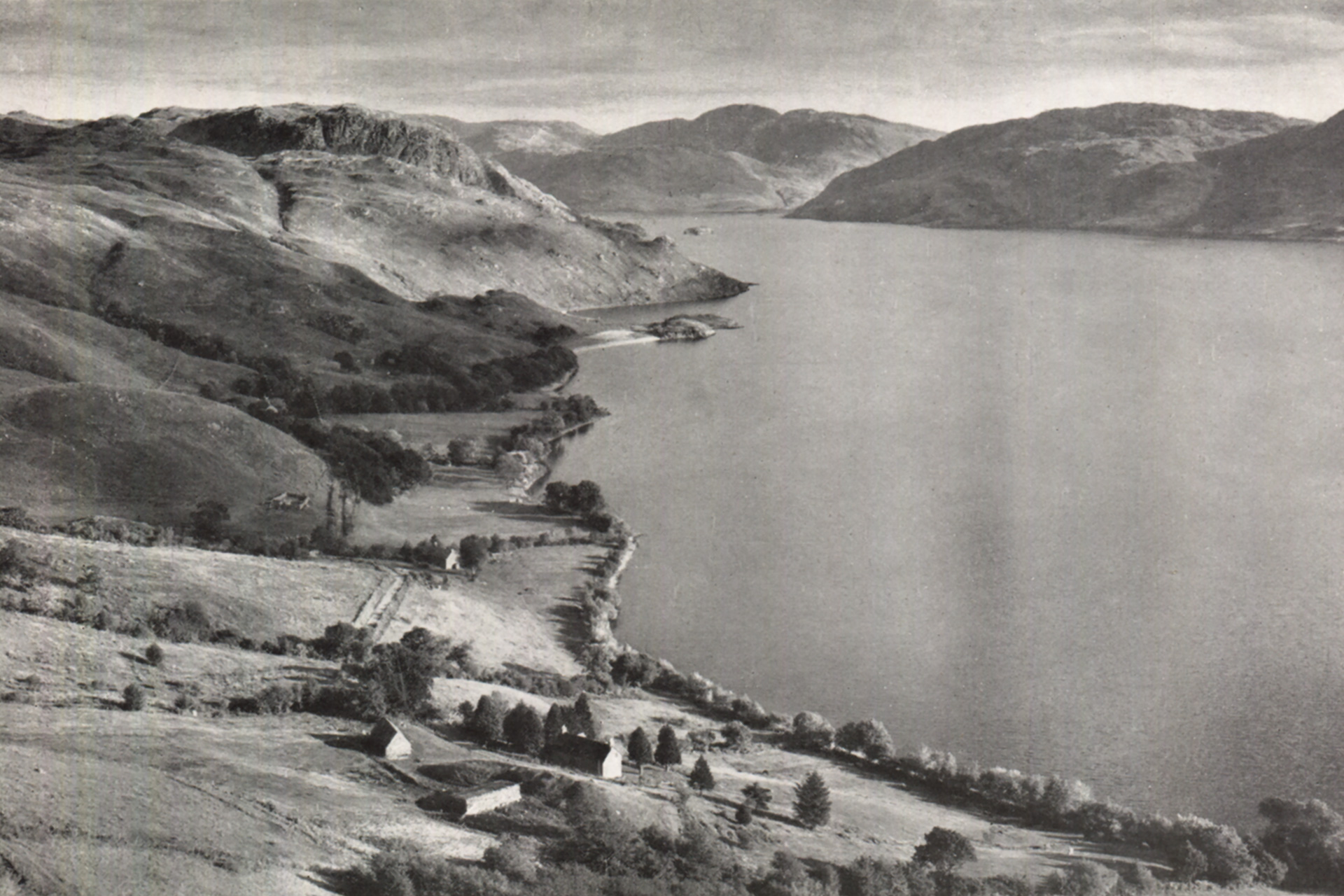
Focussing on three features, the South Morar hills on the opposite side, Brinacory Island at the far end almost touching the shore of the loch and the little jetty in front, we conclude we have found the place for a remake and settle down.
Bright spells come and go quickly, randomly tossing patches of sunshine on the landscape. Brinacory Island towards the back of the shot is regularly bathed in sunshine. As expected, we have to wait for the light, so we have plenty of opportunities to compare the past and present.
‘It is striking how much the trees have come up,’ is Malcolm’s first thought. ‘The pastures along the loch shore are well-maintained, which keeps them bracken-free. Higher up, it is rougher, and when not cut, the bracken comes in and covers everything.’ That is clearly visible in the remake.
The three buildings in the foreground are part of Croft 8, with two byres and the main house opposite the road, where Domhnall Hamish McDonell lived, an outstanding fiddle player.
A buzzard circles overhead.
Moving to the middle, the house to the left of the jetty is Croft 9. Malcolm tells: ‘It was the home of John Mackay, and after he died, it lay empty for a long time until his great-nephew restored the house after his marriage.’ A small part of the green roof is visible. The trees, which have grown considerably in 70 years, mark one of the many smaller streams leading to the loch.
The road passes a sheepfold and ends at Bracarina. The roof and part of one gable of that dwelling are visible in Thomson’s picture. Bracarina, originally a chapel, until 1888 when its congregation moved to Morar. It became a school in 1897.
Only hiking boots and a good level of fitness will get you further along the shore up to Tarbet at Loch Nevis.
The electricity poles reveal when Thomson took the photo published in his booklet Let’s See Mallaig and the Road to the Isles. Malcolm explains: ‘In 1946, the North of Scotland Hydro-Electric Board built a dam which was completed in 1948. Right after, the electricity poles were erected in the crofting community. So Thomson visited Bracara before, more or less when Malcolm’s father settled in the village.
Malcolm says: “My father, Bob Poole, who lived in East London, joined the army, and after his first mission in Norway in 1940, he volunteered for the Special Operations Executive, a highly secretive organisation to train agents in sabotage and subversion, before deployment into countries occupied by Nazi Germany and her allies. The Arisaig area was dotted with SOE training places, and my father was sent to Meoble Lodge, a mile up the valley between the two hills at the top of the picture. After the war, he couldn’t get used to living stuck in four walls, so he returned to Bracara.’
He had a happy childhood. ‘Apart from going to school in Morar, we spent most of our time outside.’
‘During the first nine decades of the 20th century, there was very little change, and after that, things started moving,’ Malcolm reflects. There were eight crofts. Now Malcolm counts fourteen houses, three of which are holiday homes. ‘We are nowhere near how life used to be because people watch television and surf the internet in the evening. Traditional croft life is lost, but you can say that Bracara is certainly still a community.’
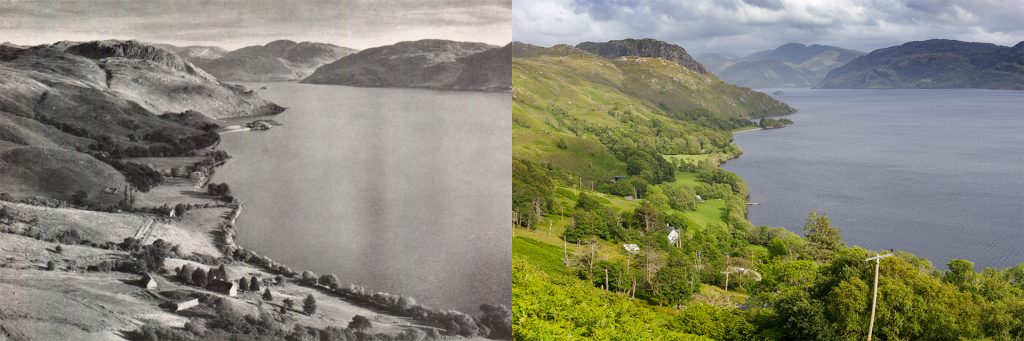
Move the slider to discover what changed.

Travel in Time – Lochaber Series is supported by the West Highland Museum and the Year of Stories 2022 Community Stories Fund.
Estelle has published a 64-page book with 30 side-by-side then-and-now pictures, which you can find in local shops or buy online. More information available here.