
The Durham Ox – Late 1940s
“To start. There are no hills at Six Hills,” said Bob Trubshaw of The Wolds Historical Organisation (WHO), founded in 1987 to promote interest in the local history of the villages on the western side of the Leicestershire Wolds in Charnwood Borough. Six Hills lies on the edge of Charnwood and Melton Borough, divided between the two boroughs, near the centre of a plateau about 350 feet above sea level. “The name is a corruption of ‘Seggs Hill’, probably derived from the Anglo-Saxon personal names Segga or Secca.” Six Hills, now most known as a business park and industrial estate, has been embedded in history since pre-Roman times. Bob explained: “Six Hills is at the crossroads of two tracks, the Roman Fosse Way (now the A46, and the Saltway, a minor Roman road, running from the River Soar at Barrow up to the ironstone ridge above Long Clawson (now the B676), continuing in the general direction of the Roman town near Goadby Marwood.”
“Both are almost certainly pre-Roman in origin and in use during the Roman occupation. Although not systematically maintained as they would have been during the Roman period, these routes remained in use during the Anglo-Saxon and Viking periods through to the medieval period and beyond. However, we know that by the 18th century, the Fosse Way had become severely neglected along much of its length.”
“It is reasonable to suppose that the east-west route, and perhaps also the Fosse Way, remained drovers’ routes in the post-medieval period. The presence of a substantial area of extra-parochial land would allow animals to be grazed overnight, with the Kingston Brook meeting the needs for water. The 19th-century inn at Six Hills was known until recent years as the Durham Ox, a name which might reflect its earlier use by drovers walking the cattle to the markets in the country’s south.”
The Nottingham Journal of 3 February 1821 mentioned an auction held at the Durham Ox of “valuable freehold estates situated in Willoughby on the Wolds”: three “dwelling houses with outhouses” and the “public house, called the Plough with stables, barn, garden and other conveniences and 27 acres of land, now in the tenure of William Hallam”.
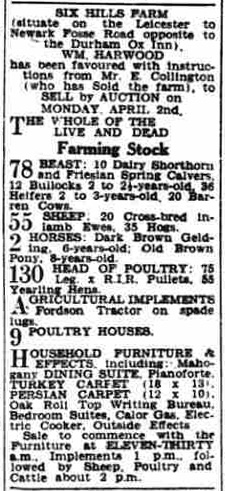
“My wife Mary lived for a time at the Durham Ox Hotel Six Hills, where her grandparents were in charge,” wrote Colin Ardron. “This would have been the early 1950s to 1960s. Her auntie Jean lived opposite the hotel, approximately where the garage and petrol station are now. Everard Collington was her aunty’s husband.” Mary told her husband Colin a story about how her auntie Jean made dinner for Everard and put it ready for him on the table. “Alas, his dog got there first and ate the lot. The tragic end was that Everard shot the dog but lived to regret his spontaneous reaction.”
Colin continued: “Along the road Mary’s uncle lived at a poultry farm now called Shoby Poultry. I remember it (and the hotel) all very well. Lots of Mary’s extended family lived around the area. I miss those days.”
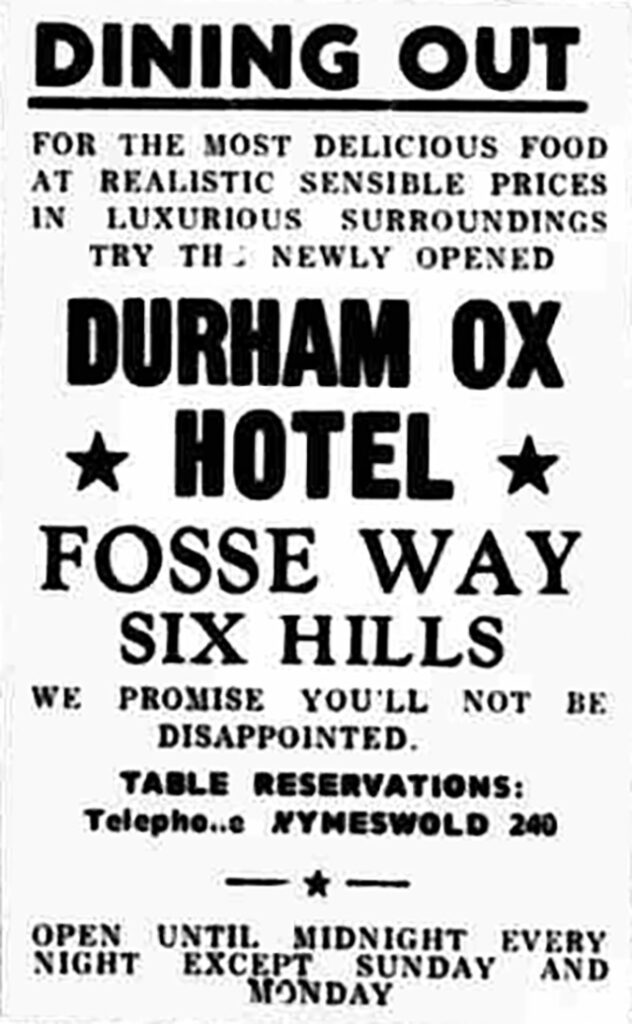
The Durham Ox Inn was a favourite place for many people in the wider area. The building was extended in 1954, 1964 and again about 1990. Somewhere in time, the inn became a hotel. “The newly opened Durham Ox Hotel” was advertised in the Leicester Chronicle of 15 May 1970 as a place for dining out.
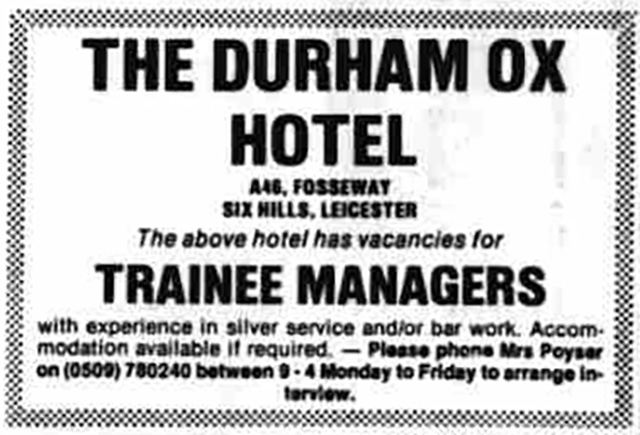
And in 1985, the hotel had vacancies for trainee managers, as published in the Grantham Journal of 8 November 1985.
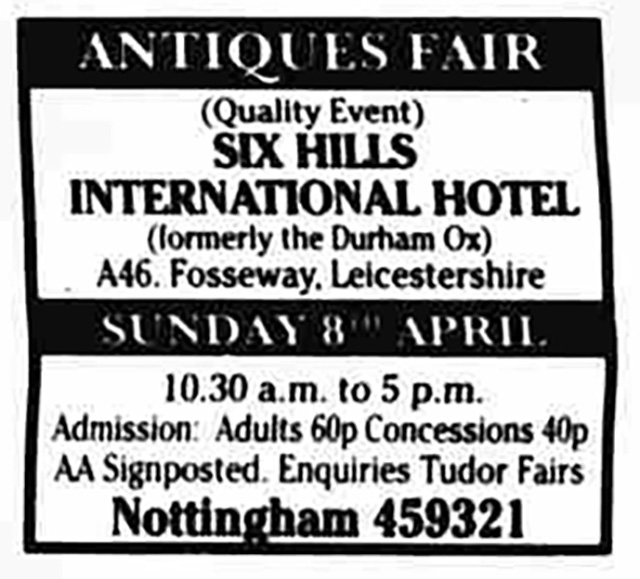
The name change to Six Hills Hotel came before 1990. On Sunday 8 April 1990, an antiques fair (quality event) was held at the Six Hills International Hotel, formerly the Durham Ox, 46 Fosseway, Leicestershire.
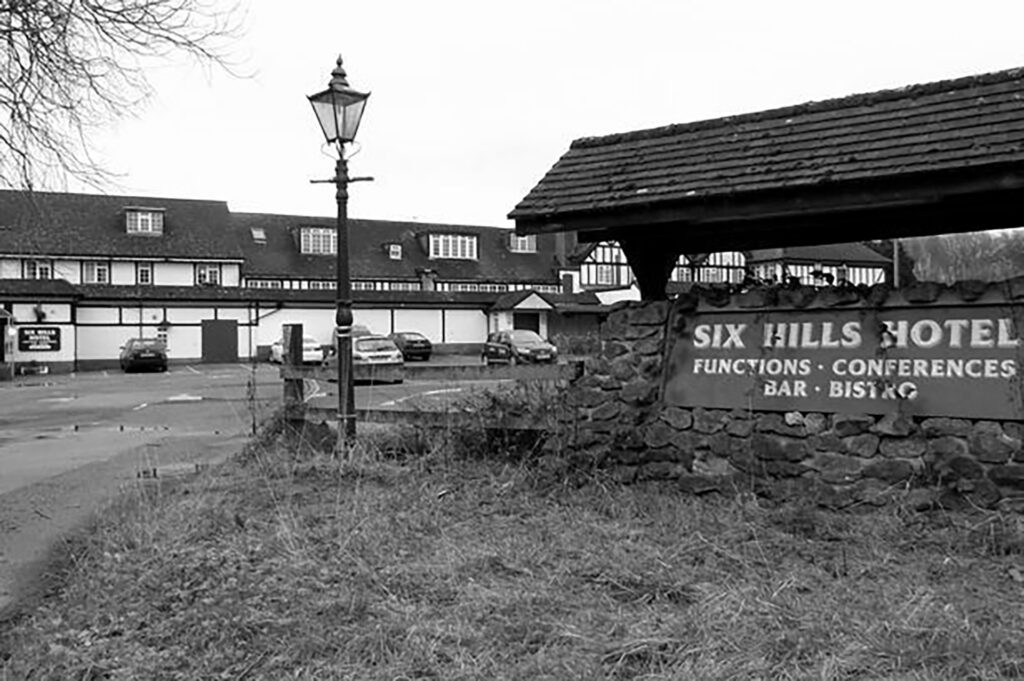
The 55-room hotel closed down about 2017 and was bought by the Loughborough-based Christian charity The Carpenter’s Arms as a rehabilitation centre. Since the A46 was widened to a dual carriageway in 1964, the entrance is on the other side of the building. The old picture was taken in the late 1940s by Mr F. Lumbers and published in the book ‘Leicestershire’ (1950) by Guy Paget and Lionel Irvine.
75 years ago, the road was far less busy than now, with hundreds of cars and lorries speeding by when I took the remake from the nettled verge. I made a safe stop at the Murco petrol station at the A46 opposite the former hotel to reach the verge.
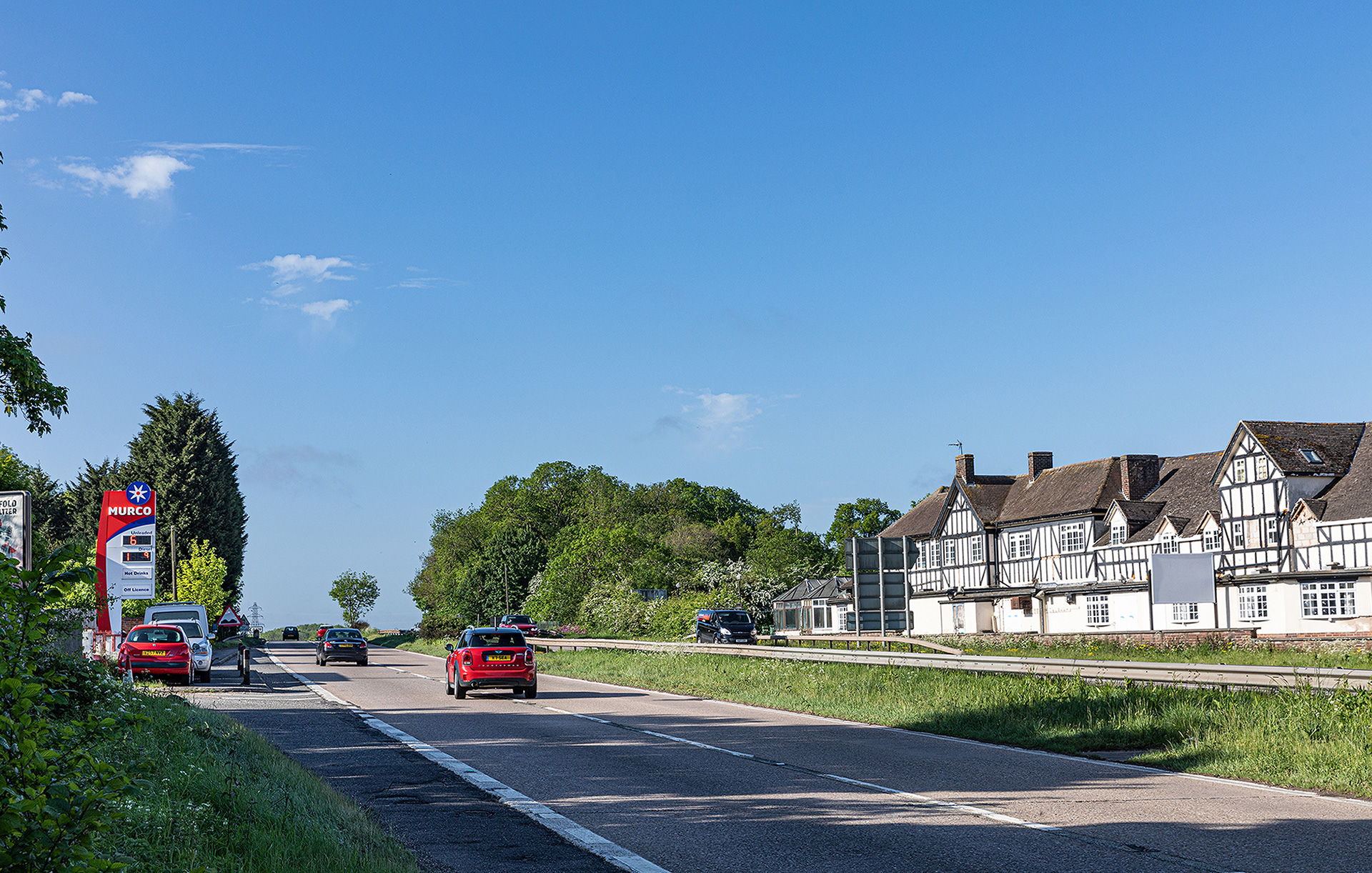
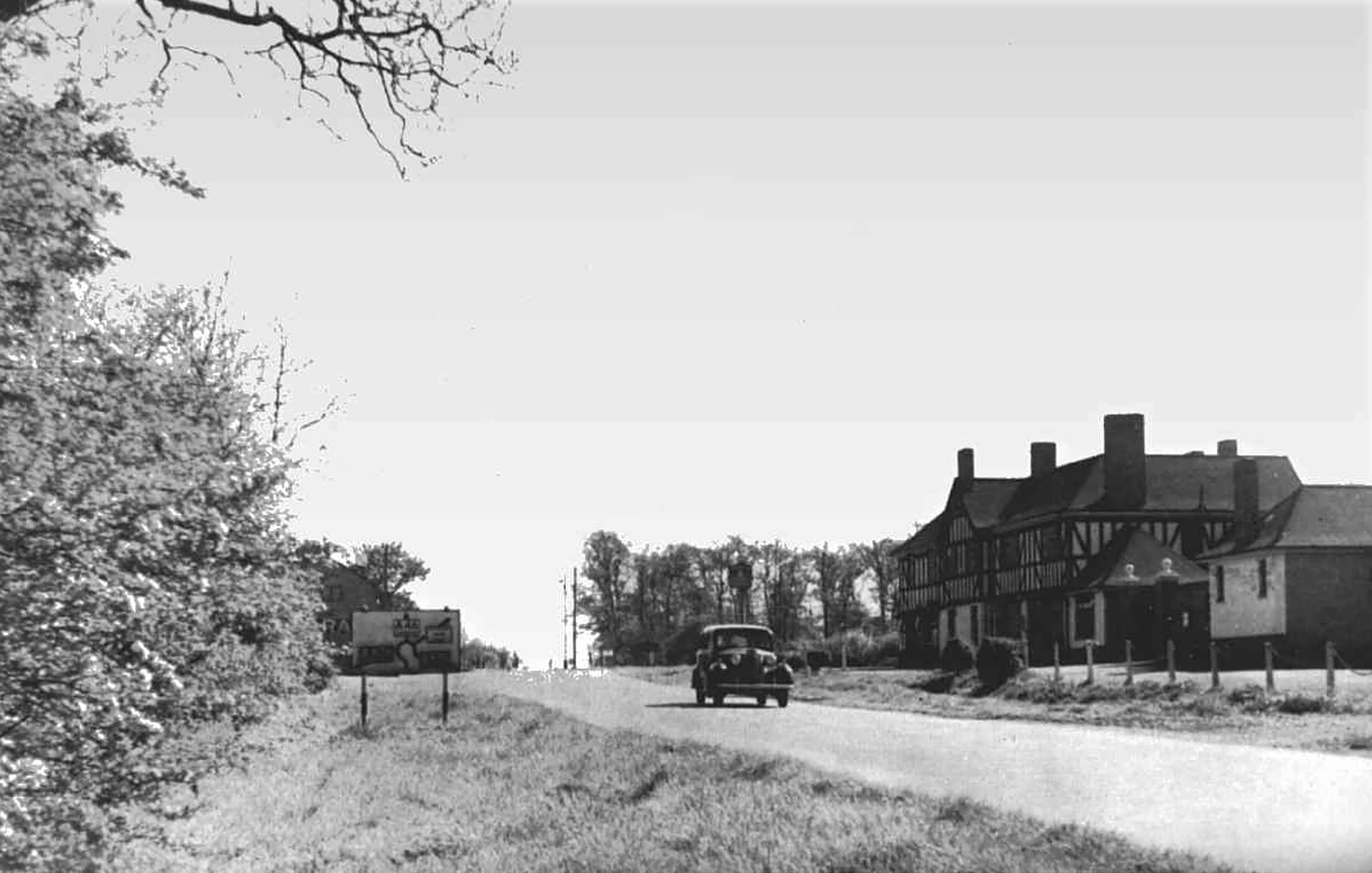
On the village
There was never a village in Six Hills, and you can hardly call it a hamlet. Bob Trubshaw: “An 1876 map shows the Durham Ox with the farmhouse opposite and the chapel of ease built by Rev Sawyer. The Durham Ox Inn was depicted in the frontispiece to ‘Leicestershire and its Hunts’ (1926) by Charles Simpson as a place where the hunt gathered.” Six Hills was also regularly advertised in late 19th and early 20th-century newspapers as a place where The Quorn Hounds met for their fox hunting outings.
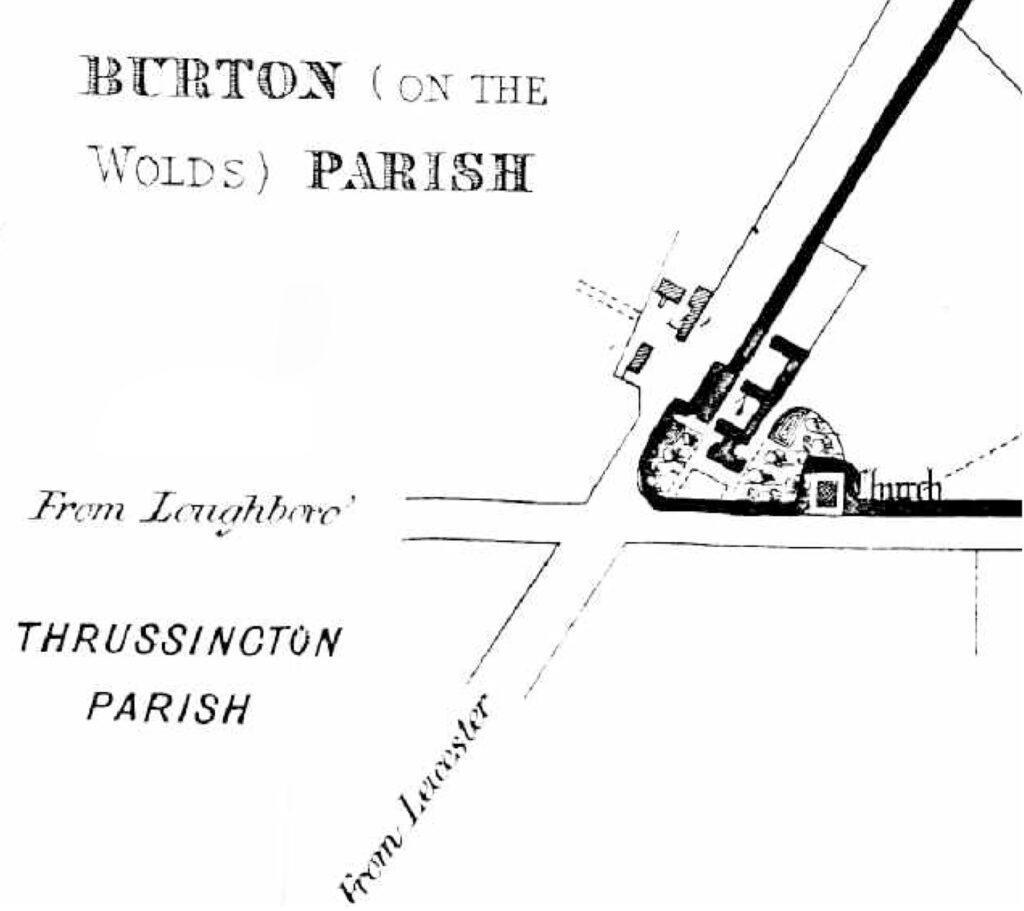
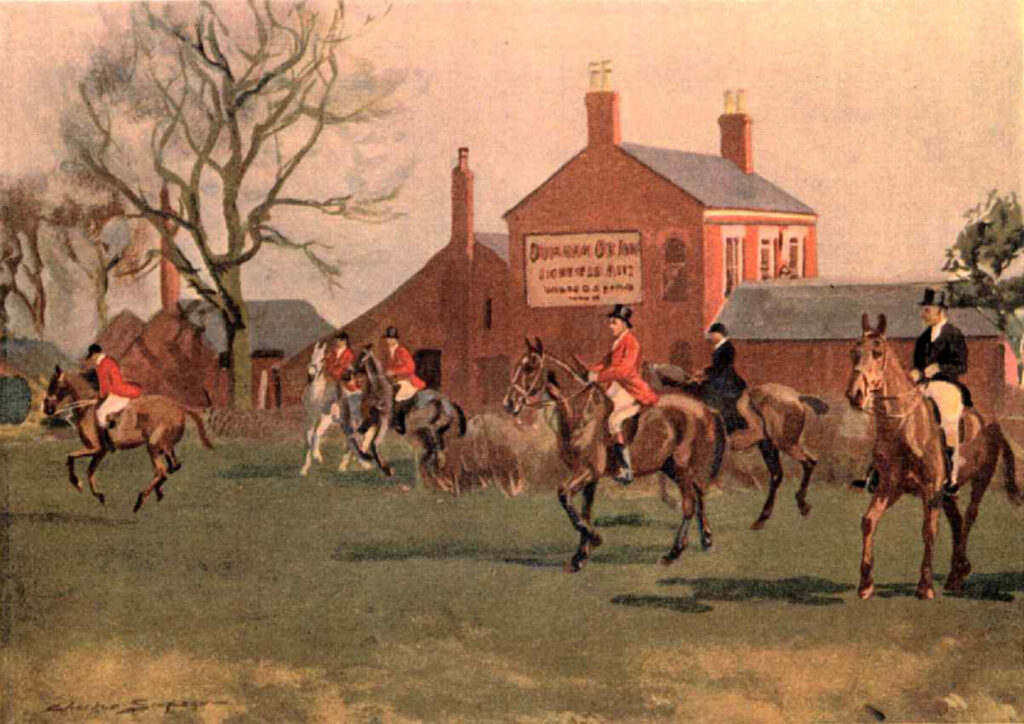
About the farm, the Grantham Journal announced on 22 March 1951 the auction of “the whole of the live and dead farming stock” and the “household furniture & effects” ordered by “Mr E. Collington, who has sold the farm.”
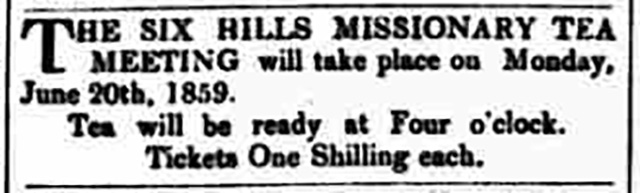
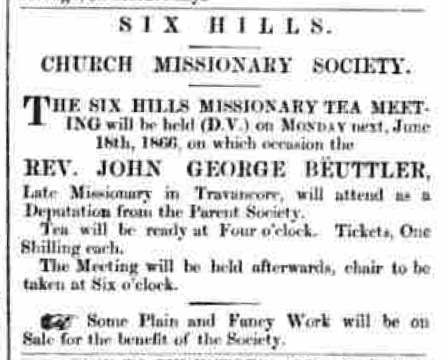
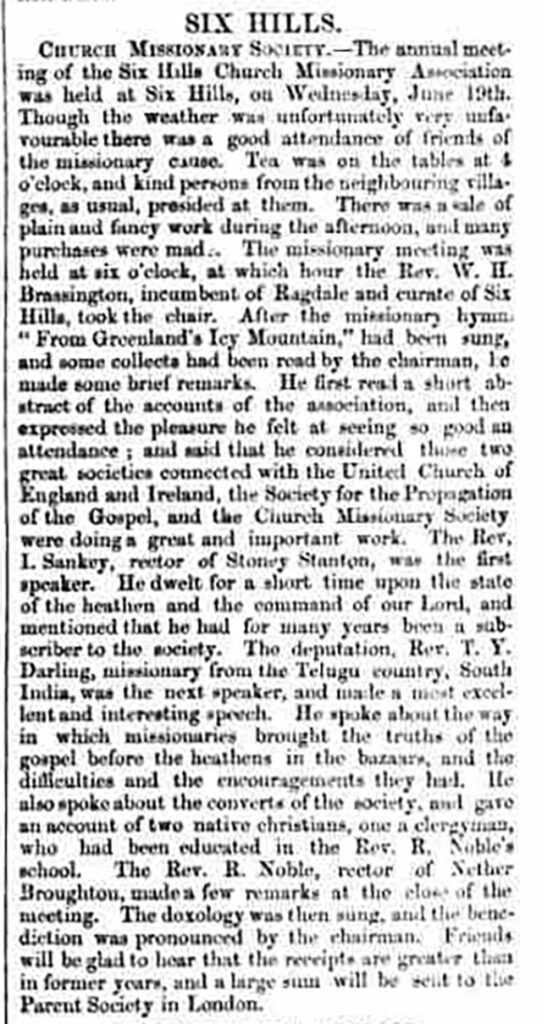
From 1859 to 1867, the Leicester Journal, the Leicester Mail and the Loughborough Monitor regularly advertised or published articles on the annual Six Hills Missionary Tea Meetings, organised by the Church Missionary Society, which was founded in 1799. The biographical history of the Church Missionary Society Archive noted: “In the late 18th century, the Church of England did not have a body to organise and effect its missionary activity and there became a growing realisation that there was scope for a society to evangelise the indigenous people.” The meetings were held to keep the friend of the Church updated on the society’s activities and “plain and fancy work was on sale for the benefit of the Society.”
Late 19th century OS Map also depicts a smithy and a school and reveals six ways to hit the same central point.


Would you like to add your story and recollection? Leave a comment at the bottom of this page or send a message.
More pictures
Would you like to add pictures? Send a message.
Domesday Book
Six Hills was not mentioned in the Domesday Book..
Links
- Wolds Historical Organisation
- Wolds Historical Organisation – Publication on Six Hills
Would you like to add a link? Send a message.