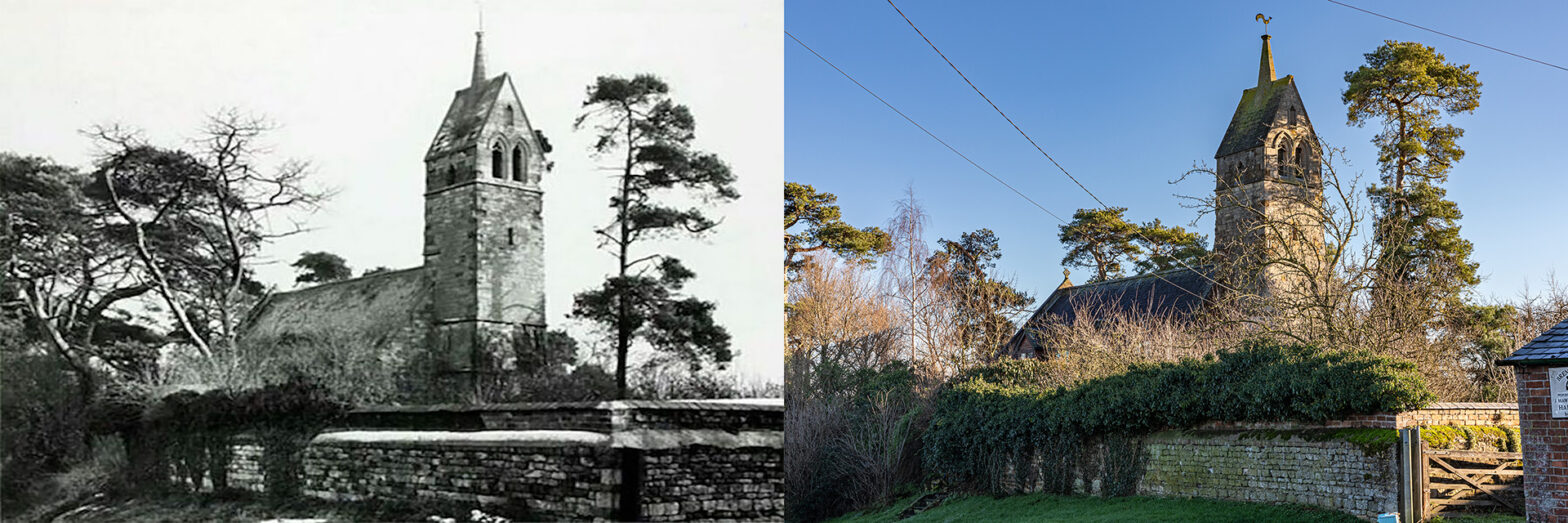
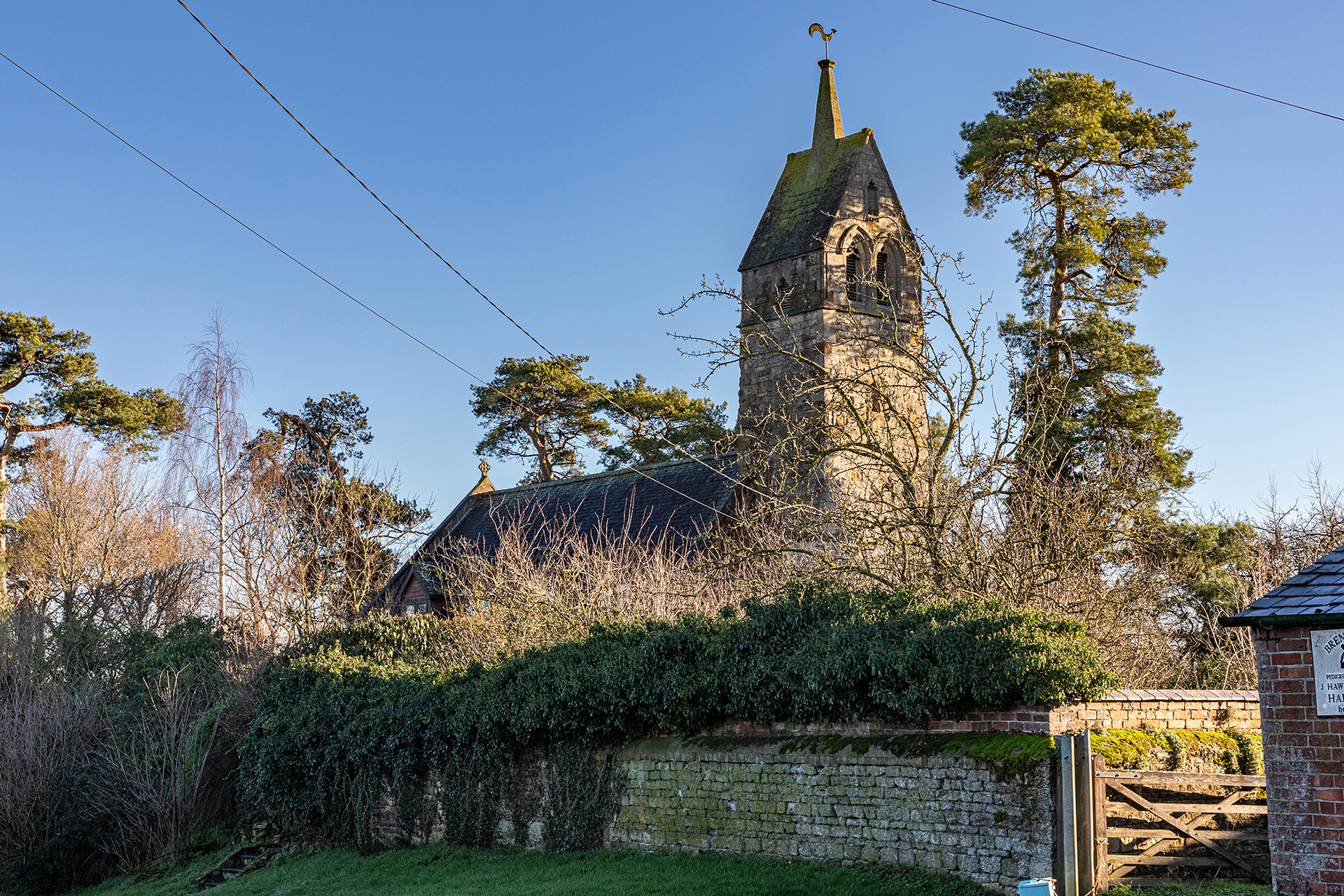
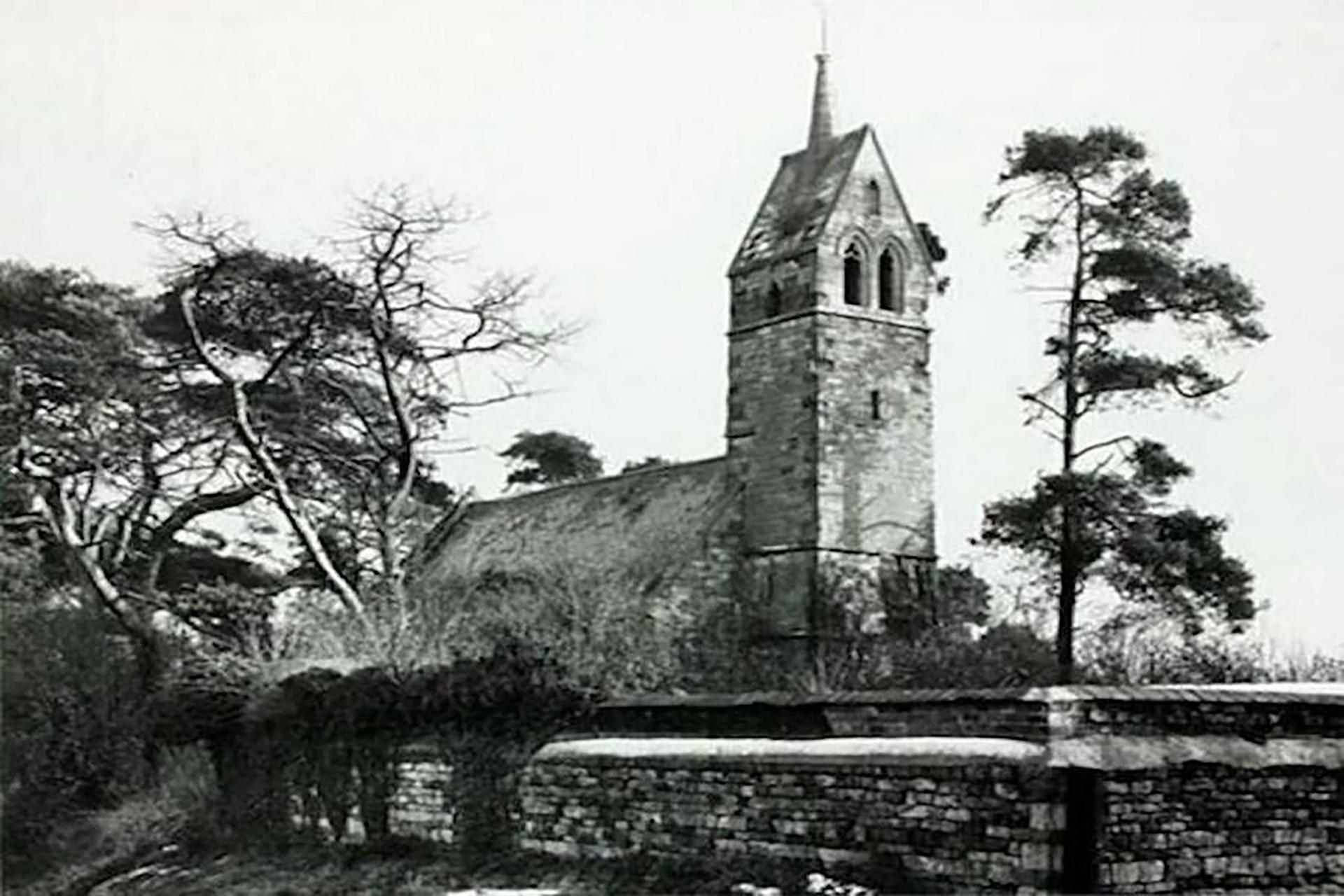
St Mary’s Chapel – 1950s
“When John de Woodford purchased the manor of Brentingby in 1317, a period of prosperity and stability began in the hamlet,” writes Stephen Butt on his website The Woodforde Story, about 700 years of history of the Woodfordes. During their tenure of the manor, an older church was replaced in the 14th century by a chapel with an unusual saddleback tower. However, the prosperity was short-lived because, in 1445, Brentingby was already an impoverished village. Because of a population drop, residents were granted a significant taxation relief. In 1524 only seven tax-payers were counted.
In 1487 the last Woodford died. The manor passed through the female line to the Mortons and again in the mid-16th century to the Smiths, a prominent Catholic family. Sir Francis Smith of Ashby Folville gave the manor to his son Thomas. In 1634, the manor came into possession of the Hartopps. When remodelled in 1660, the distinctive bell turret was kept just as it is now.
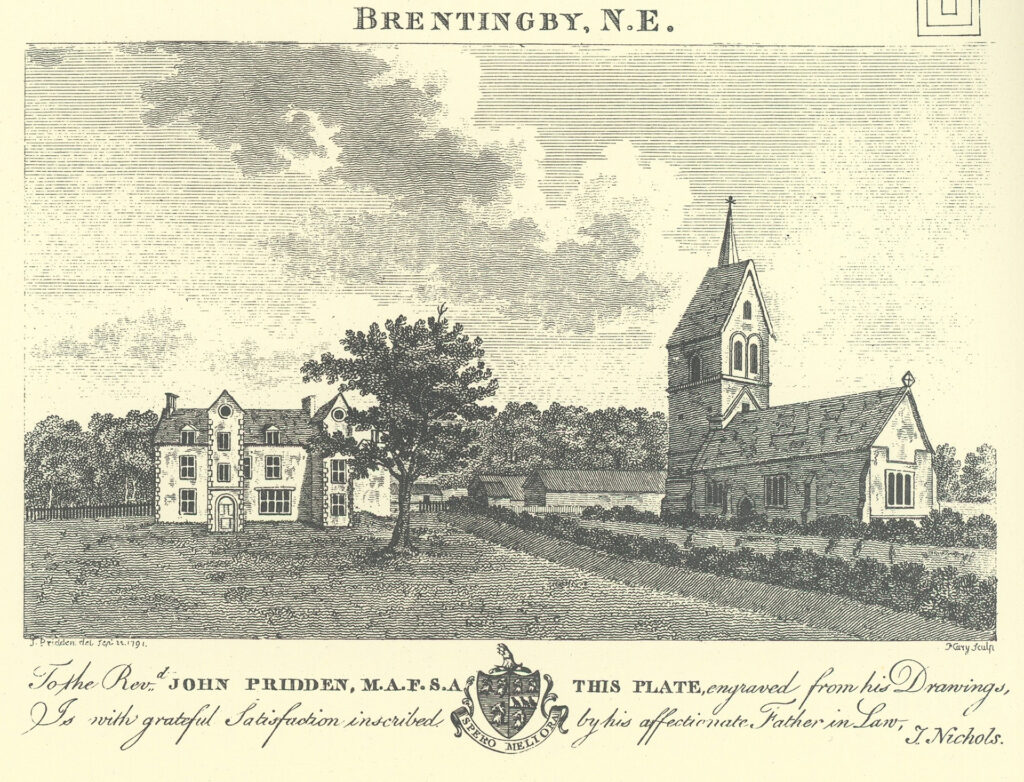
An engraving published in John Nichols’ book History & Antiquities of the County of Leicester (1791) highlights a beautiful view of the manor farmhouse and the chapel.
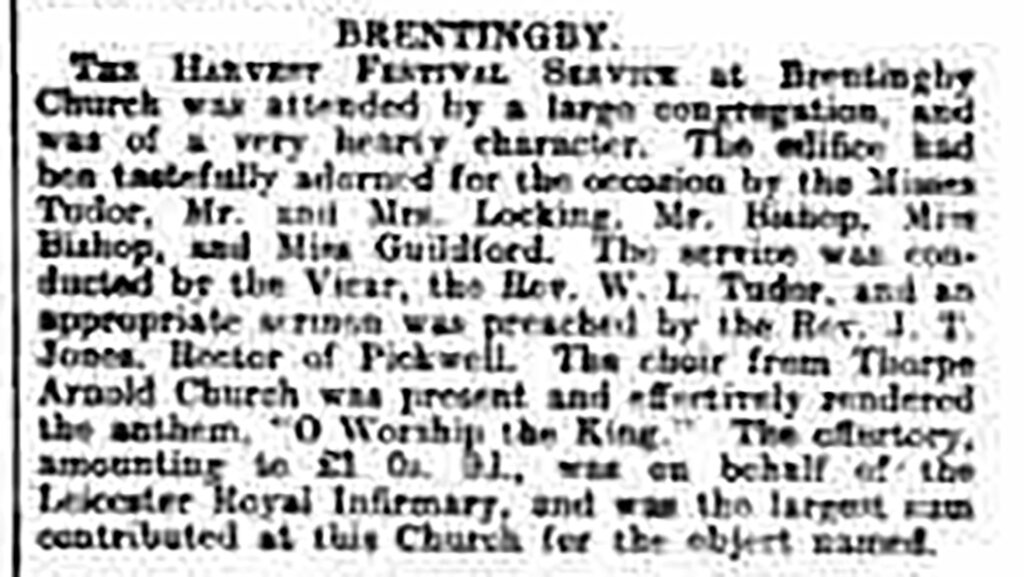
Much of use for six centuries, the chapel was declared redundant in the 1950s. The Leicester Advertiser reported on 6 February 1960: “At Brentingby, the church has been closed, its furnishings removed, and it faces complete ruin.” Brentingby Chapel is often referred to as Brentingby Church, but it was never a parish church in its own right but a chapelry of Thorpe Arnold. Marriages and baptisms occurred in the chapel, but the churchyard was never used for burials.
The condition of the chapel seriously deteriorated until, in 1978, Helen and Trevor Mear purchased the building for conversion into a house. Leicestershire archaeologist Peter Liddle wrote in a report about the St Mary’s Chapel excavations and observations: “A small trial excavation was carried out in 1972-3 to access the archaeological potential of the site. Lack of time and resources prevented the total excavation that the site properly demanded, but as a plan of the early building could be recovered without damaging the stratigraphy, this was achieved.”
In 1978-9 Leicestershire archaeologists returned to the site. Peter Liddle reported: “As might be expected from a church excavation, the amount of pottery found was very small. One of the most interesting aspects of the later history of St Mary’s Brentingby is the fine series of wall paintings that have been revealed. On the east wall above the level of the late ceiling was a very fine Royal Coat of Arms. In several other parts of the chapel were found the fragmentary remains of various texts. On the west wall of the nave are a pair of figures. These were covered by lime-wash and only uncovered at a late stage of the work. The first to be discovered was a skeleton holding a spear in its right hand and a spade in its left. The second figure depicts a man wearing laced boots and a tunic.”
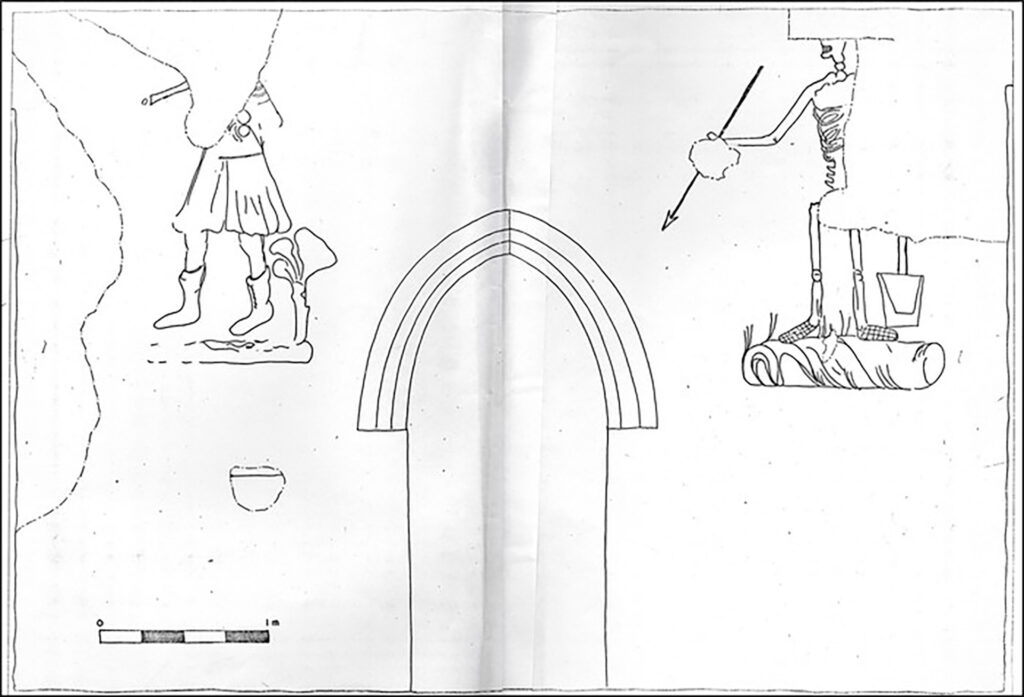
The planned chapel conversion meant that the painting would have been split by inserting a new floor level. The figures were detached for conservation and displayed in the Newarke Houses Museum in Leicester, later kept in a storage facility.
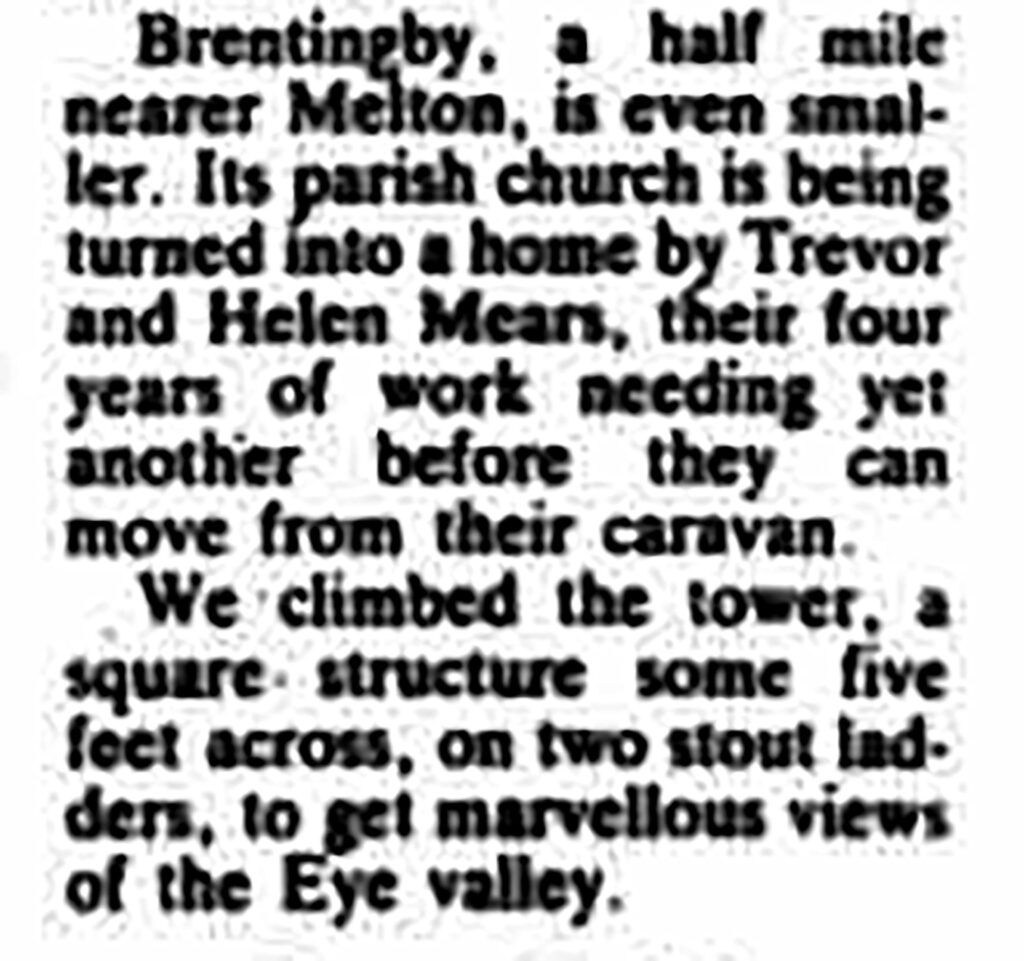
“The Mears have been living for the last six-and-a-half years in a caravan,” reported the Melton Times on 21 September 1984, “and only six months ago they moved into the church, which Trevor has lovingly converted to a house, doing everything from the plumbing to the well designed and finally made kitchen furniture.”
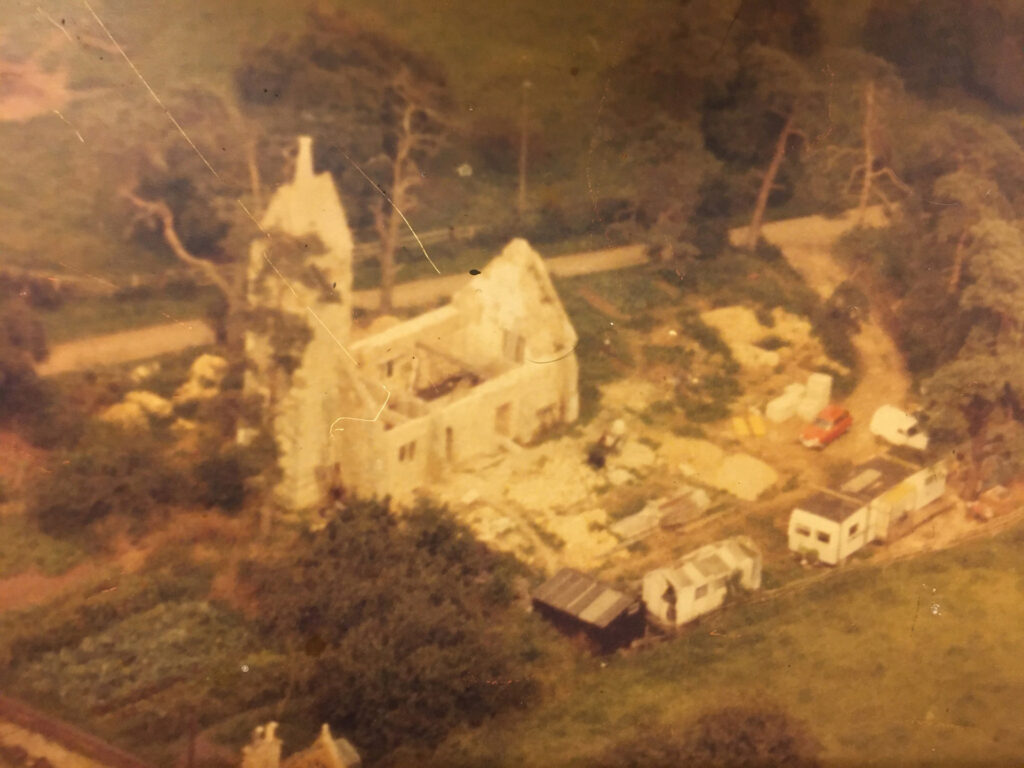
An aerial view of the chapel must be dated after the archaeological research of 1978 and 1979 because archaeologist Peter Little remembers the roof was still on when doing their research.
The Churches Conservation Trust owns the tower, which had two bells. Stephen Butt: “The oldest of the two bells in the tower of Brentingby Chapel was cast by John of York in 1380. When the church fell into disuse, it was stored at Thorpe Arnold and then under the crossing at St Mary’s, Melton. It is now mounted in the Bell Shopping Centre in Melton Mowbray. It is regarded as the oldest church bell in England for which a date can be given.” The other cast in the early-15th century is the treble bell at Thorpe Arnold Church.
The stone wall is still there. To the right in both photographs is the entrance to the Grade II listed manor house farm rebuilt in 1658 and restored in 1846, also called Hall Farm. Rebranded since 2010 to Brentingby Meadows, four generations of Hawleys have farmed at Hall Farm, their home since the 1880s. In 1984, the Melton Times’ article cited: “Next door to the chapel live Brentingby’s oldest residents. John Hawley is, of course, not that old but has lived here for 30 years. Now he farms the 300 acre Hall Farm with his two sons, Robert and Ian.”
In the 1980s, most of Brentingby’s residents were farmers and farm workers. “Mr F.G. Coy, who farmed here for 52 years, but is now retired, remembers things have changed very little,” reported the Melton Times 38 years ago. “A couple of men were platelayers for the railway built in 1846, which runs from Melton to Peterborough just beside the river.”
On the village
Brentingby is one of the tiniest hamlets of the Melton Borough, hidden in the valley of the River Eye. To reach Brentingby, a small road slopes down from Pinfold Lees Hill. The hamlet’s name is thought to mean the “place of the Brentings”, an old tribe mentioned in a Saxon poem celebrating the chieftain Beowolf.
According to the Leicester Survey c.1125, In the early 12th century, the Earl of Leicester held the manor of Brentingby as part of the fee of Thorpe Arnold. Consecutively from the 14th century, the Woodfords, the Mortons, the Smiths and the Hartopps held the manor. White’s Directory 1846 on Brentingby said that it had “54 souls, about 600 acres” and that “the small antique chapel had two bells but no burial ground.”. The old manor house had been thoroughly repaired at that time and was occupied by Henry Clever Woodcock. Other farmers were William Hickson and William Gunby.
Archaeologists were already interested in Brnetingby’s history in the 1800s, far before the research in the 1970s. When the Leicestershire Archaeological Society visited Brentingby in the second half of the 19th century, Sir H. Dryden had a letter in his possession that indicated the date of Brentingby Hall. It was from Lady Hartopp to her brother, Sir John Dryden, of Canon’s Ashby, who died in 1658, and it was written after the death of her husband, Sir Edward Hartopp, who died in 1652. Lady Hartopp wrote: “For brentingbee (hall) the seay is A convenient dueling house (with) no brou hous nor dery house for the hous is but half done.” The archaeologists noticed that a drip was made to the stone mullions of the hall’s windows, which, though of the same period as the windows of the body of the church, were much richer in character.
Also, Oakham Canal, connecting Melton Mowbray with Oakham in Rutland, ran through Brentingby. The Melton and Oakham Waterways Society website briefly highlights the canal’s history: “The Oakham Canal was opened in 1802. Leaving the old canal basin by the Boat Inn at Melton Mowbray, it followed the valley of the River Eye to Saxby before reaching a wharf which became Station Cottages (the location of the former Whissendine railway station), and then on to Edmondthorpe and Market Overton. Heading south to the Ashwell / Cottesmore Road, it is now crossed by the former mineral railway at the Cottesmore Iron Ore Mines sidings, the ‘Rocks by Rail’ site before reaching the Oakham canal basin. Despite difficulties with water supply, the canal was financially successful, especially in its last ten years of operation, carrying some 30,000 tons (mainly coal) in 1846. The canal closed in 1847, having been sold to the Midland Railway Company to construct the Syston and Peterborough railway.”
Would you like to add your story and recollection? Leave a comment at the bottom of this page or send a message.
More pictures
Would you like to add pictures? Send a message.
Domesday Book
There is no reference to Brentingby.
Links
- Report on Brentingby St Mary’s Chapel – Excavations and observations – P. Liddle and S.R. Hughes – Transactions of the Leicestershire Archaeological & Historical Society, 1978-79, (Vol 54)
- Historic England – England’s Places – Architectural Red Box Collection
Would you like to add a link? Send a message.