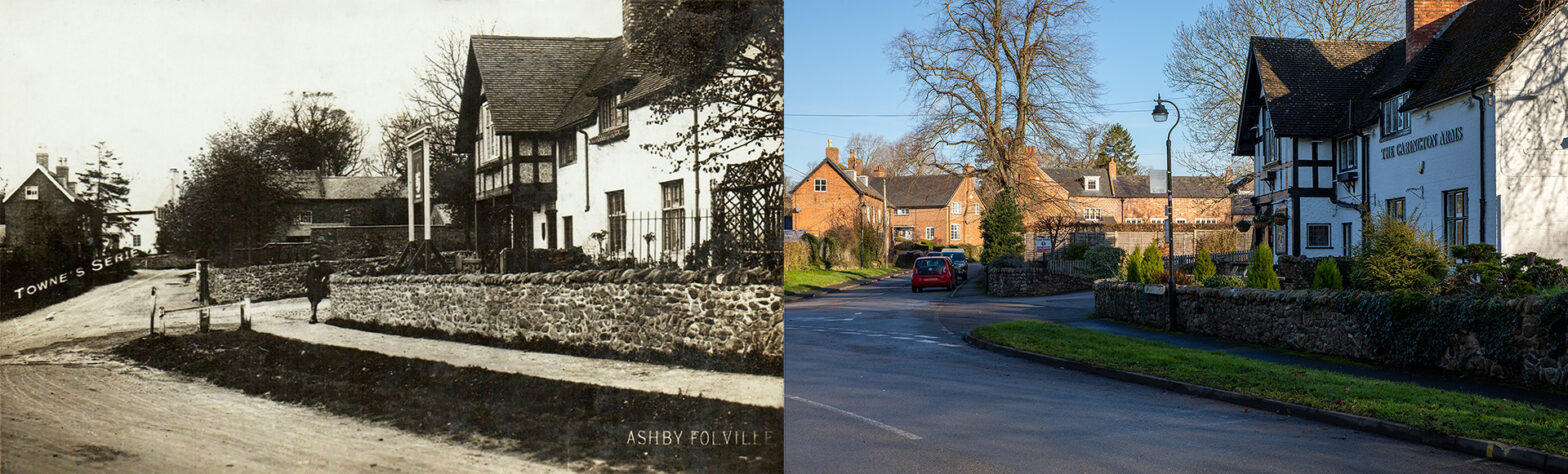
The Carington Arms – 1905-1910
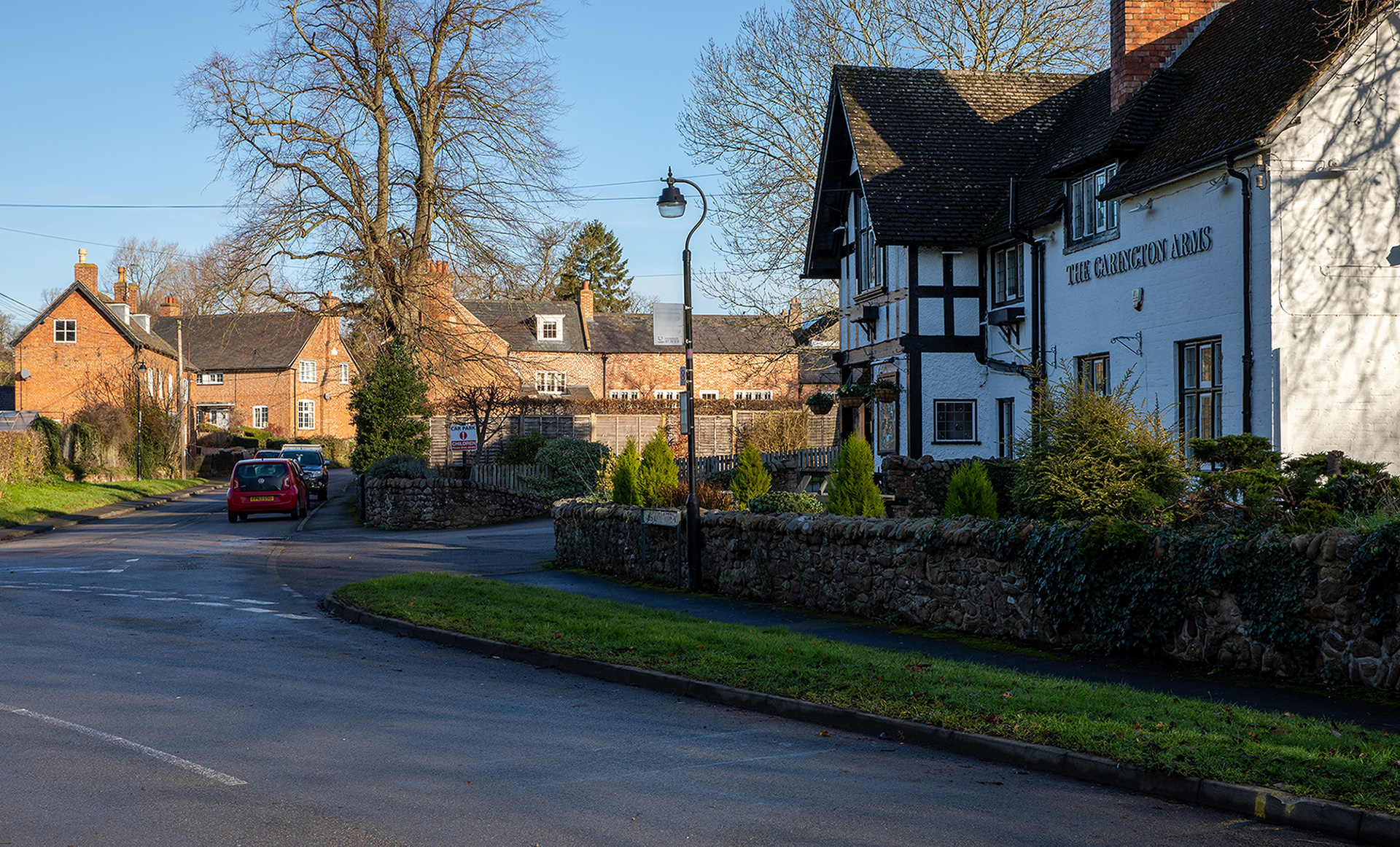
A man, probably the publican, leans against the stone wall of the village pub in Folville Street. The houses along Ashby Folville’s main road, which snakes through the tiny village, were rebuilt between 1890 and 1910 by Herbert Smith-Carington, who bought the Ashby Folville Estate in 1890. The village pub, once thatched, was rebuilt in 1892 and renamed three years later. The Grantham Journal wrote on 31 August 1895: “An application was received from Mr Smith Carrington for an alteration in the name of the licensed house at Ashby Folville, from the “Royal Oak” to the “Carrington Arms,” which was allowed.” Often Carington was misspelt as Carrington.
A photograph dated 1885 was the Royal Oak before the pub was rebuilt in 1892. Also confirming it had a roof of thatch. At first sight, it is not that easy to back this idea because of the actual location of Gaddesby Brook.
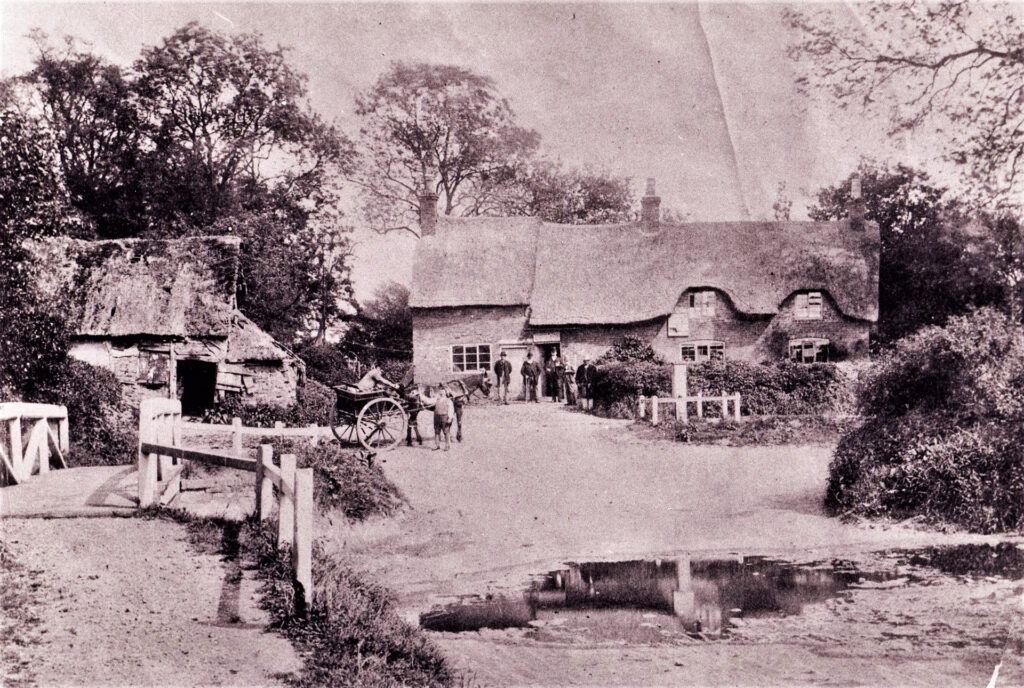
But having a closer look at the Ordnance Survey map, published in 1884, Gaddesby Brook runs much closer to the public house. Even a ford is mapped, which also matches the picture.


Reflecting on how Gaddesby Brook ran differently on the 1884 and 1904 maps, the only conclusion can also be that the river was altered significantly in the whole village.
On the history of the Royal Oak, Grantham Journal on 12 May 1877 wrote: “At the Melton Petty Sessions the licence of the Royal Oak was transferred from Mr Thomas Black to Mr William Ballard.” And according to several newspaper clippings from The Leicester Journal, The Stamford Mercury and The Grantham Journal, published between 1866 and 1888, public auctions and coroners’ inquests were held in the Royal Oak Inn.
Coroners inquests took also place in the Carington Arms Inn in 1904. Grantham Journal published on 24 September 1910 referred to a political meeting of the Committee of the Unionist Association for the Gaddesby district, that took place in the Carington Arms, and in the Sheffield Daily Telegraph of Friday 26 March 1915, the pub was indicated as a hunting appointment for the Quorn Hunt on Monday April 5. About the publicans, several names are found in 20th-century newspapers. Grantham Journal, Saturday 4 July 1936: ”At Melton petty sessions on Tuesday, several licensing matters came before the Bench. Applications were granted for the transfer of the license of the Carington Arms Inn, Ashby Folville, to Mrs Mary Frances Walker, widow of the late license.” “Mrs Mary L. Walker (75) has been at the Carington Arms for 50 years. She took over the licence when Mr Walker died 17 years ago,” added the Leicester Evening Mail, printed on Thursday, 27 August 1953.
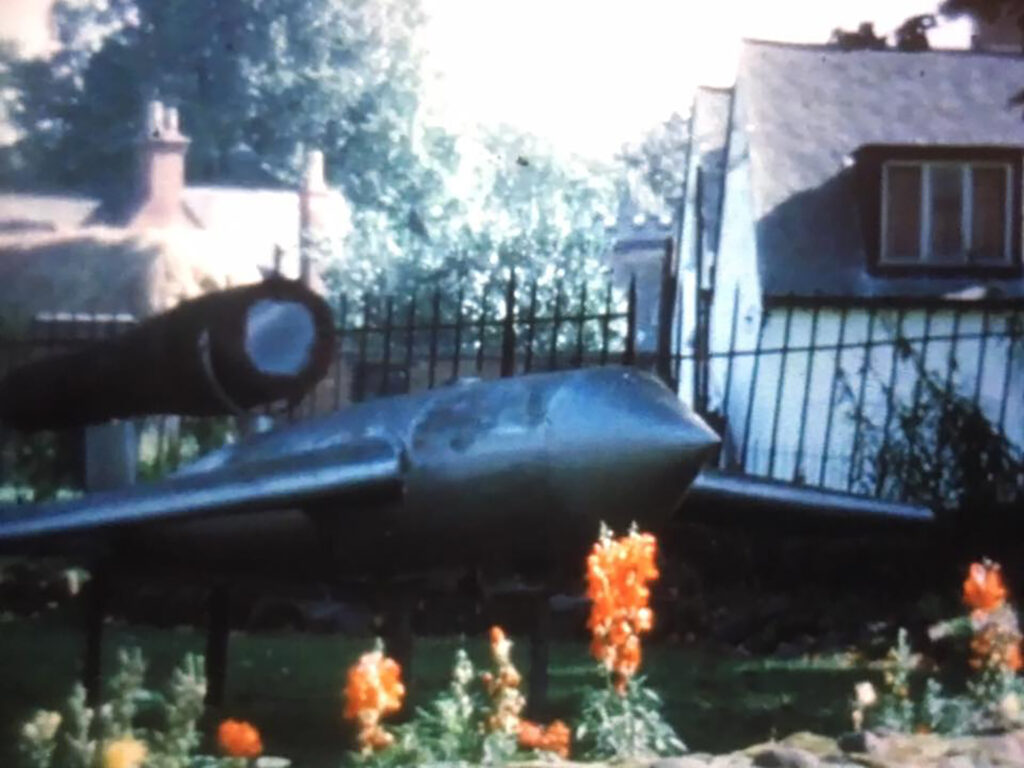
In the 1950s, a remarkable feature was displayed in the pub’s garden: a doodlebug, a V-1 flying bomb, sent by the Germans as part of raids on London during World War II. Not the real stuff, but a replica, scale 1:4, built by US Army engineers and used to instruct American soldiers stationed in the village during the war. The V1 model was left as a post-war gift and ended up in The Carington Arms’ garden. Many children spent time sitting on the object, drinking pop and eating crisps, whilst dad was in the pub. The replica likely rusted away.
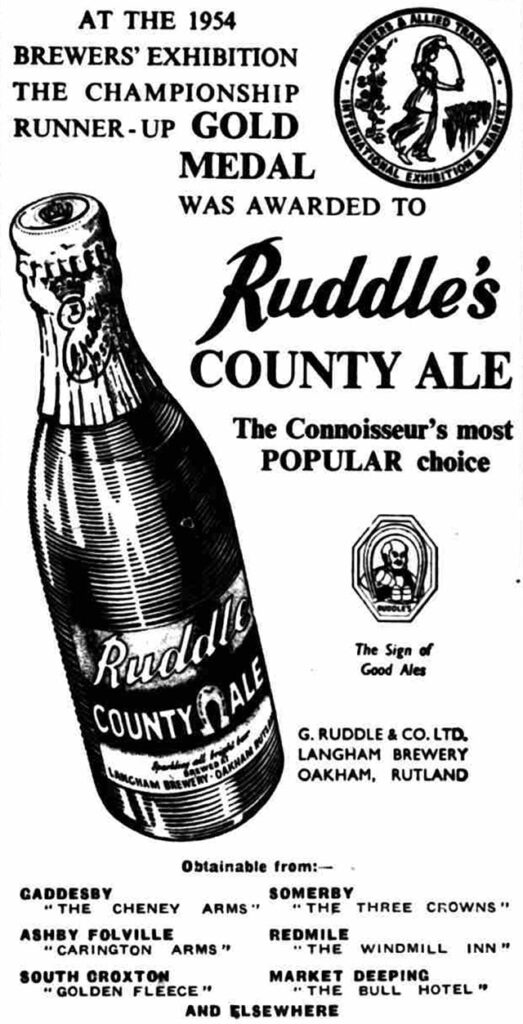
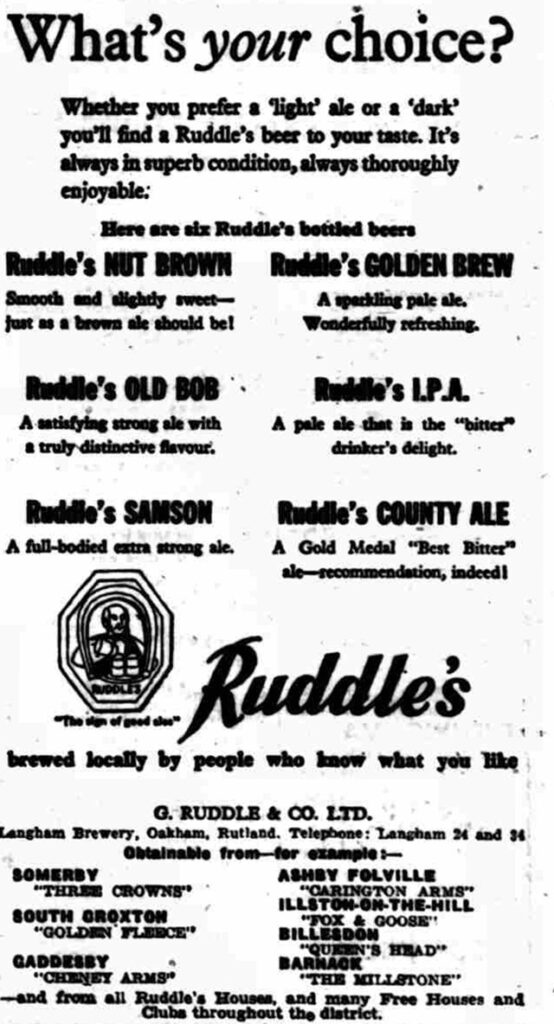
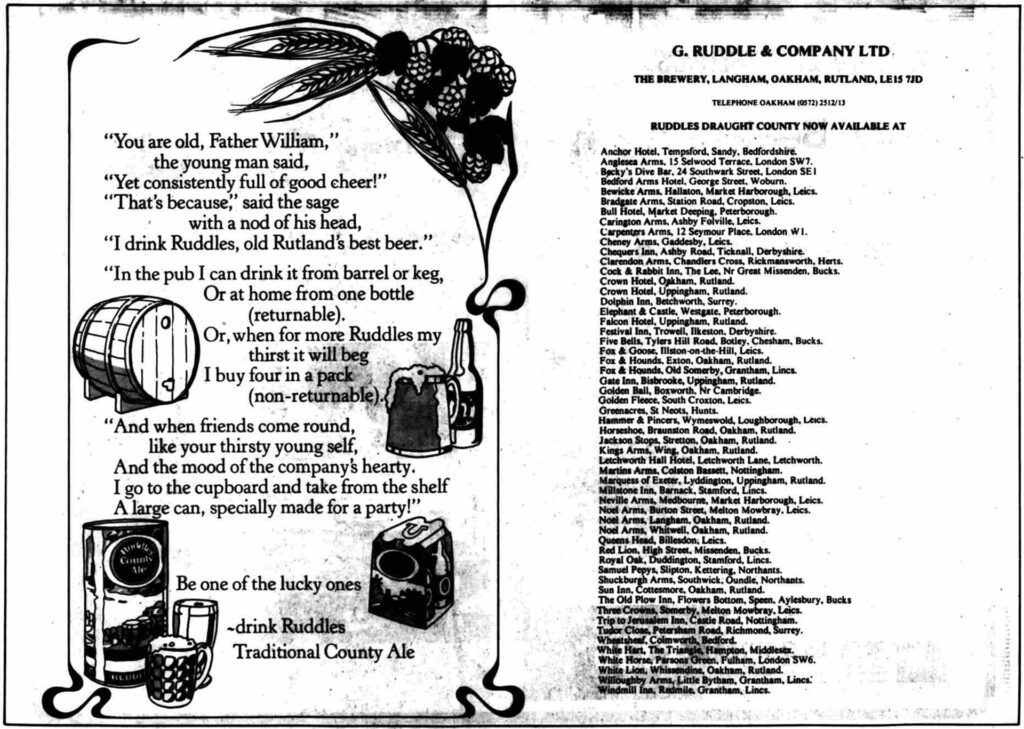
Around that time Ruddles Brewery (G. Ruddle & Co) was the beer supplier and did so until the mid 1970s. Ruddles was a brewery established in 1858 in Langham, Rutland, and got that name when bought by George Ruddle in 1912. The brand is now owned by Greene King who still brews beers under the Ruddles name in Suffolk.
In 1983 journalist Peter Squires wrote: “Well-aware of the importance behind their pub’s name, John and Pat Stead have run the establishment for four years. It proves a popular meeting place for followers of the Quorn Hunt – the hunt meets at the nearby Ashby Pastures.”
In 1985 when Mick and Wendy Farmer were interviewed for the Behind Bars feature, published in the Melton Times on Friday 22 November, they ran the pub for a year. “We are delighted we took over,” said Mick. “We could never have hoped to get a better house than this.” The brewery, Everards, was also happy with the couple because the Carington Arms was ranked among the brewery’s top-selling pubs. “Carole Raven has been helping at the Carington for some ten years,” said Mick. Among other helpers was Barbara Dikes, who gave a hand in the kitchen.
Two other main features near the pub have disappeared: a water pump against the stone wall on the left side of the pub’s driveway and the pub sign. That latter was replaced several times until it was removed around 2010.
The cottages on Highfield End, the street on the left, were not rebuilt during the village’s revamp of 1890-1910. On the left is Harewell House, a Grade II listed former farmhouse and service wing built in the late 18th century. Claire Clayton-Stead, who has been living there since 1986, said: “I think you can see, to the left, the old greenhouse that was there when we moved in. Sadly it was beyond repair and isn’t in the later photo.” “My husband’s family, the Davies, lived in the farmhouse next to the pub. They had the farm in Ashby Folville,” added Tina Davies.

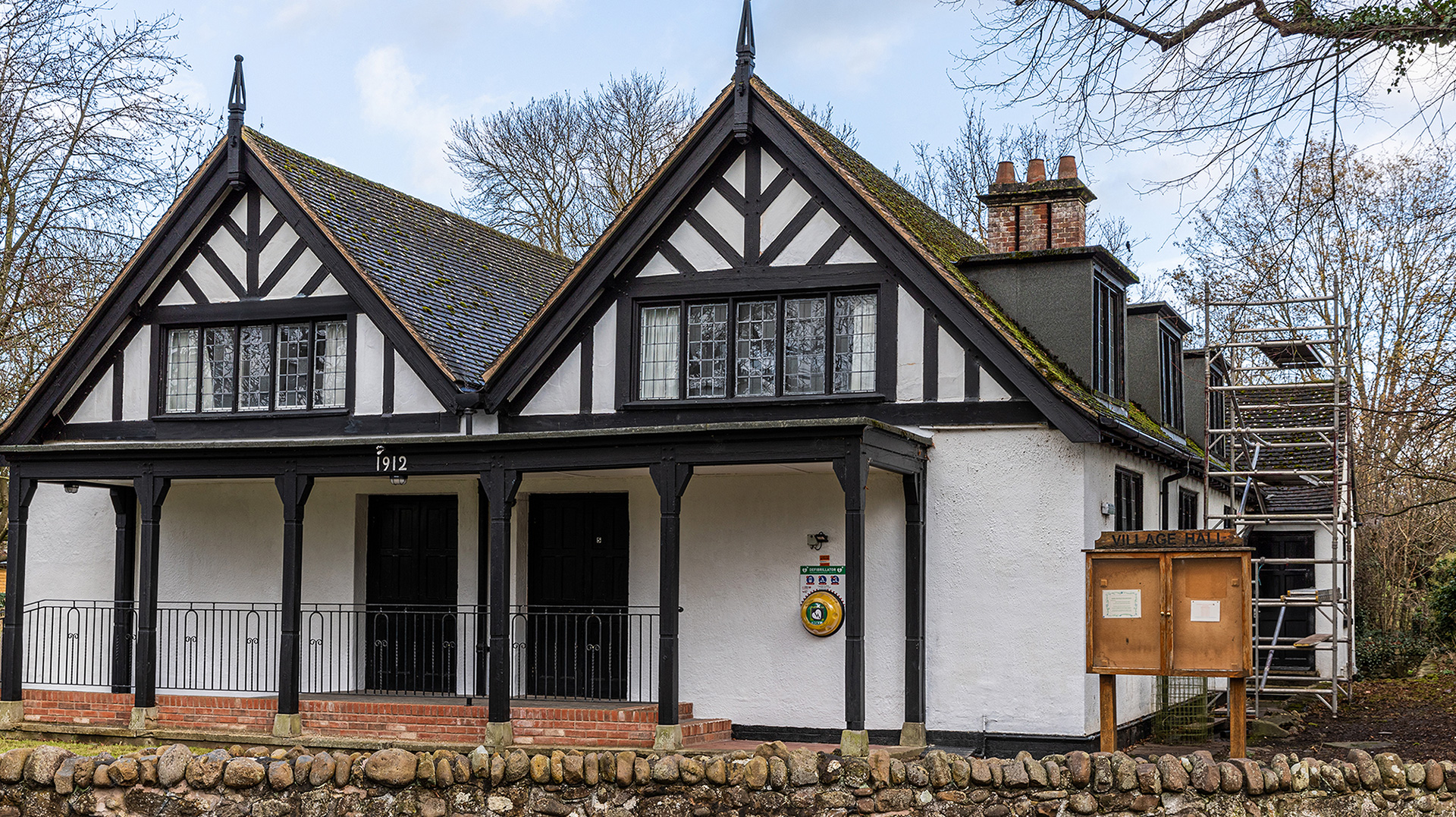
Village Hall
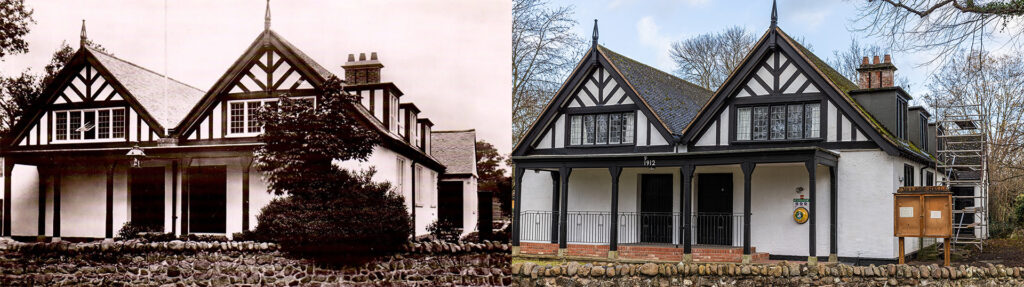
The old postcard is titled “Club House”, possible the clubhouse of the Ashby Folville Cricket Club, with its playground on the opposite side of the road, Folville Street. But this is a wild guess. In The History of Cricket in Ashby Folville and Barsby written by Nigel Lewis – he indicates the document of nearly 100 pages is a work in progress – a newspaper picture published in the Leicester Evening Mail of 6 February 1935 the caption reads: “Seated at the table at the Ashby Folvill Cricket Club’s annual dinner, held at the Village Hall.” Freda Lane recollected: “When I lived at Ashby Folville, in the 1960s it was the Village Hall.”

On the village
From around 1137 the Folville family lived in the village and gave to the parish the latter half of its name. The Folvilles, six brothers of a knightly family, one of them a priest, forming a nucleus of a criminal gang in Leicestershire, committing not only less-conspicuous crimes but also responsible for the murder of a Baron of the Exchequer on the highway between Melton and Leicester and holding captive and to ransom Sir Richard Willoughby a justice of the King’s Bench. Eustice Folville, a ringleader, was eventually pardoned by the King for military service.
“By the female line, came the Woodfords, and then, in the same way, the Smits, one of whom married into the Carington family and became Lord Carington in 1664,” wrote Rev Philip Hunt in the Melton Times of 20 August 1982. “The church of St Mary dates from the 13th century and has many notable features including the reputed tomb of the once-outlawed Sir Eustace Folville.”
At the end of 1983, journalist Peter Squires, describes a visit to Ashby Folville as “a trip in a time machine”. He continued: “Wing-Cdr John Smith-Carington, former High Sheriff of Leicestershire, now [1983] lives in the Lodge with his wife Noreen. His family’s connection with Ashby Folville – as well as much of the village’s history – is contained in a book commissioned by his father. A parchment sheet appendix traces the Carington family from the Norman Conquest to the turn of the century.”
“The imposing Manor is currently [1983] the home of Mr and Mrs Frank Sturgess. The building was purchased from the Carington family shortly after World War II. Remnants of this period still remain in the grounds, most noticeable the nissen huts in the gardens. The huts and the Manor itself housed many Polish refugees families as well as USA servicemen. Since then Mr Sturgess has transformed the Manor into one of the most impressive buildings in the area surrounding Ashby Folville, restoring it to its former glory.”
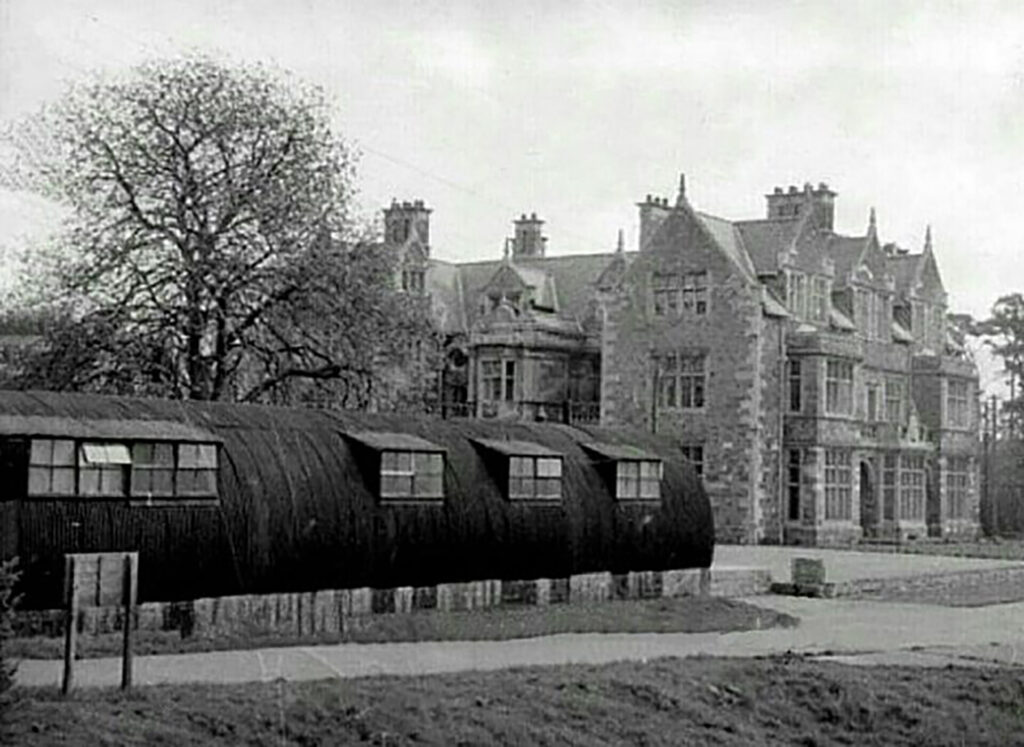
Here you can read more on the Polish refugees’ families in Ashby Folville.
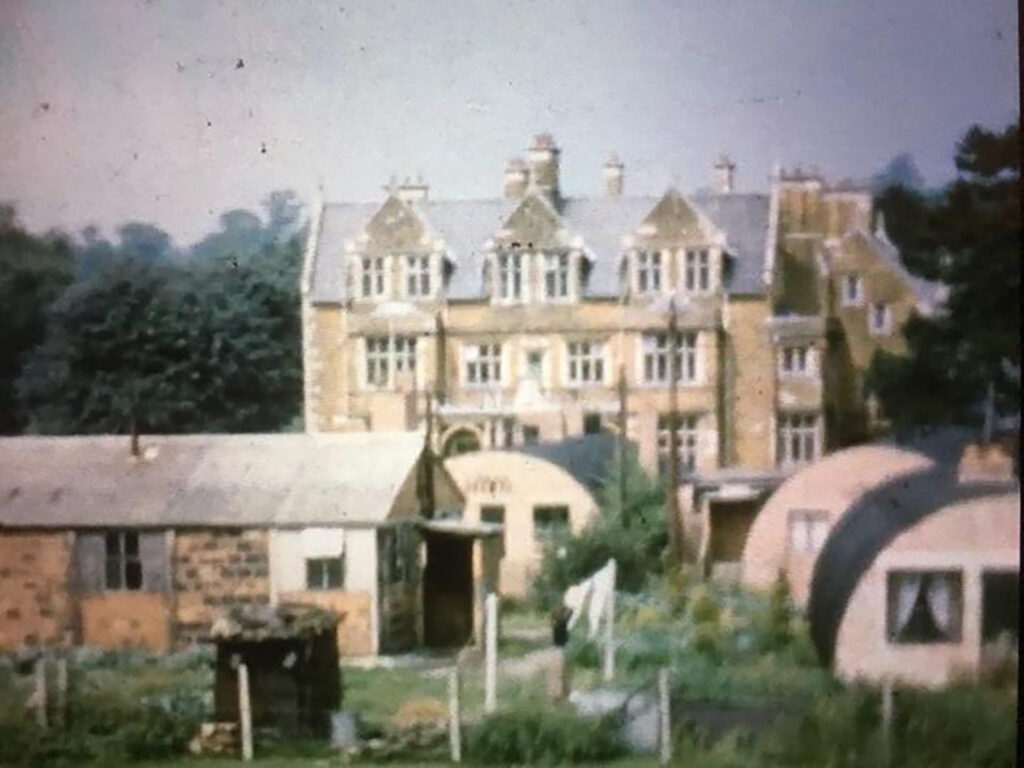
The colour above photograph is a still taken from an amateur film made in 1953 of a visit of pupils from Westcotes Secondary Modern School for Boys in Leicester to Ashby Folville. Click here to watch the film.
More pictures
Would you like to add pictures? Send a message.
Domesday Book
Ashby [Folville] was a settlement in Domesday Book, in the hundred of Goscote and the county of Leicestershire.
It had a recorded population of 32 households in 1086, putting it in the largest 40% of settlements recorded in Domesday, and is listed under 2 owners in Domesday Book.

- Land of Henry of Ferrers
- Households: 2 villagers.
- Ploughland: 1 ploughland.
Valuation
- Annual value to lord: 3 shillings in 1086; 3 shillings when acquired by the 1086 owner.
Owners
- Tenant-in-chief in 1086: Henry of Ferrers.
- Lord in 1086: Hugh.
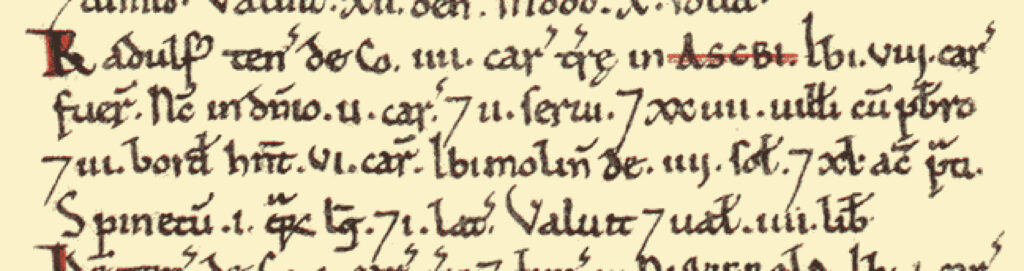
2. Land of Countess Judith
- Households: 24 villagers. 3 smallholders. 2 slaves. 1 priest.
- Ploughland: 8 ploughlands. 2 lord’s plough teams. 6 men’s plough teams.
- Other resources: Meadow 40 acres. Woodland 1 * 1 furlongs. 1 mill, value 4 shillings.
Valuation
- Annual value to lord: 4 pounds in 1086; 4 pounds when acquired by the 1086 owner.
Owners
- Tenant-in-chief in 1086: Countess Judith.
- Lord in 1086: Ralph <of Ashby>.
2 responses to “Ashby Folville”
Did you know that the Cheney Arms public house (originally a Cheney dower house) in Gaddesby is situated on land which used belong to the manor of Ashby Folville? The Cheney Arms was transferred to Gaddesby in 1882.
FYI – I have recently completed my chapter on Ashby Folville for a book I am writing, which outlines the 800-year succession of the Ashby Folville manor into the 20th century along with the stories and pedigrees of the various families who held it.
Interesting to know about the Cheney Arms. I will add this to the Gaddesby story.
Congratulations on completing the chapter. Keep me updated on the progress!