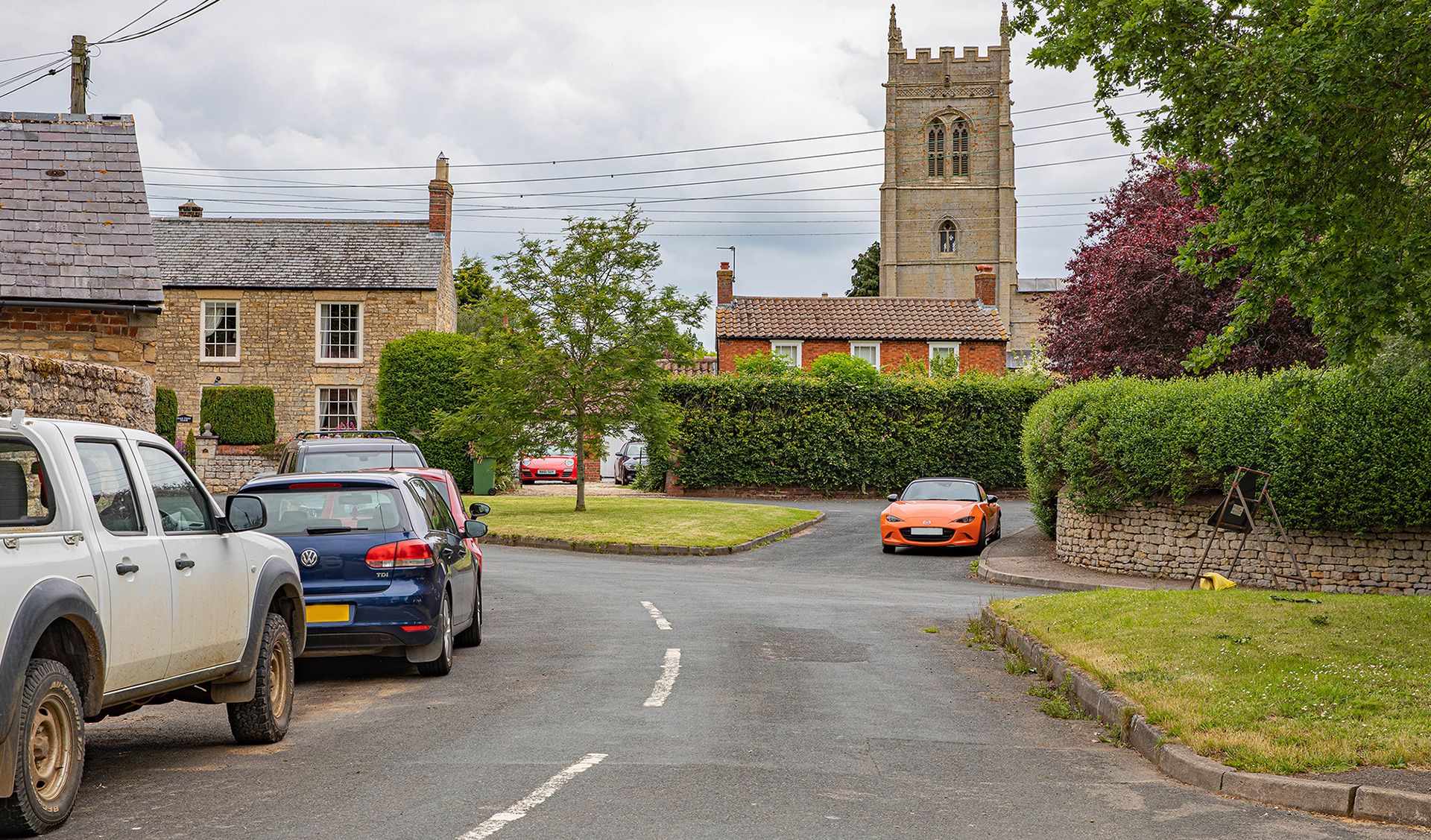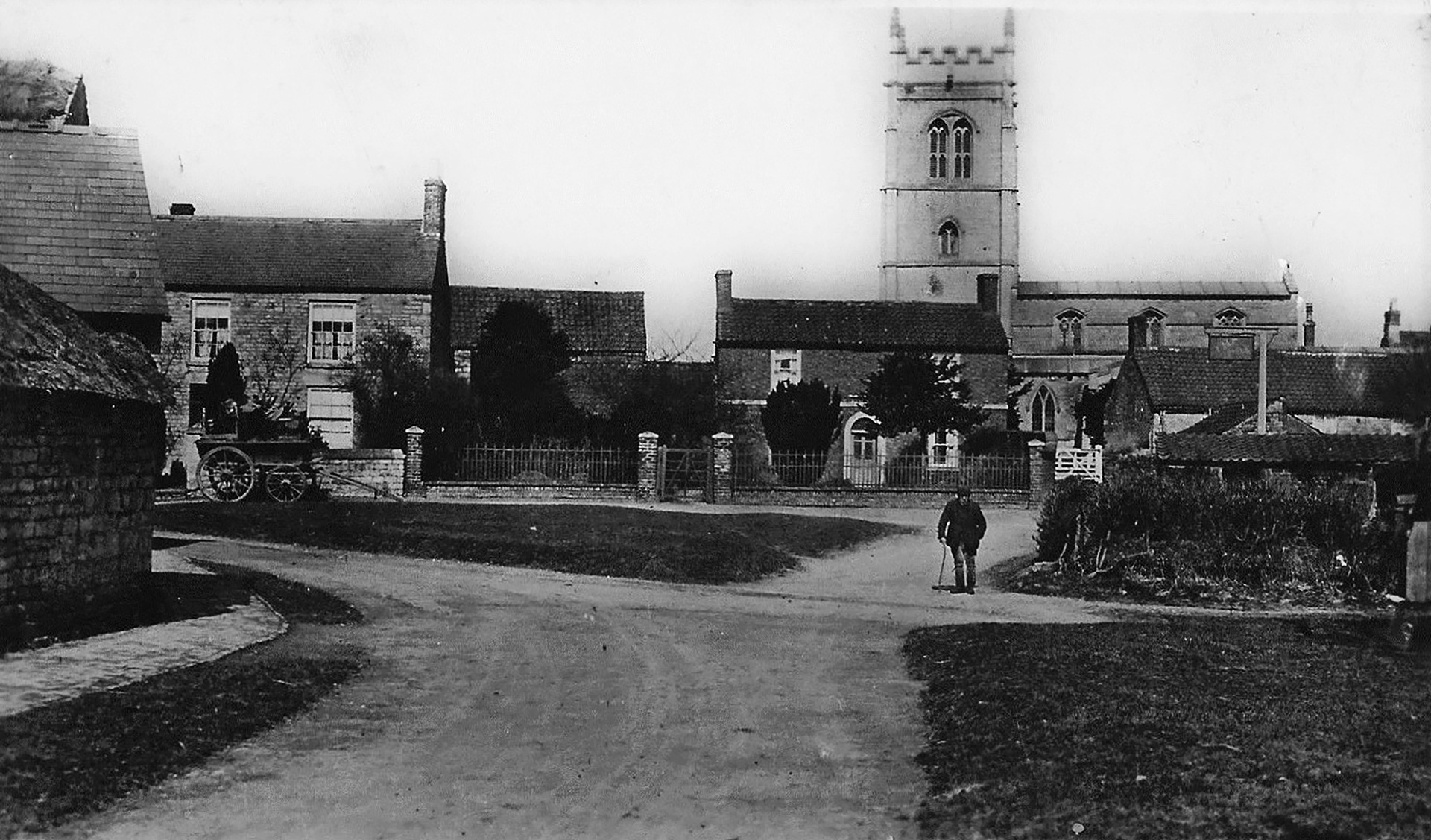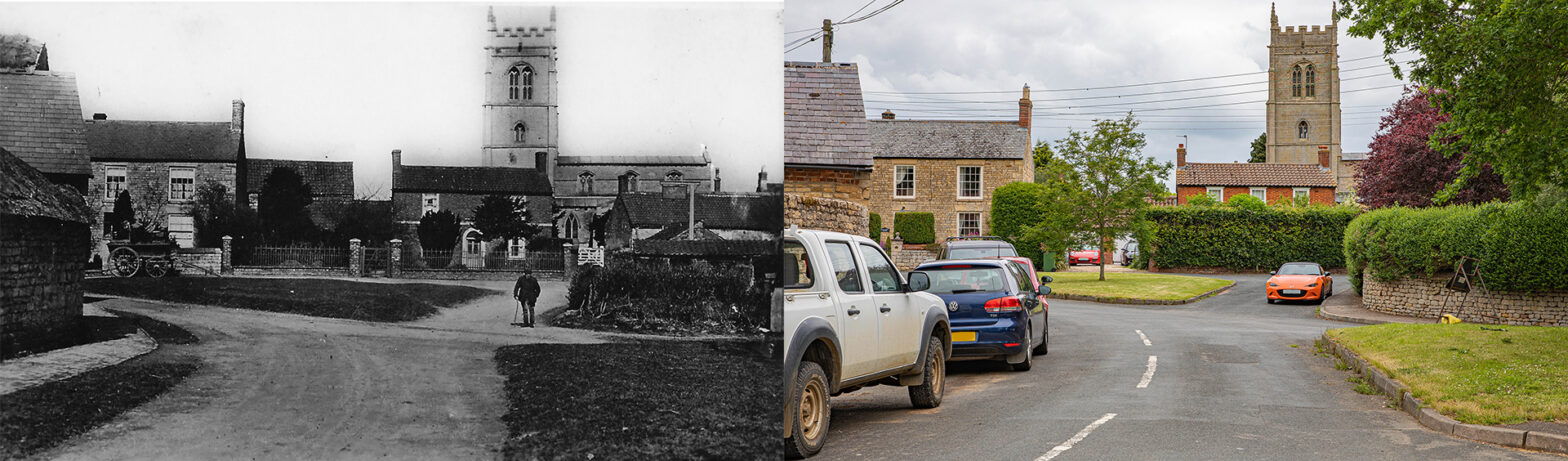
The Green – 1900s
Wandering around the old heart of Stonesby throws you back in time. At first sight not much seems to have changed. The Green gives the impression of three streets sprouting as a leaf veins from Main Street. Former farmhouses and barns, and dwellings are clustered around the Anglican Church and the Methodist Chapel. Villager’s comments and a closer look at the old postcard and new remake tell the story.
The wall on the left is part of the Gorse Farm House barn. Just around the corner, but out of sight, there is a typical red coloured Type K6 Telephone kiosk, designed in 1935 by Sir Giles Gilbert Scott. “I love the horse drawn cart in front of Pear Tree”, says Sarah Sims. A 1930s aerial photo of Stonesby in Richard Snodin’s archive identifies the dwelling on the right side of Pear Tree House. It was its barn which was later demolished.
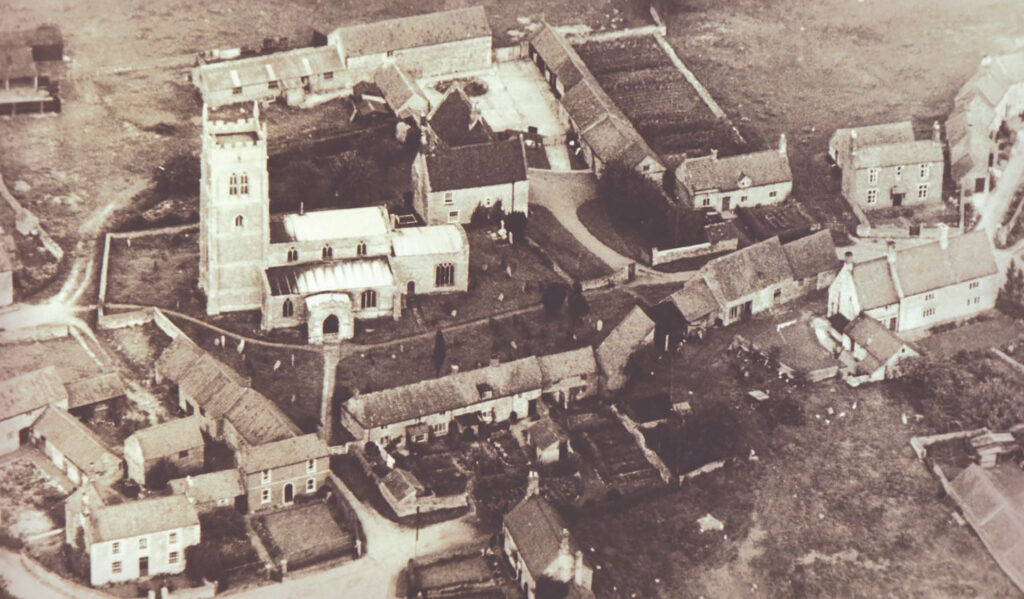
“The house that sits in front of the church tower is where my husband’s great Grandma lived”, recalls Penny Eggleston. A high hedge now obscures most parts of that house. The 14th-century parish church, with probably Norman origins, is dedicated to Saint Peter. It was renovated in 1875 by R.W. Johnson, and is a Grade II listed building.
“At the right hand side, between the stone wall and the house, you can spot a pub sign”, says Glen Whittingham. The Fox Inn closed in the early 1960s. Ros Turner recalls: “My late parents bought the pub when it was sold by the brewery in 1961. It had a clause in the sales contract that it could not be opened again as a licenced premises.” There is this story in the village, the pub was closed by the Methodists. But that is just coincidental, because Turner’s parents were Methodists.
I took the new picture with Manor Farm far left at my back. Richard Snodin recalls: “My grandparents and parents farmed at that farm, and were there throughout World War II. I spent the first three years of my life at Manor Farm, and I was baptised in Stonesby church, where I also was married.” Margaret Lowe adds: “My husband Brian, born in Stonesby, spent many happy hours watching films at Manor Farm’s barn which Richard’s father put on for the children of the village.”